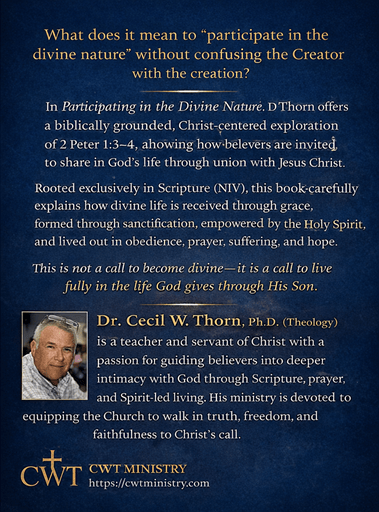
Participating in the Divine Nature
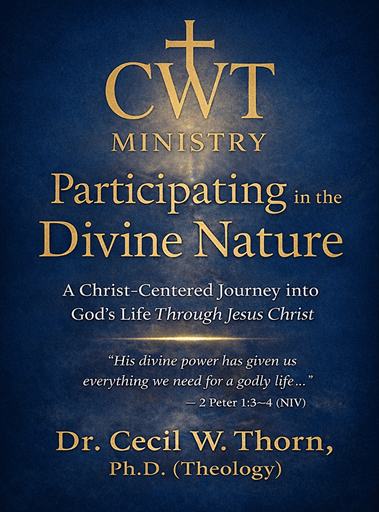
A Christ-Centered Understanding of God’s Life at Work in the Believer
“His divine power has given us everything we need for a godly life through our knowledge of him who called us by his own glory and goodness. Through these he has given us his very great and precious promises, so that through them you may participate in the divine nature, having escaped the corruption in the world caused by evil desires.”
— 2 Peter 1:3–4 (NIV)
Preface
The phrase “participating in the divine nature” has often been misunderstood, misused, or avoided altogether. Some fear it implies that human beings become divine. Others treat it as vague spiritual language with little practical meaning. Scripture allows neither error.
The Bible teaches that God is holy, eternal, and uncreated—and that humanity remains created, dependent, and redeemed only by grace. Yet the same Scriptures boldly declare that believers are called to share in God’s life, character, and power through Jesus Christ. Participation is not equality with God, but union with Christ.
This book is written to explore that truth carefully, biblically, and Christ-centered. Every chapter is anchored in Scripture, interpreted through Scripture, and applied through the life, death, resurrection, and ongoing ministry of Jesus Christ. The Holy Spirit is not presented as an abstract force, but as the Spirit who reveals Christ, forms Christ in us, and empowers Christlike living.
Only the New International Version (NIV) of the Bible is used throughout. All doctrine is tested by Scripture. All experience is subordinated to Christ. The goal is not spiritual excitement, but faithful, transformed discipleship.
Participating in the Divine Nature (PDF) English: DOWNLOAD
Table of Contents
Preface
A Christ-Centered Invitation to Divine Life
Part One — The Foundation of Divine Participation
Chapter 1
The Gift of Divine Life
2 Peter 1:3–4 and the Sufficiency of Christ
Chapter 2
Union with Christ
The Heart of Participating in the Divine Nature
Chapter 3
The New Birth
Entering Divine Life Through Christ
Chapter 4
Sanctification
Becoming Like Christ Through the Spirit
Part Two — The Holy Spirit and Divine Empowerment
Chapter 5
The Promise of the Holy Spirit
Divine Life Requires Divine Empowerment
Chapter 6
Anointed for Presence and Purpose
Sharing in Christ’s Anointing
Chapter 7
Abiding in Truth and Discernment
Remaining Faithful in the Last Days
Part Three — Living Divine Life in a Broken World
Chapter 8
Prayer and Participation in Divine Life
Communion with God Through Christ
Chapter 9
Healing, Suffering, and Divine Life
Trusting God in Weakness and Hope
Chapter 10
The Presence of God in Everyday Life
Living Aware of God’s Nearness
Part Four — The Shape and Goal of Divine Life
Chapter 11
The Cross and the Shape of Divine Life
Obedience, Humility, and Transformation
Chapter 12
Worship and the Obedient Life
Living as a Living Sacrifice
Chapter 13
Glory, Perseverance, and the Hope of Completion
Fixing Our Eyes on Christ
Doctrinal Summary (Christ-Centered)
Chapter 1
The Divine Gift That Begins With Christ
The Source of Participation
The apostle Peter begins not with human effort, spiritual discipline, or mystical experience—but with divine initiative.
“His divine power has given us everything we need for a godly life…”
— 2 Peter 1:3 (NIV)
Participation in the divine nature does not begin with what believers do. It begins with what God has already given. The source is not human striving but God’s power, and that power is revealed through knowledge of Christ.
Peter is not speaking of intellectual awareness alone. In Scripture, “knowledge” refers to relational knowing—a lived, covenant relationship with Jesus Christ.
“…through our knowledge of him who called us by his own glory and goodness.”
Everything needed for godly living flows from knowing Christ, not merely knowing about Him.
Christ Is the Giver, Not the Goalpost
Scripture consistently teaches that spiritual life is received, not earned.
“For it is by grace you have been saved, through faith—and this is not from yourselves, it is the gift of God.”
— Ephesians 2:8 (NIV)
Participation in the divine nature is an extension of salvation itself. Just as salvation is God’s work from beginning to end, so is transformation. The believer does not climb toward divinity; rather, Christ brings divine life to the believer.
This guards the church from pride, legalism, and spiritual elitism. All participation is mediated through Christ alone.
Escaping Corruption, Not Escaping Creation
Peter continues:
“…having escaped the corruption in the world caused by evil desires.”
— 2 Peter 1:4 (NIV)
Notice what participation does not mean. It does not remove believers from the physical world. It does not erase human limitations. It does not eliminate temptation. Instead, it breaks the power of corruption.
This echoes the teaching of Jesus:
“They are not of the world, even as I am not of it.”
— John 17:16 (NIV)
Believers remain in the world, but they are no longer ruled by its corruption. Participation in the divine nature means sharing in Christ’s victory over sin, not sharing in God’s essence.
Divine Promises, Not Human Potential
Peter emphasizes that participation comes through God’s promises, not human capability.
“Through these he has given us his very great and precious promises…”
— 2 Peter 1:4 (NIV)
God’s promises reveal His character, His will, and His faithfulness. Every promise finds its fulfillment in Christ.
“For no matter how many promises God has made, they are ‘Yes’ in Christ.”
— 2 Corinthians 1:20 (NIV)
Participation in the divine nature is therefore Christ-shaped, Christ-limited, and Christ-glorifying.
Summary of the Chapter
- Participation begins with God’s power, not human effort
- Christ is both the source and mediator of divine life
- Believers escape corruption, not creation
- God’s promises—not mystical experience—anchor transformation
CHAPTER 1 — The Gift of Divine Life
Questions
- According to 2 Peter 1:3–4, what is the source of everything needed for a godly life?
- Why does participation in the divine nature begin with God’s initiative rather than human effort?
- How does Peter connect divine promises with escaping corruption?
- Why must participation never be separated from Christ?
NOTE: See the end of the book for our answers
Chapter 2
Union With Christ: The Heart of Divine Participation
Participation Begins With Union, Not Imitation
Many Christians attempt to live godly lives by imitation alone—trying to copy Jesus’ behavior without first sharing in His life. Scripture, however, presents a deeper reality. The Christian life is not primarily about imitation, but union.
Jesus Himself defines the foundation of participation in divine life:
“Remain in me, as I also remain in you. No branch can bear fruit by itself; it must remain in the vine.”
— John 15:4 (NIV)
A branch does not strive to produce fruit; it bears fruit because it is connected. In the same way, believers do not manufacture holiness. Holiness flows from abiding in Christ.
Participation in the divine nature is not external conformity to moral rules—it is shared life through union with Jesus.
Christ the True Vine
Jesus’ teaching in John 15 places participation squarely within relationship.
“I am the vine; you are the branches. If you remain in me and I in you, you will bear much fruit; apart from me you can do nothing.”
— John 15:5 (NIV)
The phrase “apart from me you can do nothing” eliminates all spiritual self-reliance. Any attempt to live a godly life disconnected from Christ results in exhaustion, legalism, or hypocrisy.
Union with Christ means:
- His life flows into ours
- His righteousness covers us
- His Spirit empowers us
- His obedience shapes us
This union is not symbolic—it is spiritual and real, established by faith and sustained by the Holy Spirit.
Sharing in Christ’s Life, Not God’s Essence
It is critical to clarify what Scripture means by participation. Believers do not share God’s essence—only God is eternal, uncreated, and self-existent. Instead, believers share in Christ’s life, which is mediated to them by the Spirit.
Jesus prayed:
“I have given them the glory that you gave me, that they may be one as we are one.”
— John 17:22 (NIV)
This glory is not divine status; it is revealed life, holiness, and relational unity. Christ shares what He has received from the Father so that believers may live in communion with God.
Union does not erase distinction. It establishes relationship.
Adam and Christ: Two Sources of Life
Scripture consistently contrasts Adam and Christ as two representatives of humanity.
“For as in Adam all die, so in Christ all will be made alive.”
— 1 Corinthians 15:22 (NIV)
Adam represents fallen humanity—corruption, separation, and death. Christ represents redeemed humanity—life, righteousness, and restoration.
Participation in the divine nature occurs only in Christ. Outside of Him, humanity remains under corruption. In Him, believers receive a new source of life.
This aligns with Paul’s teaching:
“If anyone is in Christ, the new creation has come: The old has gone, the new is here!”
— 2 Corinthians 5:17 (NIV)
Union with Christ is not self-improvement; it is new creation.
Abiding: The Ongoing Experience of Union
Union with Christ begins at salvation, but it is experienced through abiding. Jesus’ repeated command—“remain”—reveals that participation is relational and continuous.
Abiding involves:
- Trusting Christ daily
- Receiving His Word
- Yielding to the Spirit
- Walking in obedience
This is not passive resignation, nor is it anxious striving. It is dependent cooperation.
“If you keep my commands, you will remain in my love, just as I have kept my Father’s commands and remain in his love.”
— John 15:10 (NIV)
Obedience does not create union; it flows from union.
Union Protects Against False Spirituality
False spirituality often promises power without submission, enlightenment without repentance, or transformation without Christ. Scripture warns against these distortions.
“See to it that no one takes you captive through hollow and deceptive philosophy, which depends on human tradition and the elemental spiritual forces of this world rather than on Christ.”
— Colossians 2:8 (NIV)
Any teaching about participation in divine life that bypasses Christ—or minimizes His lordship—is not biblical participation at all.
True participation is:
- Christ-centered
- Cross-shaped
- Spirit-empowered
- Scripture-governed
Summary of the Chapter
- Participation flows from union with Christ
- Abiding is the lived experience of that union
- Believers share in Christ’s life, not God’s essence
- Obedience flows from relationship, not effort
- Union guards against false spirituality
CHAPTER 2 — Union with Christ
Questions
- What does Jesus mean when He says believers must “remain” in Him?
- Why is union with Christ more than imitation of Christ?
- How does John 15 describe fruitfulness in the Christian life?
- What dangers arise when spiritual growth is attempted apart from union with Christ?
NOTE: See the end of the book for our answers
In the next chapter, we will explore how this union begins through the new birth and how regeneration opens the door to participation in divine life.
Chapter 3
The New Birth: Entering Divine Life Through Christ
Participation Begins With Regeneration
Union with Christ is not achieved through moral effort or religious education. It begins with a radical, God-initiated act Scripture calls the new birth. Without regeneration, participation in the divine nature is impossible.
Jesus made this unmistakably clear:
“Very truly I tell you, no one can see the kingdom of God unless they are born again.”
— John 3:3 (NIV)
To be “born again” is not to become more religious; it is to receive new life from God. Participation in the divine nature begins when God imparts life where there was spiritual death.
From Death to Life
Scripture describes the human condition apart from Christ as spiritual death.
“As for you, you were dead in your transgressions and sins.”
— Ephesians 2:1 (NIV)
Death cannot heal itself. It cannot improve itself. It cannot participate in life. Regeneration, therefore, must be entirely God’s work.
Paul continues:
“But because of his great love for us, God, who is rich in mercy, made us alive with Christ.”
— Ephesians 2:4–5 (NIV)
Notice the language: made us alive. Participation in the divine nature begins not with human desire, but with divine resurrection power applied to the soul.
Born of the Spirit
Jesus explained the nature of the new birth to Nicodemus:
“Flesh gives birth to flesh, but the Spirit gives birth to spirit.”
— John 3:6 (NIV)
Natural birth produces natural life. Spiritual birth produces spiritual life. This does not make believers divine; it makes them alive to God.
The Holy Spirit is the agent of regeneration. He does not bypass Christ, but applies the finished work of Christ to the believer.
“He saved us through the washing of rebirth and renewal by the Holy Spirit.”
— Titus 3:5 (NIV)
Participation in the divine nature is therefore Trinitarian:
- The Father initiates salvation
- The Son accomplishes redemption
- The Spirit applies new life
A New Nature, Not a New Status Alone
Salvation involves a legal declaration—justification—but it also involves an internal transformation.
“Therefore, if anyone is in Christ, the new creation has come.”
— 2 Corinthians 5:17 (NIV)
The phrase “new creation” points to real inward change, not merely external status. God does not simply forgive sinners; He recreates them in Christ.
This new nature is not divine essence, but renewed humanity restored to God’s purpose. It is humanity as God intended—dependent, obedient, Spirit-filled, and Christ-centered.
Escaping Corruption Through New Life
Peter links participation directly to escape from corruption:
“…having escaped the corruption in the world caused by evil desires.”
— 2 Peter 1:4 (NIV)
Corruption is not escaped by suppressing desire alone, but by receiving a stronger life. The new birth implants new desires, new affections, and new capacities.
This echoes the promise of the Old Testament:
“I will give you a new heart and put a new spirit in you.”
— Ezekiel 36:26 (NIV)
What the prophets promised, Christ fulfills. Participation in the divine nature begins when God replaces a heart bent toward corruption with one inclined toward righteousness.
Grace Does Not Eliminate Growth
While regeneration is instantaneous, transformation is progressive. New life must mature.
“Like newborn babies, crave pure spiritual milk, so that by it you may grow up in your salvation.”
— 1 Peter 2:2 (NIV)
The new birth is the doorway, not the destination. Participation deepens as believers grow in faith, obedience, and knowledge of Christ.
Grace does not remove responsibility; it empowers growth.
Summary of the Chapter
- Participation begins with regeneration
- Spiritual life is received, not improved
- The Holy Spirit applies Christ’s work in the new birth
- Believers become a new creation in Christ
- New life enables escape from corruption
- Growth follows regeneration
CHAPTER 3 — The New Birth
Questions
- Why does Jesus say the new birth is necessary to see the kingdom of God?
- How does regeneration differ from moral improvement?
- What role does the Holy Spirit play in the new birth?
- How does the new birth make participation in divine life possible?
NOTE: See the end of the book for our answers
In the next chapter, we will examine sanctification—how the life given in the new birth is progressively shaped into the likeness of Christ through the work of the Holy Spirit.
Chapter 4
Sanctification: Becoming Like Christ
Life Given Must Be Life Formed
The new birth brings life, but sanctification shapes that life. Participation in the divine nature does not stop at regeneration; it progresses toward Christlikeness. Sanctification is the ongoing work of God by which believers are conformed to the character of Jesus Christ.
Jesus prayed this for His followers:
“Sanctify them by the truth; your word is truth.”
— John 17:17 (NIV)
Sanctification is not withdrawal from the world, nor is it moral perfection achieved by willpower. It is the Spirit of God using the Word of God to form the life of Christ in the people of God.
Set Apart in Christ
The word sanctify means “to set apart.” In Scripture, believers are first sanctified positionally through Christ.
“To those sanctified in Christ Jesus and called to be his holy people.”
— 1 Corinthians 1:2 (NIV)
Before believers grow in holiness, they are already set apart in Christ. This guards against despair and legalism. Sanctification is not an attempt to become accepted by God; it is the outworking of being already accepted in Christ.
Progressive Transformation
While positional sanctification is immediate, practical sanctification is ongoing.
“For those God foreknew he also predestined to be conformed to the image of his Son.”
— Romans 8:29 (NIV)
God’s goal is not mere moral improvement but conformity to Christ. Participation in the divine nature means sharing in Christ’s attitudes, desires, and obedience.
This transformation is described as an inward renewal:
“Be transformed by the renewing of your mind.”
— Romans 12:2 (NIV)
As the mind is renewed by truth, the life follows.
The Role of the Holy Spirit
Sanctification is impossible without the Holy Spirit. What the law demands, the Spirit empowers.
“For it is God who works in you to will and to act in order to fulfill his good purpose.”
— Philippians 2:13 (NIV)
The Spirit does not override the believer’s will; He reshapes it. Participation in the divine nature involves cooperation with the Spirit, not passive resignation or self-driven effort.
This cooperation is described as walking by the Spirit:
“So I say, walk by the Spirit, and you will not gratify the desires of the flesh.”
— Galatians 5:16 (NIV)
Victory over sin flows from Spirit-led living, not self-control alone.
The Cross at the Center of Sanctification
Sanctification is not merely about power—it is shaped by the cross.
“Whoever wants to be my disciple must deny themselves and take up their cross daily and follow me.”
— Luke 9:23 (NIV)
Participation in divine life involves sharing not only in Christ’s resurrection power, but also in His death to self-will. The cross dismantles pride, self-sufficiency, and rebellion, making room for Christ’s life to be expressed.
The psalmist’s prayer reflects this heart posture:
“Create in me a pure heart, O God, and renew a steadfast spirit within me.”
— Psalm 51:10 (NIV)
Holiness as Relationship, Not Rule-Keeping
Biblical holiness flows from relationship with God, not from fear of punishment.
“Just as he who called you is holy, so be holy in all you do.”
— 1 Peter 1:15 (NIV)
Holiness is imitation grounded in participation. Believers become like the One they love and follow.
This guards against two extremes:
- Legalism, which focuses on rules without life
- License, which claims grace without transformation
True participation produces obedient love.
Suffering and Sanctification
Scripture does not separate sanctification from suffering.
“Though he was a son, he learned obedience from what he suffered.”
— Hebrews 5:8 (NIV)
Suffering does not make believers divine, but it does refine faith, deepen dependence, and shape Christlike endurance. Participation in the divine nature includes trusting God amid hardship, just as Christ did.
Summary of the Chapter
- Sanctification shapes the life given in regeneration
- Believers are set apart in Christ before they grow in holiness
- Transformation is progressive and Spirit-led
- The cross is central to Christlike formation
- Holiness flows from relationship, not rule-keeping
- Suffering can serve sanctification
CHAPTER 4 — Sanctification
Questions
- What is the difference between positional and progressive sanctification?
- How does sanctification protect believers from legalism?
- Why is holiness relational rather than merely behavioral?
- How does suffering contribute to sanctification?
NOTE: See the end of the book for our answers
In the next chapter, we will turn to the promise and ministry of the Holy Spirit, exploring how Jesus taught the Spirit’s role in empowering believers to live out the divine life they have received.
Chapter 5
The Promise of the Holy Spirit
Divine Life Requires Divine Empowerment
The life Christ gives cannot be lived in human strength alone. Participation in the divine nature requires divine empowerment, and that empowerment comes through the Holy Spirit. Jesus never intended His followers to rely on their own resolve, discipline, or intellect to live godly lives. Instead, He promised the Spirit as God’s abiding presence and power within them.
On the night before His crucifixion, Jesus said:
“And I will ask the Father, and he will give you another advocate to help you and be with you forever—the Spirit of truth.”
— John 14:16–17 (NIV)
The Spirit is not an optional addition to Christian life. He is God’s provision so that believers may live the life Christ calls them to live.
The Spirit Given by Christ
Jesus makes clear that the Holy Spirit is given because of His redemptive work.
“But the Advocate, the Holy Spirit, whom the Father will send in my name, will teach you all things and will remind you of everything I have said to you.”
— John 14:26 (NIV)
The Spirit is sent in Christ’s name. He does not speak independently of Christ, nor does He draw attention to Himself. His role is to reveal, glorify, and apply the work of Jesus.
This ensures that participation in the divine nature remains Christ-centered rather than experience-centered.
The Spirit and the Presence of God
One of the great promises of the gospel is God’s nearness.
“I will not leave you as orphans; I will come to you.”
— John 14:18 (NIV)
Jesus fulfills this promise through the Holy Spirit. God no longer dwells among His people merely in sacred spaces, but within them.
“Do you not know that your bodies are temples of the Holy Spirit, who is in you, whom you have received from God?”
— 1 Corinthians 6:19 (NIV)
Participation in the divine nature includes living with the awareness that God’s presence is not distant but internal, relational, and constant.
The Spirit as Teacher and Guide
Jesus describes the Spirit as the Spirit of truth.
“But when he, the Spirit of truth, comes, he will guide you into all the truth.”
— John 16:13 (NIV)
The Spirit does not introduce new doctrines disconnected from Scripture. He illuminates what Christ has already revealed. Participation in divine life therefore grows through Spirit-led understanding of God’s Word.
This guards believers from deception and spiritual pride. True spiritual maturity is measured not by extraordinary experiences, but by increasing conformity to Christ’s truth.
The Spirit Empowers Obedience
Participation in the divine nature is not theoretical—it is lived. Jesus connects the Spirit’s work directly to obedience.
“If you love me, keep my commands.”
— John 14:15 (NIV)
The Spirit empowers believers to do what love requires. He strengthens obedience, produces holiness, and enables perseverance.
Paul explains:
“For the kingdom of God is not a matter of talk but of power.”
— 1 Corinthians 4:20 (NIV)
This power is not coercive or spectacular for its own sake. It is the power to live faithfully, love sacrificially, and stand firm in truth.
Peace as Evidence of Divine Life
Jesus links the Spirit’s presence with peace:
“Peace I leave with you; my peace I give you. I do not give to you as the world gives.”
— John 14:27 (NIV)
Participation in the divine nature produces a settled confidence rooted in Christ, not circumstances. This peace is not the absence of conflict, but the presence of God amid it.
The Spirit applies Christ’s peace to the believer’s heart, anchoring faith in times of uncertainty.
Summary of the Chapter
- Participation in divine life requires divine empowerment
- The Holy Spirit is given by Christ and sent in His name
- The Spirit reveals Christ and applies His work
- God’s presence now dwells within believers
- The Spirit teaches truth and empowers obedience
- Peace is a fruit of the Spirit’s indwelling presence
CHAPTER 5 — The Promise of the Holy Spirit
Questions
- Why did Jesus promise the Holy Spirit to His followers?
- How does the Spirit glorify Christ rather than Himself?
- What does it mean for the believer to be a temple of the Holy Spirit?
- How does the Spirit empower obedience?
NOTE: See the end of the book for our answers
In the next chapter, we will explore anointing and empowerment, examining how Scripture connects the Spirit’s work with consecration, service, and Christlike mission.
Chapter 6
Anointed for Presence and Purpose
Anointing in Scripture: God’s Empowering Presence
Throughout Scripture, anointing represents God’s presence and empowerment for a specific purpose. It is never about personal elevation, but about divine enabling. Participation in the divine nature includes being set apart and empowered by God to live and serve in alignment with Christ’s mission.
In the Old Testament, anointing involved oil applied to priests, kings, and sacred objects. God commanded Moses:
“Then take the anointing oil and anoint him by pouring it on his head.”
— Exodus 29:7 (NIV)
The oil itself was not magical. It symbolized God’s choice, presence, and authority resting upon a person for His purposes.
Christ: The Anointed One
All Old Testament anointing finds its fulfillment in Jesus Christ.
“The Spirit of the Lord is on me, because he has anointed me to proclaim good news to the poor.”
— Luke 4:18 (NIV)
Jesus is the Christ, meaning “the Anointed One.” He does not merely receive an anointing—He embodies it. The Spirit rests on Him without measure, empowering Him to preach, heal, deliver, and ultimately redeem.
Participation in the divine nature is therefore participation in the life of the Anointed One, not a separate or independent anointing.
Believers Share in Christ’s Anointing
Scripture teaches that believers share in Christ’s anointing through union with Him.
“Now it is God who makes both us and you stand firm in Christ. He anointed us.”
— 2 Corinthians 1:21 (NIV)
This anointing does not elevate believers to Christ’s unique role, but it equips them to live faithfully as His people. It is relational and derivative—flowing from Christ to those who belong to Him.
John writes:
“But you have an anointing from the Holy One, and all of you know the truth.”
— 1 John 2:20 (NIV)
This anointing enables discernment, stability, and faithfulness amid deception.
Anointing and Abiding
John connects anointing directly to abiding in Christ.
“As for you, the anointing you received from him remains in you, and you do not need anyone to teach you. But as his anointing teaches you about all things… just as it has taught you, remain in him.”
— 1 John 2:27 (NIV)
This does not eliminate the need for biblical teaching or leadership. Rather, it affirms that the Spirit enables believers to recognize truth and resist error. Participation in the divine nature involves remaining anchored in Christ, not chasing novelty or spiritual sensationalism.
Purpose Before Power
Biblical anointing is always connected to God’s purpose.
“The Spirit of the Sovereign Lord is on me, because the Lord has anointed me to proclaim good news.”
— Isaiah 61:1 (NIV)
Anointing empowers mission. It equips believers to love, serve, witness, and endure. It is not a badge of spiritual superiority, but a call to faithful obedience.
Jesus reminded His disciples:
“Whoever wants to become great among you must be your servant.”
— Mark 10:43 (NIV)
Participation in the divine nature expresses itself through humble service shaped by Christ’s example.
Guarding Against Misuse of Anointing Language
Scripture warns against divorcing anointing from obedience and truth.
“Not everyone who says to me, ‘Lord, Lord,’ will enter the kingdom of heaven, but only the one who does the will of my Father.”
— Matthew 7:21 (NIV)
True anointing leads to Christlikeness, not self-promotion. It produces holiness, compassion, discernment, and perseverance.
Participation in the divine nature must always be measured by faithfulness to Christ, not emotional intensity or visible power.
Summary of the Chapter
- Anointing symbolizes God’s empowering presence
- Jesus is the ultimate Anointed One
- Believers share in Christ’s anointing through union with Him
- Anointing supports abiding, discernment, and faithfulness
- Purpose precedes power
- True anointing produces obedience and humility
CHAPTER 6 — Anointed for Presence and Purpose
Questions
- What does anointing represent in Scripture?
- How is Jesus the fulfillment of Old Testament anointing?
- In what sense do believers share in Christ’s anointing?
- Why must anointing always be connected to obedience and purpose?
NOTE: See the end of the book for our answers
In the next chapter, we will examine abiding and discernment in the last days, exploring how participation in divine life guards believers against deception and sustains faithfulness to Christ.
Chapter 7
Abiding in Truth and Discernment
The Need for Discernment in a Confusing World
Participation in the divine nature does not remove believers from the realities of deception, false teaching, or spiritual confusion. In fact, Scripture teaches that the closer one draws to Christ, the more essential discernment becomes. Divine life must be protected by truth.
John writes with urgency:
“Dear children, this is the last hour; and as you have heard that the antichrist is coming, even now many antichrists have come.”
— 1 John 2:18 (NIV)
John is not calling believers to fear, but to faithful discernment. Participation in divine life includes the ability—through the Spirit—to recognize what is not of Christ.
Abiding as Protection
The primary safeguard against deception is not superior intelligence or spiritual experience, but abiding in Christ.
“As for you, see that what you have heard from the beginning remains in you.”
— 1 John 2:24 (NIV)
What believers “heard from the beginning” refers to the gospel centered on Jesus Christ—His incarnation, atoning death, resurrection, and lordship. Participation in the divine nature does not advance beyond Christ; it remains rooted in Him.
Jesus Himself emphasized this:
“If you hold to my teaching, you are really my disciples.”
— John 8:31 (NIV)
Abiding is not stagnation; it is stability.
The Anointing and Truth
John again refers to the believer’s anointing:
“But you have an anointing from the Holy One, and all of you know the truth.”
— 1 John 2:20 (NIV)
This knowing is not exhaustive knowledge, but spiritual recognition. The Holy Spirit enables believers to discern truth from error by keeping Christ central.
Later, John clarifies:
“I am writing these things to you about those who are trying to lead you astray.”
— 1 John 2:26 (NIV)
Participation in divine life includes vigilance. The Spirit does not replace Scripture; He anchors believers in it.
Christ-Centered Discernment
False teaching often fails not because it denies spirituality, but because it redefines Christ. John gives a clear test:
“Who is the liar? It is whoever denies that Jesus is the Christ.”
— 1 John 2:22 (NIV)
Any teaching that diminishes Christ’s sufficiency, uniqueness, or authority undermines participation in divine life. True participation magnifies Christ rather than elevating human experience or spiritual technique.
Paul echoes this warning:
“For no one can lay any foundation other than the one already laid, which is Jesus Christ.”
— 1 Corinthians 3:11 (NIV)
Remaining Rather Than Roaming
In times of spiritual uncertainty, believers are tempted to chase novelty—new revelations, new movements, or new teachers. Scripture calls instead for remaining.
“Just as it has taught you, remain in him.”
— 1 John 2:27 (NIV)
Remaining in Christ does not mean resisting growth, but resisting drift. Participation in the divine nature grows deeper, not broader, when it remains anchored to Christ’s truth.
Jesus warned:
“Watch out that no one deceives you.”
— Matthew 24:4 (NIV)
Discernment is not suspicion; it is faithful attentiveness to Christ’s voice.
Confidence Without Fear
John balances warning with assurance:
“And now, dear children, continue in him, so that when he appears we may be confident and unashamed before him at his coming.”
— 1 John 2:28 (NIV)
Participation in divine life produces confidence, not anxiety. Those who abide in Christ do not fear His return; they look forward to it.
This confidence rests not in personal perfection, but in faithful relationship.
Summary of the Chapter
- Participation in divine life requires discernment
- Abiding in Christ is the primary safeguard against deception
- The Spirit enables recognition of truth, not independence from Scripture
- True discernment is Christ-centered
- Remaining in Christ guards against spiritual drift
- Abiding produces confidence, not fear
CHAPTER 7 — Abiding in Truth and Discernment
Questions
- Why is discernment essential for those participating in divine life?
- How does abiding in Christ protect against deception?
- What test does Scripture give for identifying false teaching?
- Why is remaining in Christ more important than pursuing novelty?
NOTE: See the end of the book for our answers
In the next chapter, we will explore prayer and communion with God, examining how participation in divine life is nurtured through prayer, intercession, and dependence on Christ.
Chapter 8
Prayer and Participation in Divine Life
Prayer as Communion, Not Performance
Prayer is one of the primary ways believers experience participation in the divine nature. Yet prayer is often misunderstood as a religious task rather than a relational gift. Scripture presents prayer not as performance before God, but as communion with God—a living interaction made possible through Christ.
Jesus taught His disciples to pray not as servants approaching a distant master, but as children drawing near to a loving Father:
“This, then, is how you should pray: ‘Our Father in heaven…’”
— Matthew 6:9 (NIV)
Participation in divine life begins with relationship, and prayer expresses that relationship in trust, dependence, and intimacy.
Prayer Rooted in Christ’s Mediation
Prayer is effective not because of human sincerity or eloquence, but because it is offered through Jesus Christ.
“In that day you will no longer ask me anything. Very truly I tell you, my Father will give you whatever you ask in my name.”
— John 16:23 (NIV)
To pray in Jesus’ name is not to recite a formula, but to pray in alignment with His will, character, and mission. Participation in divine life means sharing Christ’s priorities and trusting His mediation before the Father.
Paul affirms this access:
“For through him we both have access to the Father by one Spirit.”
— Ephesians 2:18 (NIV)
Prayer is Trinitarian—offered to the Father, through the Son, by the Spirit.
Prayer Sustains Divine Life
Just as physical life requires nourishment, spiritual life requires ongoing communion. Prayer is not merely a response to crisis; it is a sustaining practice.
The psalmist writes:
“As the deer pants for streams of water, so my soul pants for you, my God.”
— Psalm 42:1 (NIV)
Participation in the divine nature deepens as believers cultivate a hunger for God’s presence. Prayer keeps the heart aligned with God’s purposes and sensitive to the Spirit’s leading.
Prayer and Dependence
Jesus modeled prayer as dependence, even though He was the Son of God.
“Very early in the morning, while it was still dark, Jesus got up, left the house and went off to a solitary place, where he prayed.”
— Mark 1:35 (NIV)
If Christ lived in dependence on the Father through prayer, how much more must His followers do the same? Participation in divine life does not eliminate dependence—it deepens it.
Prayer and Healing
Scripture connects prayer with God’s healing work, always centered on His will and compassion.
“Is anyone among you sick? Let them call the elders of the church to pray over them and anoint them with oil in the name of the Lord.”
— James 5:14 (NIV)
Healing prayer is not manipulation of divine power, but trust in God’s mercy and sovereignty. Participation in divine life means entrusting body and soul to God, whether healing is immediate, gradual, or ultimately fulfilled in resurrection.
James continues:
“The prayer offered in faith will make the sick person well; the Lord will raise them up.”
— James 5:15 (NIV)
Faith here is confidence in God, not control over outcomes.
Prayer That Aligns the Will
Prayer does not force God to conform to human desires. Rather, it aligns the believer’s will with God’s will.
Jesus prayed:
“Yet not my will, but yours be done.”
— Luke 22:42 (NIV)
Participation in the divine nature includes learning to desire what God desires. Prayer reshapes motives, tempers expectations, and forms Christlike submission.
Prayer Produces Peace
Paul describes prayer as the pathway to peace:
“Do not be anxious about anything, but in every situation, by prayer and petition, with thanksgiving, present your requests to God.”
— Philippians 4:6–7 (NIV)
The peace that follows is not emotional denial, but divine assurance guarding the heart and mind in Christ.
Summary of the Chapter
- Prayer is communion, not performance
- Christ mediates access to the Father
- Prayer sustains participation in divine life
- Dependence is central to Christlike prayer
- Healing prayer expresses trust in God’s will
- Prayer aligns the believer’s will with God’s
- Peace flows from prayerful dependence
CHAPTER 8 — Prayer and Participation in Divine Life
Questions
- How does Jesus redefine prayer as relationship rather than performance?
- Why is praying “in Jesus’ name” more than a formula?
- How does prayer align the believer’s will with God’s will?
- What role does prayer play in experiencing peace?
NOTE: See the end of the book for our answers
In the next chapter, we will explore healing, suffering, and trust, examining how participation in the divine nature is lived out amid weakness, illness, and trial.
Chapter 9
Healing, Suffering, and Divine Life
Divine Life in a Broken World
Participation in the divine nature does not remove believers from a world marked by sickness, suffering, and death. Instead, it enables them to live faithfully and hopefully within it. Scripture holds healing and suffering together without contradiction, always centered on Christ.
Isaiah prophesied of the Messiah:
“Surely he took up our pain and bore our suffering.”
— Isaiah 53:4 (NIV)
This passage points to Christ’s compassion and redemptive work. Healing is not an abstract principle—it is rooted in the person and mission of Jesus.
Jesus the Healer
The Gospels consistently portray Jesus as one who heals out of mercy and authority.
“Jesus went throughout Galilee, teaching in their synagogues, proclaiming the good news of the kingdom, and healing every disease and sickness among the people.”
— Matthew 4:23 (NIV)
Healing is a sign of the kingdom breaking into a broken world. It reveals God’s heart, affirms Christ’s authority, and restores people to community and worship.
Participation in the divine nature includes trusting God for healing while submitting to His wisdom and timing.
Healing Through Prayer and Community
The New Testament places healing prayer within the life of the church.
“And the prayer offered in faith will make the sick person well; the Lord will raise them up.”
— James 5:15 (NIV)
Healing prayer is communal, humble, and Christ-centered. It acknowledges human weakness while affirming God’s power. Participation in divine life does not isolate believers; it draws them into mutual care and intercession.
When Healing Is Delayed or Denied
Scripture is honest about suffering that remains unresolved in this life. Even faithful believers experience weakness and pain.
Paul writes:
“But he said to me, ‘My grace is sufficient for you, for my power is made perfect in weakness.’”
— 2 Corinthians 12:9 (NIV)
Participation in the divine nature does not guarantee immediate relief, but it guarantees sustaining grace. God’s power is not diminished by weakness; it is often revealed through it.
Christ in Suffering
Jesus Himself entered fully into human suffering.
“My God, my God, why have you forsaken me?”
— Psalm 22:1 (NIV)
Quoted by Jesus on the cross, this psalm reveals both anguish and trust. Participation in divine life includes the freedom to bring honest pain before God, trusting that He remains present even when deliverance is delayed.
Suffering as Formation
While suffering is never glorified for its own sake, Scripture teaches that God can use it for transformation.
“We also glory in our sufferings, because we know that suffering produces perseverance; perseverance, character; and character, hope.”
— Romans 5:3–4 (NIV)
Participation in the divine nature does not deny pain, but it refuses despair. God works within suffering to form Christlike endurance and hope.
Hope Beyond Healing
Ultimate healing is promised, though not always experienced fully in this life.
“He will wipe every tear from their eyes. There will be no more death or mourning or crying or pain.”
— Revelation 21:4 (NIV)
Participation in divine life is anchored in resurrection hope. Whether healed now or later, believers trust in God’s final restoration through Christ.
Summary of the Chapter
- Divine life is lived in a broken world
- Healing reveals God’s compassion and kingdom
- Prayer for healing is communal and Christ-centered
- God’s grace sustains when healing is delayed
- Christ shares fully in human suffering
- Suffering can form perseverance and hope
- Resurrection hope anchors participation in divine life
CHAPTER 9 — Healing, Suffering, and Divine Life
Questions
- How does Scripture hold healing and suffering together?
- Why does God sometimes delay or withhold healing?
- How does Christ’s suffering inform the believer’s experience of pain?
- What role does hope play when healing does not come immediately?
NOTE: See the end of the book for our answers
In the next chapter, we will explore God’s presence in daily life, examining how participation in the divine nature shapes ordinary moments, work, and worship.
Chapter 10
The Presence of God in Everyday Life
Divine Life Lived in Ordinary Places
Participation in the divine nature is not confined to moments of worship, prayer, or crisis. Scripture teaches that God desires to dwell with His people in the ordinary rhythms of life. Divine life is not an escape from daily responsibilities—it transforms them.
Jacob encountered this truth unexpectedly:
“Surely the Lord is in this place, and I was not aware of it.”
— Genesis 28:16 (NIV)
Jacob did not find God in a temple, but in the midst of travel, uncertainty, and vulnerability. Participation in divine life includes learning to recognize God’s presence where we least expect it.
God With Us
From beginning to end, Scripture reveals God’s desire to dwell with His people.
“I will walk among you and be your God, and you will be my people.”
— Leviticus 26:12 (NIV)
This promise finds its ultimate fulfillment in Christ.
“The Word became flesh and made his dwelling among us.”
— John 1:14 (NIV)
Jesus embodies God’s nearness. Through union with Christ and the indwelling Spirit, believers now live as carriers of God’s presence.
Living With Awareness of God
Participation in the divine nature grows as believers cultivate awareness of God’s presence throughout the day.
The psalmist declares:
“I keep my eyes always on the Lord. With him at my right hand, I will not be shaken.”
— Psalm 16:8 (NIV)
This awareness is not constant emotional intensity, but steady attentiveness—a life oriented toward God in thought, action, and intention.
God’s Presence in Work and Responsibility
Scripture affirms that ordinary work can be an expression of divine life.
“Whatever you do, work at it with all your heart, as working for the Lord.”
— Colossians 3:23 (NIV)
Participation in divine life sanctifies daily labor. Whether visible or unnoticed, work becomes worship when offered to God in faithfulness and integrity.
The Presence of God in Obedience
God’s presence is often most clearly experienced in obedience.
“Anyone who loves me will obey my teaching. My Father will love them, and we will come to them and make our home with them.”
— John 14:23 (NIV)
Obedience does not earn God’s presence—it expresses love and deepens communion. Participation in divine life includes choosing faithfulness in small, unseen decisions.
God’s Nearness in Weakness
Divine presence does not withdraw in times of weakness or struggle.
“The Lord is close to the brokenhearted and saves those who are crushed in spirit.”
— Psalm 34:18 (NIV)
Participation in the divine nature includes the assurance that God remains near in sorrow, fatigue, and confusion. His presence sustains when strength fails.
Worship as a Way of Life
Worship is not limited to music or gatherings—it is the orientation of the heart.
“Therefore, I urge you… to offer your bodies as a living sacrifice, holy and pleasing to God—this is your true and proper worship.”
— Romans 12:1 (NIV)
Participation in divine life transforms everyday actions into acts of worship when lived in surrender to God.
Summary of the Chapter
- Divine life is lived in ordinary circumstances
- God desires to dwell with His people
- Awareness of God’s presence stabilizes faith
- Daily work can be an expression of worship
- Obedience deepens experience of God’s presence
- God remains near in weakness
- Worship is a way of life, not a moment
CHAPTER 10 — The Presence of God in Everyday Life
Questions
- How does Scripture show God’s presence extending into ordinary life?
- Why is awareness of God’s presence essential to participation in divine life?
- How can work become an act of worship?
- How does obedience deepen awareness of God’s nearness?
NOTE: See the end of the book for our answers
In the next chapter, we will explore the cross, obedience, and transformation, examining how participation in the divine nature is shaped through surrender and Christlike humility.
Chapter 11
The Cross and the Shape of Divine Life
Divine Life Is Cross-Shaped
Participation in the divine nature is often misunderstood as continuous victory, strength, or spiritual elevation. Scripture presents a different picture. Divine life is shaped by the cross. It is through surrender, humility, and obedience that Christ’s life is most fully expressed in the believer.
Jesus made this unmistakably clear:
“Whoever wants to be my disciple must deny themselves and take up their cross daily and follow me.”
— Luke 9:23 (NIV)
Participation in divine life does not bypass the cross—it follows Christ through it.
The Cross Reveals God’s Character
The cross is not merely the means of forgiveness; it is the clearest revelation of God’s nature.
“But God demonstrates his own love for us in this: While we were still sinners, Christ died for us.”
— Romans 5:8 (NIV)
Participation in the divine nature therefore means sharing in God’s self-giving love. Divine life is not self-centered power, but sacrificial love expressed through obedience and humility.
Obedience Through Surrender
Jesus’ obedience was not abstract—it was costly.
“And being found in appearance as a man, he humbled himself by becoming obedient to death—even death on a cross!”
— Philippians 2:8 (NIV)
Participation in divine life involves learning obedience in the same way—not through compulsion, but through trust. Believers surrender their will not because they are coerced, but because they trust the Father’s goodness.
This obedience forms Christlike character.
Death Before Resurrection Power
Scripture consistently teaches that resurrection life follows death to self.
“Unless a kernel of wheat falls to the ground and dies, it remains only a single seed. But if it dies, it produces many seeds.”
— John 12:24 (NIV)
Participation in the divine nature includes letting go of self-rule, pride, and independence. As self-centeredness dies, Christ’s life is revealed more fully.
Paul writes:
“I have been crucified with Christ and I no longer live, but Christ lives in me.”
— Galatians 2:20 (NIV)
This is not loss of identity, but transformation of identity.
The Cross and Daily Faithfulness
The cross is not only a past event—it is a daily posture.
“Therefore we do not lose heart… For our light and momentary troubles are achieving for us an eternal glory that far outweighs them all.”
— 2 Corinthians 4:16–17 (NIV)
Participation in divine life produces perseverance. The believer learns to interpret hardship through the lens of God’s eternal purposes rather than immediate comfort.
Power Perfected in Weakness
The cross redefines strength.
“My grace is sufficient for you, for my power is made perfect in weakness.”
— 2 Corinthians 12:9 (NIV)
Participation in divine life does not eliminate weakness; it redeems it. God’s power is displayed not in self-sufficiency, but in dependence.
Summary of the Chapter
- Divine life is shaped by the cross
- The cross reveals God’s self-giving love
- Obedience flows from surrender
- Death to self precedes resurrection life
- Daily faithfulness reflects cross-shaped living
- God’s power is perfected in weakness
CHAPTER 11 — The Cross and the Shape of Divine Life
Questions
- Why must participation in divine life be cross-shaped?
- How does the cross redefine power and weakness?
- What does it mean to die to self daily?
- How does resurrection life follow surrender?
NOTE: See the end of the book for our answers
In the next chapter, we will turn to true worship and Spirit-led obedience, exploring how participation in the divine nature reshapes worship from ritual into transformed living.
Chapter 12
Worship and the Obedient Life
Worship as the Response to Divine Life
Worship is the natural response to participation in the divine nature. It is not limited to songs, services, or sacred spaces, but encompasses the whole of life lived in response to God’s grace. True worship flows from knowing God through Christ and living in submission to His will.
Jesus clarified the nature of true worship:
“Yet a time is coming and has now come when the true worshipers will worship the Father in the Spirit and in truth.”
— John 4:23 (NIV)
Participation in divine life leads to worship that is Spirit-empowered and grounded in truth—not emotional display or empty ritual.
Worship Rooted in God’s Mercy
Biblical worship begins with a response to God’s mercy, not an attempt to earn His favor.
“Therefore, I urge you, brothers and sisters, in view of God’s mercy, to offer your bodies as a living sacrifice.”
— Romans 12:1 (NIV)
Paul connects worship directly to the transformed life. Participation in the divine nature is expressed through daily surrender—offering thoughts, actions, and decisions to God.
This kind of worship is active, ongoing, and costly.
Obedience as an Act of Worship
Scripture consistently links worship and obedience.
“Does the Lord delight in burnt offerings and sacrifices as much as in obeying the Lord? To obey is better than sacrifice.”
— 1 Samuel 15:22 (NIV)
Participation in divine life does not replace obedience with spiritual experience; it empowers obedience through love.
Jesus affirmed this connection:
“Anyone who loves me will obey my teaching.”
— John 14:23 (NIV)
Love for Christ expresses itself through faithful obedience, not mere verbal devotion.
Worship That Transforms the Mind
True worship reshapes the believer’s thinking.
“Do not conform to the pattern of this world, but be transformed by the renewing of your mind.”
— Romans 12:2 (NIV)
Participation in divine life includes allowing God’s truth to challenge cultural assumptions, personal preferences, and sinful habits. Worship forms the mind to reflect Christ’s priorities.
False Worship and Self-Deception
Scripture warns that outward religious activity can coexist with inward disobedience.
Through the prophet Isaiah, God declared:
“These people come near to me with their mouth and honor me with their lips, but their hearts are far from me.”
— Isaiah 29:13 (NIV)
Participation in the divine nature guards against this hypocrisy by aligning heart, mind, and action with God’s will.
Worship Expressed Through Justice and Compassion
God connects worship to ethical living.
“Is not this the kind of fasting I have chosen: to loose the chains of injustice… and to share your food with the hungry?”
— Isaiah 58:6–7 (NIV)
Participation in divine life expresses itself through compassion, generosity, and justice. Worship that ignores love for others contradicts God’s character.
Joyful Obedience
Obedience rooted in divine life is not burdensome.
“For the joy set before him he endured the cross.”
— Hebrews 12:2 (NIV)
Participation in the divine nature produces joy not because obedience is easy, but because it is meaningful. Believers obey not to gain life, but because they share in Christ’s life.
Summary of the Chapter
- Worship flows from participation in divine life
- True worship is Spirit-empowered and truth-centered
- Obedience is an essential expression of worship
- Worship renews the mind and transforms behavior
- False worship separates devotion from obedience
- Divine life expresses itself through justice and compassion
- Obedience rooted in Christ produces joy
CHAPTER 12 — Worship and the Obedient Life
Questions
- How does Scripture define true worship?
- Why is obedience central to worship?
- How does worship renew the mind?
- Why does God reject worship that lacks justice and compassion?
NOTE: See the end of the book for our answers
In the next chapter, we will turn to Glory, Perseverance, and the Hope of Completion, exploring how participation in the divine nature reshapes worship from ritual into transformed living.
Chapter 13
Glory, Perseverance, and the Hope of Completion
Divine Life Directed Toward Glory
Participation in the divine nature is not an end in itself. It has a destination: the glory of God revealed in and through Jesus Christ. From beginning to end, Scripture teaches that God shares His life with His people so that His glory may be displayed—not that humanity may be exalted, but that Christ may be honored.
Jesus prayed:
“Father, I want those you have given me to be with me where I am, and to see my glory.”
— John 17:24 (NIV)
Participation in the divine nature ultimately means sharing in the life Christ has with the Father—not as equals, but as redeemed children brought into fellowship.
Glory Already Given, Glory Yet to Come
Scripture speaks of glory as both a present reality and a future hope.
Jesus declared:
“I have given them the glory that you gave me.”
— John 17:22 (NIV)
This glory is not divine status, but shared life, holiness, and unity. It is the visible evidence of God’s work in transformed people.
Yet Scripture also points forward:
“When Christ, who is your life, appears, then you also will appear with him in glory.”
— Colossians 3:4 (NIV)
Participation in the divine nature now is a foretaste of what will be fully revealed when Christ returns.
Perseverance as Evidence of Divine Life
True participation produces perseverance. Divine life does not fade when circumstances grow difficult; it endures.
Paul writes:
“He who began a good work in you will carry it on to completion until the day of Christ Jesus.”
— Philippians 1:6 (NIV)
Perseverance is not self-powered determination, but God’s sustaining grace at work within the believer. Participation in divine life does not mean believers never struggle—it means they are never abandoned.
Hope That Anchors the Soul
Scripture anchors participation in divine life to hope—hope rooted not in circumstances, but in God’s promise.
“We have this hope as an anchor for the soul, firm and secure.”
— Hebrews 6:19 (NIV)
This hope guards believers against despair, fear, and spiritual exhaustion. Participation in the divine nature produces resilience because it is grounded in God’s faithfulness, not human strength.
The Final Victory Over Corruption
Peter began with escape from corruption, and Scripture ends with its complete removal.
“There will be no more death or mourning or crying or pain, for the old order of things has passed away.”
— Revelation 21:4 (NIV)
Participation in divine life now is partial and contested. Participation then will be complete and uncontested. What is begun through Christ will be finished by Christ.
Living Between Promise and Fulfillment
Until that day, believers live faithfully between what has already been given and what will one day be revealed.
“Let us run with perseverance the race marked out for us, fixing our eyes on Jesus.”
— Hebrews 12:1–2 (NIV)
Participation in the divine nature is sustained by continual focus on Christ—not on self, not on experience, not on circumstance.
Summary of the Chapter
- Participation in divine life is directed toward God’s glory
- Glory is both present and future
- Perseverance evidences God’s sustaining work
- Hope anchors the believer amid difficulty
- Corruption will be fully removed
- Christ completes what He begins
- The believer’s focus remains fixed on Jesus
CHAPTER 13 — Glory, Perseverance, and the Hope of Completion
Questions
- What is the ultimate goal of participation in the divine nature?
- How does perseverance reveal genuine divine life?
- Why is hope essential for endurance?
- How does fixing our eyes on Christ sustain faithfulness?
NOTE: See the end of the book for our answers
Final Exhortation
Living as Participants, Not Spectators
Participation in the divine nature is not reserved for spiritual elites, extraordinary leaders, or mystical experiences. It is the calling of every believer united to Christ by faith.
God has not called His people merely to observe salvation, but to live in the power of the life He gives—a life shaped by Christ, empowered by the Spirit, and grounded in Scripture.
“For we are God’s handiwork, created in Christ Jesus to do good works.”
— Ephesians 2:10 (NIV)
To participate in the divine nature is to:
- Abide in Christ
- Walk by the Spirit
- Live obediently
- Persevere faithfully
- Hope confidently
- Glorify God fully
This participation does not blur the line between Creator and creation. It magnifies the grace of God, who shares His life with redeemed people through His Son.
Doctrinal Summary (Christ-Centered)
- Participation is through Christ alone
- Divine life is received, not achieved
- The Holy Spirit applies Christ’s life to believers
- Scripture governs all doctrine and experience
- Sanctification is progressive and Spirit-led
- Glory belongs to God, not humanity
Scripture Index
(All quotations from the New International Version – NIV)
- 2 Peter 1:3–4
- John 3; 4; 12; 14–17
- Romans 5; 8; 12
- Ephesians 2
- Philippians 1; 2
- 1 John 2
- James 5
- Isaiah 53; 58; 61
- Psalms 22; 34; 42; 51
- Hebrews 6; 12
- Revelation 21
Answer Section
(All Answers Collected Together)
Chapter 1 Answers
- God’s divine power through knowledge of Christ.
- Because salvation and transformation are gifts of grace.
- God’s promises enable escape from corruption caused by sinful desire.
- Because all participation is mediated through Christ alone.
Chapter 2 Answers
- To live in continual dependence and relationship with Christ.
- Union involves shared life, not mere external behavior.
- Fruit comes from remaining connected to the vine.
- It leads to legalism, exhaustion, or false spirituality.
Chapter 3 Answers
- Spiritual life cannot be accessed without regeneration.
- Regeneration is new life, not improved behavior.
- The Spirit gives birth to spiritual life.
- It provides the life necessary to participate.
Chapter 4 Answers
- Positional sanctification is immediate; progressive sanctification is ongoing.
- It grounds holiness in grace, not performance.
- Holiness flows from love and relationship with God.
- Suffering refines faith and produces Christlike character.
Chapter 5 Answers
- To empower believers to live the life Christ calls them to live.
- By revealing and applying Christ’s truth.
- God dwells within believers through the Spirit.
- The Spirit enables believers to obey God’s will.
Chapter 6 Answers
- God’s empowering presence for His purposes.
- Jesus is the Anointed One in whom all anointing is fulfilled.
- Believers share in Christ’s anointing through union with Him.
- Because anointing exists for service, not self-exaltation.
Chapter 7 Answers
- Because deception increases in the last days.
- Abiding keeps believers anchored in truth.
- Any teaching that denies Christ’s identity and work.
- Novelty often leads to drift away from truth.
Chapter 8 Answers
- Prayer is communion with the Father.
- It means praying according to Christ’s will and authority.
- Prayer reshapes desires to align with God’s purposes.
- Prayer brings God’s peace that guards the heart.
Chapter 9 Answers
- Healing reveals God’s compassion; suffering reveals His sustaining grace.
- To deepen dependence and trust in His purposes.
- Christ entered suffering fully and redeems it.
- Hope anchors faith beyond present circumstances.
Chapter 10 Answers
- God meets His people in ordinary places and tasks.
- Awareness sustains faith and stability.
- Work offered to God becomes worship.
- Obedience invites deeper fellowship with God.
Chapter 11 Answers
- Because divine life follows the pattern of Christ.
- Power is revealed through weakness and dependence.
- Daily surrender of self-will.
- Resurrection life flows from surrender to God.
Chapter 12 Answers
- Worship is life lived in Spirit and truth.
- Obedience expresses love for God.
- Worship transforms thinking and priorities.
- Because true worship reflects God’s character.
Chapter 13 Answers
- The glory of God revealed in Christ.
- Perseverance shows God’s sustaining work.
- Hope anchors the soul amid trials.
- Christ remains the source of strength and focus.
Feel free to reach out using the form below for any reason—whether you have comments on my articles, questions, or just want to connect. I’d love to hear from you and continue this journey together.
Copyright Notice © 2025 Dr. Cecil W Thorn, Ph.D. (Theology). Permission is hereby granted, free of charge, to any person obtaining a copy of this work authored by Dr. Cecil W Thorn, Ph.D. (Theology) to distribute, display, and reproduce the work, in its entirety, including verbatim copies, provided that no fee is charged for the copies or distribution. This permission is granted for non-commercial distribution only.