


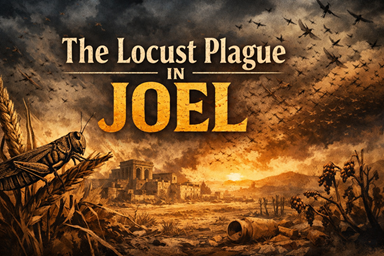
The Locust Plague in Joel: When God Speaks Through Devastation
“Even in loss, God is calling—not to destroy us, but to draw us back to Him.”
Introduction
The book of Joel opens with one of the most vivid scenes in Scripture—a devastating locust plague that strips the land bare. At first glance, it may seem like a natural disaster account. But when we examine it through the lens of your scholarly resources—especially your ICC (International Critical Commentary) volume—we see something far deeper.
This is not just about insects. It is about God speaking through real events.
Joel’s message is clear: what is happening physically reflects something happening spiritually. The land is devastated because the people are disconnected. The crisis is not merely agricultural—it is theological.
And that makes this passage just as relevant today.
Table of Contents
- The Reality of the Locust Plague
- The Total Devastation (Joel 1:4–7)
- Worship Disrupted (Joel 1:8–13)
- The Day of the Lord Is Near (Joel 1:14–15)
- A Call to Return to God
- How This Applies Today
- From My Heart to Yours
- Final Thought
- Discussion Questions + Answers
1. The Reality of the Locust Plague
Key Scripture (ESV)
Joel 1:4
“What the cutting locust left, the swarming locust has eaten.
What the swarming locust left, the hopping locust has eaten,
and what the hopping locust left, the destroying locust has eaten.”
Teaching Focus
The locust plague was a real, historical event, not just symbolic language.
Commentary
Your ICC commentary highlights that the four terms for locusts likely represent successive waves or stages of infestation, not random poetic repetition. Each wave consumes what the previous one left behind, emphasizing complete and systematic destruction. This reflects real agricultural patterns seen in the ancient Near East.
This layered destruction is intentional in the text. Joel is showing that the devastation is not partial—it is absolute. Every level of provision is stripped away. Grain, wine, and oil—the core elements of survival and worship—are all affected. The message is clear: nothing remains untouched.
At a deeper level, the commentary reveals that this event is being interpreted theologically. Joel is not merely describing what happened—he is explaining what it means. God is using a real disaster to confront His people with a spiritual reality they cannot ignore.
Notes
- Four locust types = total destruction
- Reflects real agricultural collapse
- God uses real events to communicate
Reflection
What areas of your life feel like they are being “stripped away”?
Application
Recognize that God may be speaking through circumstances—not just through words.
Prayer
Lord, help me to see Your hand even in difficult circumstances, and give me the wisdom to respond rightly.
2. The Total Devastation (Joel 1:5–7)
Key Scripture (ESV)
“Awake, you drunkards, and weep… for it is cut off from your mouth.”
Teaching Focus
The destruction affects every level of society.
Commentary (3 Paragraphs)
Your resources emphasize that Joel calls out different groups—drunkards, farmers, priests—not randomly, but strategically. Each group represents a different layer of society affected by the crisis. This shows that the judgment is not isolated; it is comprehensive.
The loss of wine symbolizes more than just economic hardship. In Scripture, wine often represents joy and blessing. Its removal indicates that joy itself has been disrupted. The same is true for grain and oil—basic necessities that also had spiritual significance in offerings.
The ICC perspective reinforces that this is not accidental devastation. It is structured, purposeful, and meant to awaken the people. The language is urgent because the situation is severe—and because the response must be immediate.
Notes
- Affects all people groups
- Joy and provision removed
- Crisis is intentional, not random
Reflection
What has God allowed to be removed that once brought comfort or security?
Application
Do not ignore spiritual warnings during difficult seasons.
Prayer
Father, awaken my heart so I do not miss what You are trying to show me.
3. Worship Disrupted (Joel 1:8–13)
Key Scripture (ESV)
“The grain offering and the drink offering are cut off from the house of the Lord.”
Teaching Focus
The greatest loss is not material—it is spiritual.
One of the most important insights from your library is that the locust plague directly impacts temple worship. Without grain, wine, and oil, the offerings cease. This is critical—because worship was central to Israel’s relationship with God.
The ICC commentary highlights that this is not just a side effect—it is a central point. The disruption of worship reveals the deeper issue: the people’s relationship with God is already broken. The physical inability to offer sacrifices reflects a spiritual disconnect that already exists.
This shifts the focus of the entire passage. The real tragedy is not the loss of crops—it is the loss of communion with God. Joel is calling the people to recognize that what has been interrupted externally must be restored internally.
Notes
- Worship halted
- Spiritual condition exposed
- External reflects internal
Reflection
Is anything in your life disrupting your connection with God?
Application
Prioritize restoring your relationship with God above all else.
Prayer
Lord, restore my heart to true worship, even when circumstances are difficult.
4. The Day of the Lord Is Near (Joel 1:14–15)
Key Scripture (ESV)
“Alas for the day! For the day of the Lord is near…”
Teaching Focus
The locust plague is a warning of greater judgment.
Commentary
Your ICC volume makes it clear that Joel is connecting the present event to a larger theological reality—the Day of the Lord. This phrase does not only refer to the end times; it refers to moments when God intervenes decisively in history.
The locust plague is one such moment. It is not the final judgment, but it is a preview. It serves as a warning—a tangible example of what happens when God’s judgment unfolds. This gives urgency to Joel’s message.
The commentary stresses that this is an opportunity for repentance. The warning is not meant to condemn, but to redirect. The people are being given a chance to respond before something greater comes.
Notes
- Day of the Lord = present + future
- Warning, not final judgment
- Opportunity to repent
Reflection
Are you responding to God’s warnings, or ignoring them?
Application
Take spiritual warnings seriously and respond quickly.
Prayer
God, give me a heart that responds to Your warnings with humility and repentance.
5. A Call to Return to God
Teaching Focus
The solution is not external—it is repentance.
Commentary
Across your resources, there is strong agreement: Joel’s solution is not agricultural recovery—it is spiritual renewal. The people are called to fast, mourn, and cry out to God. This is a communal response, not just individual.
The ICC emphasizes that this is not superficial repentance. It is meant to be genuine and heartfelt. The outward actions (fasting, mourning) must reflect an inward transformation.
This is the turning point of the passage. The devastation leads to decision: will the people return to God, or continue in spiritual indifference?
Notes
- Call to fasting and prayer
- Community response
- True repentance required
Reflection
What is God calling you to change right now?
Application
Take intentional steps toward repentance and renewal.
Prayer
Lord, help me not just to feel conviction, but to act on it.
6. How This Applies Today
- God still uses circumstances to get our attention
- Loss can be a tool for spiritual awakening
- True restoration begins with repentance
From My Heart to Yours
Sometimes we look at hardship and only see loss. But Joel reminds us that God can speak through what we are going through. The locust plague was devastating—but it was also a message.
God was calling His people back.
In your life, what feels like loss may actually be an invitation. An invitation to return. An invitation to refocus. An invitation to rebuild your relationship with Him.
Don’t ignore that call.
Final Thought
The locust plague was not the end of the story—it was the beginning of a turning point.
God’s warnings are always invitations.
The question is: Will we listen?
Discussion Questions + Answers
1. What do the four types of locusts represent?
They represent successive waves of destruction, emphasizing total devastation.
2. Why is the disruption of worship important?
It shows that the real issue is spiritual, not just physical.
3. What is the “Day of the Lord”?
A time when God intervenes in judgment—both in history and ultimately in the future.
4. What is the main response Joel calls for?
Repentance through fasting, prayer, and returning to God.
5. How does this apply today?
God still uses life events to call people back to Him.
Feel free to reach out using the form below for any reason—whether you have comments on my articles, questions, or just want to connect. I’d love to hear from you and continue this journey together.
Copyright Notice © 2025 Dr. Cecil W Thorn, Ph.D. (Theology). Permission is hereby granted, free of charge, to any person obtaining a copy of this work authored by Dr. Cecil W Thorn, Ph.D. (Theology) to distribute, display, and reproduce the work, in its entirety, including verbatim copies, provided that no fee is charged for the copies or distribution. This permission is granted for non-commercial distribution only.