


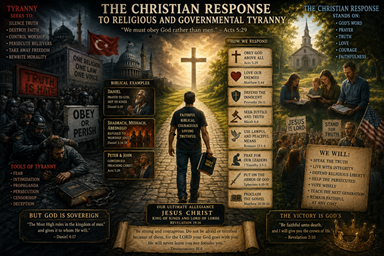
The Christian Response to Religious and Governmental Tyranny
A Biblical Study of Civil Authority, Civil Disobedience, Self-Defense, Defense of Others, Persecution, Personal Vengeance, and the Christian’s Ultimate Allegiance to God
Read the FREE complete Bible Study of:
The Christian Response to Religious and Governmental Tyranny (PDF) DOWNLOAD
Introduction
Christians have always faced the difficult question of how to live faithfully under human government while recognizing that their highest allegiance belongs to God. Scripture commands believers to respect legitimate civil authority, pray for those who govern, live peacefully whenever possible, and obey the laws of the land. Yet the same Bible records occasions when faithful servants of God refused direct commands from kings and governing authorities because obedience to those commands would have required disobedience to God. Romans 13 teaches submission to governing authorities, while Acts 5:29 establishes the boundary that can never be crossed: “We must obey God rather than men.” Understanding how these truths fit together is essential when Christians confront religious persecution, governmental oppression, attacks upon religious liberty, or demands that conflict with God’s Word.
This study examines that responsibility without falling into either of two dangerous extremes. Christianity does not require passive surrender to every form of evil simply because Jesus commanded His followers to turn the other cheek. Neither does Christianity authorize hatred, personal vengeance, indiscriminate violence, or hostility toward people merely because they belong to another religion or hold opposing political beliefs. Scripture distinguishes personal retaliation from justice, persecution from legitimate governmental authority, and hatred of an enemy from resistance to evil. Christians can vigorously oppose false doctrine, political tyranny, religious coercion, and attempts to deprive people of fundamental liberty while still obeying Christ’s command to “love your enemies and pray for those who persecute you” (Matthew 5:44, ESV).
The central issue, therefore, is not whether Christians should simply fight or surrender. The biblical question is: How can Christians remain faithful to Jesus Christ when human authority comes into conflict with God’s authority? Through Romans 12–13, Daniel 3 and 6, Acts 4–5, Matthew 5 and 26, Luke 22, John 18, Revelation 13, and other passages, Scripture provides principles for answering that question. Christians are called to stand courageously for truth, defend innocent life, contend for the faith, exercise lawful citizenship, reject personal vengeance, love their enemies, endure persecution when necessary, and recognize that no earthly government, political movement, or religious system possesses the authority that belongs exclusively to Jesus Christ.
Table of Contents
Introduction
The Christian Between God’s Authority and Human Government
Chapter 1 — Civil Government Has Legitimate Authority
Romans 13:1–7 and the God-ordained purpose of civil government.
Chapter 2 — God’s Authority Is Higher Than Government
Understanding the biblical hierarchy of authority and Acts 5:29.
Chapter 3 — When Must a Christian Say “No”?
Civil disobedience and the biblical limits of governmental authority.
Chapter 4 — The Hebrew Midwives: Refusing an Evil Government Command
Exodus 1:15–21 and obedience to God when government commands wrongdoing.
Chapter 5 — Daniel 3: Government Cannot Force False Worship
Shadrach, Meshach, and Abednego and the refusal to compromise worship.
Chapter 6 — Daniel 6: When Government Makes Obedience to God Illegal
Daniel’s prayer and faithful civil disobedience.
Chapter 7 — Acts 4 and 5: Government Cannot Silence the Gospel
Peter, John, and the declaration: “We must obey God rather than men.”
Chapter 8 — “Turn the Other Cheek”: What Did Jesus Mean?
Matthew 5:38–48 and the difference between non-retaliation and surrender to evil.
Chapter 9 — Personal Vengeance Is Forbidden
Romans 12:14–21 and why Christians must never confuse revenge with justice.
Chapter 10 — Defending the Innocent
Psalm 82, Proverbs 24, Proverbs 31, and the Christian responsibility toward those facing harm.
Chapter 11 — The Christian and Self-Defense
Examining Exodus 22:2–3, Luke 22:35–38, and related biblical principles.
Chapter 12 — “Put Your Sword Back”: Jesus, Peter, and the Arrest in Gethsemane
Matthew 26:47–54 and why Peter’s use of the sword was stopped.
Chapter 13 — Christ’s Kingdom and Political Revolution
John 18:36 and why Christianity cannot be established through forced conversion or political violence.
Chapter 14 — When Another Religion Seeks Political Power
How Christians should evaluate religious ideology, political movements, coercion, and threats to religious liberty.
Chapter 15 — Islam, Islamism, Muslims, and the Christian Response
Distinguishing theological disagreement, political ideology, and individual people while maintaining biblical truth and Christian love.
Chapter 16 — Religious Liberty: Defending Ours Without Denying Theirs
Why Christians can defend Christianity vigorously while protecting the lawful religious freedom of others.
Chapter 17 — What If Christians Become the Persecuted Minority?
Matthew 5, Matthew 10, John 15, 1 Peter 4, and preparing Christians for persecution.
Chapter 18 — Revelation 13: When Government Becomes Openly Hostile to God
The endurance and faithfulness of the saints under oppressive political authority.
Chapter 19 — Love Your Enemies Does Not Mean Agree With Your Enemies
Matthew 5:44 and maintaining Christian love without compromising biblical truth.
Chapter 20 — The Christian’s Warfare Is Ultimately Spiritual
Ephesians 6:10–18 and 2 Corinthians 10:3–5.
Chapter 21 — The Christian Citizen in a Constitutional Republic
Voting, speaking, petitioning, peaceful protest, courts, religious liberty, and lawful political participation.
Chapter 22 — Five Distinctions Every Christian Must Understand
Submission vs. absolute obedience; civil disobedience vs. anarchy; self-defense vs. revenge; defense of others vs. retaliation; opposing false teaching vs. hating people.
Chapter 23 — The Christian’s Order of Allegiance
Jesus Christ, God’s Word, obedience to God, and legitimate civil authority.
Chapter 24 — When the Christian Must Draw the Line
Determining when submission to government becomes disobedience to God.
Conclusion — “We Must Obey God Rather Than Men”
A biblical framework for courageous, lawful, loving, and uncompromising Christian faithfulness.
Scripture Reference Guide
Contact Me
Chapter 1 — Civil Government Has Legitimate Authority
God’s Purpose for Human Government
Before we can properly understand when a Christian may resist governmental authority, we must first understand what Scripture teaches about why government exists in the first place. The Bible does not present civil government as inherently evil. Government is one of the means God permits for maintaining order in a fallen world, restraining wrongdoing, administering justice, and protecting society. Although governments are administered by imperfect and sometimes sinful people, Scripture nevertheless recognizes legitimate civil authority.
This principle is especially important when discussing tyranny, religious persecution, civil disobedience, or resistance. We cannot begin by asking, “When may I disobey government?” without first asking, “When does God command me to obey government?” Biblical resistance cannot be understood apart from biblical submission. Christians are not called to rebellion simply because they dislike a ruler, disagree with a law, lose an election, or oppose a particular governmental policy.
The Christian’s normal posture should therefore be one of peaceful and lawful citizenship. But as we will discover throughout this study, governmental authority is real but limited. Government possesses authority, but it does not possess ultimate authority. That distinction becomes the foundation upon which everything else in this study rests.
Romans 13:1–7 — The Foundational Passage
Paul writes:
“Let every person be subject to the governing authorities. For there is no authority except from God, and those that exist have been instituted by God.”
— Romans 13:1 (ESV)
These words deserve careful consideration.
Paul was not writing to Christians living under a modern constitutional republic. He was writing to believers living under the authority of the Roman Empire.
That makes his command especially significant.
Paul tells Christians to recognize that civil authority exists within the sovereign purposes of God. This does not mean that every decision made by every government is approved by God. Nor does it mean that every ruler is righteous.
It means that the institution of civil authority itself serves a legitimate purpose within human society.
Without legitimate authority, society can descend into disorder where everyone becomes a law unto himself.
Judges describes such a condition:
“Everyone did what was right in his own eyes.”
— Judges 21:25 (ESV)
That is not biblical liberty.
It is lawlessness.
Government Is God’s Servant—Not God’s Replacement
Romans 13:4 contains one of the most important descriptions of civil government in Scripture:
“For he is God’s servant for your good.”
— Romans 13:4 (ESV)
Notice the language carefully.
Government is described as:
God’s servant.
Government is not God.
That means government possesses delegated authority rather than absolute authority.
A servant answers to someone greater than himself. Therefore, if government is God’s servant, government itself remains accountable to the moral authority of God.
This distinction becomes enormously important.
The Bible does not teach:
“Whatever government commands automatically becomes morally right.”
If that were true, the Hebrew midwives should have killed the Hebrew children when Pharaoh commanded it.
If that were true, Shadrach, Meshach, and Abednego should have worshiped Nebuchadnezzar’s image.
If that were true, Daniel should have stopped praying.
If that were true, Peter and John should have stopped preaching Jesus.
But they did not.
Why?
Because governmental authority exists under God’s authority.
Government Has a Responsibility to Restrain Evil
Paul continues:
“But if you do wrong, be afraid, for he does not bear the sword in vain.”
— Romans 13:4 (ESV)
This passage establishes another important principle.
Government has responsibility for restraining and punishing wrongdoing.
The expression “does not bear the sword in vain” indicates that civil authority possesses coercive power that private individuals do not possess in the same manner.
This is why Romans 12 and Romans 13 must be read together.
Romans 12 tells the individual Christian:
“Beloved, never avenge yourselves…”
— Romans 12:19 (ESV)
Then Romans 13 describes government as:
“an avenger who carries out God’s wrath on the wrongdoer.”
— Romans 13:4 (ESV)
There is an important distinction.
Personal vengeance is forbidden.
But:
Legitimate governmental justice is authorized.
The Christian cannot simply decide:
“Someone wronged me, therefore I will personally punish him.”
That would make the individual his own judge and executioner.
Instead, legitimate civil government exists partly to administer justice through established law.
Government Should Reward Good and Punish Evil
Peter presents a similar principle.
1 Peter 2:13–14
Christians are instructed to submit to legitimate human authorities, including governors sent:
“to punish those who do evil and to praise those who do good.”
— 1 Peter 2:14 (ESV)
Notice again the biblical standard.
Government should:
punish evil
and
recognize good.
Government therefore has a moral purpose.
This also raises an important question that will become increasingly significant throughout this book:
What happens when government reverses those responsibilities?
What happens when government begins:
rewarding evil,
punishing good,
protecting injustice,
persecuting righteousness,
or
commanding conduct contrary to God?
That is where the Christian must begin examining the limits of governmental authority.
But we should not reach that conclusion prematurely.
Government does not become illegitimate merely because Christians disagree with a particular policy.
Christians Should Be Good Citizens
Paul writes:
“Remind them to be submissive to rulers and authorities, to be obedient, to be ready for every good work.”
— Titus 3:1 (ESV)
Christian citizenship should ordinarily be characterized by responsibility rather than rebellion.
A Christian should seek to be known as someone who:
obeys legitimate laws,
keeps his commitments,
respects legitimate authority,
acts honestly,
helps his neighbors,
pursues justice,
and
contributes positively to society.
Our Christianity should make us better citizens—not because government is our highest authority, but because Christ is.
Christians Should Pray for Their Leaders
Our responsibility toward government extends beyond obedience.
We are commanded to pray for those who govern us.
1 Timothy 2:1–2
Paul urges that prayers be made:
“for kings and all who are in high positions, that we may lead a peaceful and quiet life, godly and dignified in every way.”
— 1 Timothy 2:2 (ESV)
Notice that Paul does not say:
Pray only for leaders you voted for.
Nor does he say:
Pray only for righteous rulers.
Christians should pray for governmental leaders regardless of political party, personality, or ideology.
We can oppose a leader’s policies and still pray for that leader.
We can pray that God gives leaders:
- wisdom;
- justice;
- humility;
- restraint;
- discernment;
- courage to do what is right;
- and repentance when they are wrong.
That is a profoundly Christian response to political disagreement.
Jesus Recognized Legitimate Civil Authority
Jesus was once confronted with a politically dangerous question concerning taxation.
His opponents asked whether it was lawful to pay taxes to Caesar.
Jesus answered:
“Render to Caesar the things that are Caesar’s, and to God the things that are God’s.”
— Mark 12:17 (ESV)
Jesus acknowledged that Caesar possessed legitimate civil claims.
But His statement also contains an enormous limitation:
Some things belong to Caesar.
Other things belong exclusively to God.
Government may legitimately require certain obligations from citizens.
But government cannot legitimately claim the Christian’s:
worship,
ultimate allegiance,
conscience before God,
or
obedience when government directly commands sin.
Caesar has a place.
But Caesar does not sit upon God’s throne.
Christianity Rejects Anarchy
This point is especially important when discussing resistance to tyranny.
The biblical doctrine of civil disobedience must never become an excuse for lawlessness.
A person cannot simply say:
“I don’t like this law, therefore Acts 5:29 allows me to ignore it.”
Acts 5:29 does not mean:
“Obey only laws you personally agree with.”
It means that when human authority directly conflicts with God’s authority, God’s authority takes precedence.
There is a tremendous difference between those two positions.
Christians may disagree strongly with:
- tax policies;
- economic regulations;
- zoning decisions;
- election results;
- court rulings;
- governmental programs;
- political leaders.
Disagreement alone does not automatically create biblical justification for civil disobedience.
What About an Unjust Government?
Scripture recognizes that rulers themselves can become wicked.
Isaiah 10:1–2
“Woe to those who decree iniquitous decrees, and the writers who keep writing oppression.”
— Isaiah 10:1 (ESV)
God does not excuse injustice simply because government legalized it.
Something does not become morally righteous merely because legislators pass it, a king decrees it, or a court approves it.
Human law and God’s moral law are not necessarily identical.
That means Christians must possess enough biblical discernment to recognize the difference between:
a law we dislike
and
a law requiring disobedience to God.
That distinction is critical.
Government’s Authority Has Boundaries
We can now begin establishing the biblical framework.
Government possesses legitimate authority.
Christians ordinarily should submit to that authority.
Government has responsibility to maintain order and restrain wrongdoing.
Christians should pray for governmental leaders.
Christians should seek peaceful and lawful lives.
But governmental authority is delegated, not absolute.
The moment government claims authority belonging exclusively to God, a conflict arises.
That conflict appears repeatedly throughout Scripture.
Pharaoh commanded murder.
The Hebrew midwives refused.
Nebuchadnezzar commanded worship.
The Hebrew men refused.
Darius’s decree prohibited prayer.
Daniel continued praying.
The Sanhedrin prohibited preaching Jesus.
Peter and John continued preaching.
These were not examples of people who rejected all governmental authority.
They were examples of people who understood where governmental authority ended.
A Biblical Hierarchy of Authority
The relationship can therefore be summarized this way:
GOD
Supreme and absolute authority
↓
GOD’S MORAL COMMANDS
The standard governing Christian obedience
↓
CIVIL GOVERNMENT
Legitimate but limited authority
↓
CHRISTIAN CITIZEN
Normally submissive to legitimate government while remaining ultimately accountable to God
This hierarchy prevents two opposite errors.
Error #1 — Anarchy
“Government has no authority over me.”
Scripture rejects this.
Error #2 — Government Absolutism
“Whatever government commands must be obeyed.”
Scripture rejects this as well.
The biblical position stands between the two:
Government possesses real authority, but God possesses ultimate authority.
Questions for Christian Discernment
Before claiming that resistance to government is biblically justified, Christians should carefully ask:
Does this governmental action actually require me to violate a command of God?
Does it prohibit something Scripture clearly commands me to do?
Am I responding from biblical conviction or simply political anger?
Have I established the facts accurately?
Are lawful remedies still available?
Can I challenge this action through voting, courts, petitions, elections, public advocacy, or peaceful protest?
Is my response motivated by righteousness or revenge?
Will my conduct honor Jesus Christ?
Those questions help distinguish principled Christian resistance from political anger disguised as biblical conviction.
Application for Christians Today
Christians living in a constitutional republic possess opportunities that believers under many historical governments never enjoyed.
We can:
- vote;
- speak publicly;
- petition government;
- peacefully assemble;
- challenge governmental actions in court;
- communicate with elected representatives;
- run for office;
- support candidates;
- publish biblical teaching;
- organize churches and ministries;
- advocate for religious liberty;
- and preach the Gospel publicly.
These freedoms should not be taken lightly.
When lawful mechanisms exist for correcting injustice, Christians should ordinarily use them.
Christian courage does not require us to bypass peaceful remedies.
Sometimes courage means patiently working through those remedies.
The Central Truth of Chapter 1
The Christian should neither worship government nor despise legitimate government.
We should understand government according to Scripture.
Romans 13 teaches:
“For he is God’s servant for your good.”
That one statement gives us both the authority and the limitation of government.
Government is:
God’s servant.
Therefore government has legitimate authority.
But government is:
God’s servant.
Therefore government is not God.
That distinction prepares us for the question addressed in the next chapter:
Chapter Conclusion
Christians should normally be peaceful, responsible, law-abiding citizens who respect legitimate governmental authority and pray for those who govern. Scripture clearly rejects unnecessary rebellion and personal lawlessness. Government serves an important purpose in maintaining order, restraining wrongdoing, and administering justice. Therefore, Christians should never treat political disagreement alone as sufficient justification for disobedience.
At the same time, governmental authority has boundaries. Government is God’s servant; it is not God’s replacement. When civil authority remains within its proper sphere, Christians should respect it. But when government attempts to command worship, prohibit obedience to God, require sinful conduct, or silence the proclamation of Christ, the Christian faces a higher obligation.
Chapter 2 — God’s Authority Is Higher Than Government
“We Must Obey God Rather Than Men”
In Chapter 1, we established that civil government possesses legitimate authority. Romans 13:1–7 teaches Christians to respect governing authorities, while 1 Peter 2:13–17 describes government as having responsibility to punish wrongdoing and encourage what is good. Christians therefore should not approach government with an automatic spirit of rebellion. We should seek to live peacefully, obey legitimate laws, pray for those who govern, and use the lawful means available to us when we believe government has acted wrongly. But acknowledging governmental authority raises an unavoidable question: What happens when human government commands something that directly conflicts with God’s commands?
Scripture gives a clear answer. Government possesses legitimate authority, but it does not possess supreme authority. No president, king, legislature, court, political movement, religious institution, or governmental system occupies the position belonging to God. Government can regulate many aspects of civil society, but it cannot rightfully demand worship, redefine God’s truth, command Christians to commit sin, or prohibit believers from obeying what God has clearly commanded. When human authority remains within its proper sphere, Christians should normally submit. But when human authority directly contradicts God’s authority, the Christian’s highest allegiance has already been determined.
The apostles expressed this principle in one of the clearest statements concerning Christian obedience ever recorded:
“We must obey God rather than men.”
— Acts 5:29 (ESV)
That declaration provides the foundation for understanding the biblical limits of governmental authority.
God Is the Supreme Authority
The Bible begins with God, not government.
“In the beginning, God created the heavens and the earth.”
— Genesis 1:1 (ESV)
Before there were nations, constitutions, kings, presidents, courts, armies, legislatures, or political parties, God was already sovereign.
Human government did not create God’s authority.
God’s authority existed before human government.
The psalmist declares:
“The LORD has established his throne in the heavens, and his kingdom rules over all.”
— Psalm 103:19 (ESV)
That means every earthly ruler governs beneath a higher throne.
The greatest political leader on earth remains a human being accountable to God.
Jesus Christ Possesses Ultimate Authority
After His resurrection, Jesus told His disciples:
“All authority in heaven and on earth has been given to me.”
— Matthew 28:18 (ESV)
Notice the scope:
All authority.
Not merely religious authority.
Not merely authority inside the church.
Christ declares authority over heaven and earth.
Paul likewise writes:
“Therefore God has highly exalted him and bestowed on him the name that is above every name.”
— Philippians 2:9 (ESV)
And Scripture declares that ultimately:
“Every knee should bow… and every tongue confess that Jesus Christ is Lord.”
— Philippians 2:10–11 (ESV)
For the Christian, therefore, the question of ultimate allegiance has already been settled.
Jesus Christ is Lord.
Government may be respected.
Country may be loved.
The Constitution may be defended.
Political liberty may be cherished.
But none of them is Lord.
Jesus Christ alone occupies that position.
Acts 5 — When Government and God Collide
Acts 5 gives us one of Scripture’s clearest examples of conflicting authority.
The apostles were publicly preaching Jesus Christ.
The religious authorities arrested them and commanded them to stop.
The issue was no longer simply political disagreement.
The government was effectively demanding:
“Stop doing what Christ commanded you to do.”
The apostles faced a choice.
They could obey the authorities and disobey Christ.
Or:
They could obey Christ and disobey the authorities.
Peter and the apostles answered:
“We must obey God rather than men.”
— Acts 5:29 (ESV)
Notice that Peter did not say:
“We obey God when convenient.”
He said:
“We must.”
This was an obligation.
Their allegiance to Christ required obedience.
Jesus Had Already Commanded Them to Preach
Why couldn’t the apostles simply stop preaching?
Because Jesus had already commanded them:
“Go therefore and make disciples of all nations…”
— Matthew 28:19 (ESV)
Jesus had also told them:
“You will be my witnesses…”
— Acts 1:8 (ESV)
Therefore, when human authorities said:
“Stop preaching,”
and Christ had said:
“Go and preach,”
the apostles could not obey both.
A decision had to be made.
And when obedience to human authority requires disobedience to divine authority, Scripture establishes the priority:
God comes first.
Acts 4 — “We Cannot But Speak”
This conflict actually appears one chapter earlier.
The authorities commanded Peter and John:
“not to speak or teach at all in the name of Jesus.”
— Acts 4:18 (ESV)
Peter and John responded:
“Whether it is right in the sight of God to listen to you rather than to God, you must judge.”
— Acts 4:19 (ESV)
Then they declared:
“For we cannot but speak of what we have seen and heard.”
— Acts 4:20 (ESV)
Their reasoning was straightforward:
Government commanded silence.
God commanded proclamation.
Therefore:
God’s command prevailed.
The Biblical Boundary
From these passages we can establish a basic biblical principle:
When government permits what God permits:
Christians may participate according to conscience.
When government prohibits something that is morally optional:
Christians should ordinarily obey.
When government commands something God clearly forbids:
Christians must refuse.
When government forbids something God clearly commands:
Christians must continue obeying God.
That distinction is extremely important.
Civil disobedience should not be based merely upon:
personal preference,
political frustration,
anger,
partisanship,
or
disagreement with policy.
There must be a genuine conflict between human command and divine obligation.
Biblical Examples of Higher Allegiance
Acts 5 is not an isolated teaching.
The same principle appears throughout Scripture.
The Hebrew Midwives — Exodus 1
Pharaoh commanded the Hebrew midwives to kill newborn Hebrew boys.
Scripture says:
“But the midwives feared God and did not do as the king of Egypt commanded them.”
— Exodus 1:17 (ESV)
Why did they disobey?
Because they:
“feared God.”
Their allegiance to God outweighed their obligation to Pharaoh.
Shadrach, Meshach, and Abednego — Daniel 3
Nebuchadnezzar commanded everyone to worship his golden image.
The three Hebrew men refused.
They told the king:
“We will not serve your gods or worship the golden image that you have set up.”
— Daniel 3:18 (ESV)
This is one of Scripture’s strongest examples of religious resistance.
They did not negotiate away their worship.
They did not say:
“We’ll bow physically but worship God privately.”
They refused.
Why?
Because government had entered territory belonging exclusively to God.
Daniel — Daniel 6
Daniel faced a law prohibiting prayer to anyone except the king.
Daniel knew the law.
Yet Scripture records:
“He got down on his knees three times a day and prayed and gave thanks before his God, as he had done previously.”
— Daniel 6:10 (ESV)
Daniel did not organize a violent revolt.
He did not attack those who wrote the law.
He simply continued obeying God.
This is an important model of peaceful but uncompromising civil disobedience.
Daniel essentially said through his actions:
“You may write the law, but you cannot become my God.”
Government Cannot Command Worship
Worship belongs exclusively to God.
Jesus said:
“You shall worship the Lord your God and him only shall you serve.”
— Matthew 4:10 (ESV)
Therefore no government possesses legitimate authority to command Christians to:
- worship another god;
- participate in idolatry;
- deny Jesus Christ;
- confess another deity as supreme;
- renounce Christianity;
- or place government itself in God’s position.
This principle applies regardless of what ideology controls government.
Whether the state identifies itself as:
Islamic,
atheistic,
communist,
fascist,
secular-totalitarian,
or even falsely claims to act in the name of Christianity,
no government may rightfully demand the worship belonging to God.
Government Cannot Silence the Gospel
Christ’s command to proclaim the Gospel is not dependent upon governmental approval.
Paul writes:
“Preach the word; be ready in season and out of season…”
— 2 Timothy 4:2 (ESV)
Jesus commanded:
“Go therefore and make disciples of all nations…”
— Matthew 28:19 (ESV)
Therefore, if a government were to prohibit Christians from proclaiming Christ entirely, believers would face the same fundamental conflict encountered by Peter and John.
Government says:
“Do not preach.”
Christ says:
“Go.”
The Christian must obey Christ.
That does not mean Christians should deliberately create unnecessary conflict. Wisdom may affect how, when, and where ministry is conducted under persecution.
But Christians cannot accept the proposition that government possesses ultimate authority to extinguish the Gospel.
Government Cannot Command Sin
The principle extends beyond worship and preaching.
Suppose government directly commands a Christian to commit an act Scripture clearly condemns.
The fact that government has legalized or commanded the behavior does not make it righteous before God.
Isaiah warned:
“Woe to those who decree iniquitous decrees…”
— Isaiah 10:1 (ESV)
Human law can be unjust.
History demonstrates this repeatedly.
Governments have legalized:
slavery,
racial persecution,
religious persecution,
genocide,
forced worship,
and other profound injustices.
Legality and morality are not always identical.
The Christian’s conscience must therefore ultimately be formed by God’s truth rather than merely by government decree.
What Civil Disobedience Is—and Is Not
Biblical civil disobedience is not:
“I dislike this law, therefore I won’t obey it.”
It is closer to:
“Obeying this command would require me to violate a clear obligation before God; therefore I must obey God.”
That is a much higher standard.
The Christian should approach such situations carefully, prayerfully, and biblically.
Before refusing governmental authority, we should ask:
What specific command of Scripture would obedience violate?
Am I interpreting that passage correctly and in context?
Is government actually requiring sin, or do I simply dislike the policy?
Can I obey God while still complying with the law?
Are lawful remedies available?
Have I sought wise biblical counsel?
Am I prepared to accept the consequences of my decision?
These questions protect the doctrine of civil disobedience from becoming an excuse for ordinary political rebellion.
Biblical Resistance May Carry a Cost
One of the most sobering truths in Scripture is that obedience to God does not guarantee freedom from consequences.
The Hebrew men refused the king.
They were thrown into the fiery furnace.
Daniel continued praying.
He was thrown into the lions’ den.
Peter and John continued preaching.
They were arrested and threatened.
The apostles continued proclaiming Christ.
They were beaten.
Acts 5:40 records that authorities:
“beat them and charged them not to speak in the name of Jesus.”
— Acts 5:40 (ESV)
Yet the apostles continued.
Biblical resistance does not mean:
“God will always prevent suffering.”
It means:
“Faithfulness to God is more important than avoiding suffering.”
The Apostles Did Not Respond With Revenge
This point is critical.
The apostles refused to obey an ungodly command.
But they did not respond by murdering their persecutors.
They continued preaching.
They prayed.
They endured suffering.
They remained faithful.
Acts records:
“Then they left the presence of the council, rejoicing that they were counted worthy to suffer dishonor for the name.”
— Acts 5:41 (ESV)
Then:
“Every day, in the temple and from house to house, they did not cease teaching and preaching that the Christ is Jesus.”
— Acts 5:42 (ESV)
That is biblical resistance.
They refused compromise without becoming consumed by vengeance.
Christians Must Not Confuse Government With God
Throughout history, governments have sometimes demanded a level of allegiance that belongs only to God.
Political leaders can become objects of near worship.
Political parties can become substitutes for biblical conviction.
National identity can become more important than Christian identity.
Christians must guard against all of these dangers.
Paul reminds believers:
“Our citizenship is in heaven…”
— Philippians 3:20 (ESV)
This does not mean earthly citizenship is meaningless.
Paul himself used his Roman citizenship and legal rights.
But earthly citizenship remains secondary.
The Christian belongs first to Jesus Christ.
Patriotism and Christian Allegiance
A Christian may deeply love his country.
He may honor those who have sacrificed for its freedoms.
He may defend its constitutional principles.
He may participate actively in political life.
There is nothing inherently unbiblical about patriotism.
But patriotism becomes spiritually dangerous when:
country replaces Christ,
political party replaces Scripture,
government replaces God,
or
national loyalty requires moral compromise.
The Christian must always be able to say:
“I love my country, but I worship my God.”
Those are not the same thing.
What If Government Attempts to Control Religion?
This question is particularly relevant to our broader study.
Suppose a government attempts to:
- determine what Christians may believe;
- prohibit biblical preaching;
- compel participation in another religion;
- force churches to deny essential Christian doctrine;
- prohibit prayer;
- outlaw Christian worship;
- require Christians to affirm another god;
- or punish people simply for faithfully confessing Jesus Christ.
At that point, the Christian must remember Acts 5:29.
The government may possess power.
It may possess police.
It may possess courts.
It may possess prisons.
It may possess armies.
But power is not the same thing as ultimate authority.
God remains God.
The Christian’s Order of Allegiance
Our priorities can be summarized this way:
1. GOD
The Creator and supreme authority.
Genesis 1:1
2. JESUS CHRIST
King of kings and Lord of lords.
Revelation 19:16
3. GOD’S WORD
The authoritative standard for Christian faith and obedience.
John 17:17
4. GOD-ORDAINED HUMAN AUTHORITIES
Including legitimate civil government.
Romans 13:1–7
5. THE CHRISTIAN CITIZEN
Called to obedience, faithfulness, truth, love, and courage.
This hierarchy explains why Christians can simultaneously affirm:
Romans 13:1 — “Be subject to the governing authorities.”
and:
Acts 5:29 — “We must obey God rather than men.”
The passages are not contradictory.
They establish different levels of authority.
Courage Without Hatred
Standing against an ungodly governmental command does not give Christians permission to hate the people enforcing it.
Jesus commands:
“Love your enemies and pray for those who persecute you.”
— Matthew 5:44 (ESV)
Therefore Christian resistance should remain recognizably Christian.
We should seek to be:
courageous without becoming hateful,
firm without becoming cruel,
truthful without becoming slanderous,
resistant to evil without seeking personal vengeance,
and
uncompromising without forgetting the Gospel.
The person persecuting us is still someone who needs Jesus Christ.
Application for Christians Today
Christians living under constitutional government should ordinarily use every legitimate peaceful remedy available before concluding that civil disobedience is necessary.
Those remedies can include:
voting,
petitioning government,
contacting elected representatives,
public advocacy,
peaceful demonstrations,
legal challenges,
supporting religious-liberty organizations,
running for office,
teaching biblical truth,
and
preaching the Gospel.
Civil disobedience should not be the first response merely because lawful political action is difficult or frustrating.
But Christians must also understand beforehand that there are boundaries they cannot cross.
If government ever commands:
“Deny Christ,”
the answer must be:
No.
If government commands:
“Worship another god,”
the answer must be:
No.
If government commands:
“Commit what God clearly calls evil,”
the answer must be:
No.
If government completely commands:
“You may no longer proclaim Jesus Christ,”
the Church must remember the apostles.
“We cannot but speak of what we have seen and heard.”
— Acts 4:20 (ESV)
The Central Truth of Chapter 2
Romans 13 establishes the Christian’s normal relationship with government:
Respect legitimate authority.
Acts 5 establishes the ultimate limitation upon that authority:
Obey God rather than men.
Daniel shows us:
Government cannot control our worship.
The apostles show us:
Government cannot possess our ultimate allegiance.
Jesus shows us:
All authority ultimately belongs to Him.
Therefore the Christian does not have to choose between respecting government and obeying God.
We respect government because we obey God.
And when government directly requires us to disobey God, we refuse because we obey God.
Chapter Conclusion
The Christian’s highest allegiance can never belong to a president, king, government, political party, nation, religious institution, or ideology. Human governments possess legitimate authority, but their authority remains delegated and limited. God alone possesses supreme authority. Jesus Christ declares that all authority in heaven and on earth belongs to Him, and every earthly ruler ultimately remains accountable before His throne.
Therefore, when government acts within its legitimate sphere, Christians should seek to obey, respect, pray for, and peacefully participate in civil society. But when human authority directly commands what God forbids or forbids what God clearly commands, the Christian reaches a boundary that cannot faithfully be crossed. Like the Hebrew midwives, we fear God above Pharaoh. Like Shadrach, Meshach, and Abednego, we refuse false worship. Like Daniel, we continue praying. Like Peter and John, we continue proclaiming Christ.
The issue is not rebellion for rebellion’s sake. It is faithfulness. And sometimes faithfulness has a price. That brings us to Chapter 3 — When Must a Christian Say “No”?, where we will examine the biblical requirements, limits, and examples of civil disobedience and determine when resistance to governmental authority becomes not merely permissible, but an obligation of Christian conscience.
Chapter 3 — When Must a Christian Say “No”?
Civil Disobedience and the Biblical Limits of Governmental Authority
In the first two chapters, we established two truths that must always be held together. Romans 13 teaches that civil government possesses legitimate authority, while Acts 5:29 establishes that God’s authority is supreme. Christians should normally be peaceful, responsible, law-abiding citizens who respect governmental authority, pray for their leaders, and use lawful means to address injustice. But Scripture also records moments when faithful servants of God deliberately refused commands issued by kings and governing authorities. Their refusal was not motivated by political anger, personal convenience, or a general rejection of government. They refused because obedience to human authority would have required disobedience to God.
That brings us to one of the most difficult questions in Christian ethics: When must a Christian say “No” to government? Not every unjust law necessarily requires civil disobedience, and not every political disagreement creates a biblical conflict of conscience. Christians must carefully distinguish between laws we dislike, laws we believe are unwise, laws we believe are unjust, and laws that actually require us to violate God’s commands. If Christians treat every political disagreement as justification for resistance, biblical civil disobedience quickly becomes ordinary rebellion. Scripture provides a much higher standard.
Biblical civil disobedience occurs when human authority crosses a boundary established by God and obedience to that authority would require the believer either to do what God forbids or to stop doing what God commands. At that point, neutrality may no longer be possible. The Christian may have to choose between obedience to government and obedience to God. Scripture’s answer is unmistakable: “We must obey God rather than men” (Acts 5:29, ESV). But making that decision requires biblical discernment, humility, courage, and a willingness to accept the consequences of faithfulness.
What Is Civil Disobedience?
Civil disobedience is the deliberate refusal to obey a particular governmental command or law because obedience would violate a higher moral obligation.
For the Christian, that higher obligation must ultimately be grounded in obedience to God.
Biblical civil disobedience is not:
“I disagree with this law.”
It is not:
“This politician makes me angry.”
It is not:
“My political party lost the election.”
It is not:
“I don’t believe this tax or regulation is fair.”
And it certainly is not:
“Nobody has the right to tell me what to do.”
That attitude is closer to lawlessness than biblical resistance.
Biblical civil disobedience says:
“I cannot obey this particular command without violating my obligation before God.”
That is a far more serious claim.
The Two Primary Biblical Conditions
Scripture gives us two broad circumstances in which obedience to government may become impossible.
1. Government Commands What God Forbids
This occurs when governmental authority requires someone to commit an act that clearly violates God’s moral commands.
The Hebrew midwives provide one of Scripture’s clearest examples.
Pharaoh ordered them to kill newborn Hebrew boys.
But:
“The midwives feared God and did not do as the king of Egypt commanded them, but let the male children live.”
— Exodus 1:17 (ESV)
They faced two conflicting commands.
Pharaoh:
Kill the children.
God’s moral requirement:
Do not murder the innocent.
They could not obey both.
They chose God.
2. Government Forbids What God Commands
The second circumstance occurs when government prohibits conduct God requires.
The apostles experienced this directly.
The authorities commanded them:
“not to speak or teach at all in the name of Jesus.”
— Acts 4:18 (ESV)
But Christ had commanded:
“Go therefore and make disciples of all nations…”
— Matthew 28:19 (ESV)
Again, the commands were incompatible.
Government said:
Stop.
Christ said:
Go.
Peter and John responded:
“We cannot but speak of what we have seen and heard.”
— Acts 4:20 (ESV)
That is biblical civil disobedience.
The Hebrew Midwives — When Government Commands Evil
Exodus 1 deserves careful attention because it establishes an important principle very early in Scripture.
Pharaoh feared the growing Hebrew population and ordered the midwives to kill newborn males.
This was governmental policy.
It came from the highest political authority in Egypt.
Yet Scripture says:
“But the midwives feared God…”
— Exodus 1:17 (ESV)
Those words explain everything.
They feared God more than Pharaoh.
Their refusal demonstrates that governmental authorization cannot transform evil into righteousness.
A government may legalize something.
A government may command something.
A government may punish those who refuse.
But none of those things changes God’s moral standard.
Legality does not automatically equal morality.
That principle has enormous implications.
Government Cannot Make Evil Good
Isaiah pronounced judgment upon rulers who used law itself as an instrument of oppression:
“Woe to those who decree iniquitous decrees, and the writers who keep writing oppression.”
— Isaiah 10:1 (ESV)
Notice that the injustice described here was not merely occurring outside the law.
The injustice was being written into law.
That means Scripture recognizes the possibility of:
legally authorized injustice.
History confirms this.
Human governments have created laws permitting or requiring terrible injustices.
Therefore Christians must never assume:
“If government says it is legal, God must approve.”
Human law remains subject to a higher moral authority.
Daniel 3 — When Government Commands False Worship
Nebuchadnezzar commanded his subjects to bow before a golden image.
The command carried governmental authority.
The punishment was severe:
“Whoever does not fall down and worship shall immediately be cast into a burning fiery furnace.”
— Daniel 3:6 (ESV)
Shadrach, Meshach, and Abednego knew the consequences.
Yet they told the king:
“We will not serve your gods or worship the golden image that you have set up.”
— Daniel 3:18 (ESV)
They did not ask:
“What is safest?”
They asked, in effect:
“What does faithfulness to God require?”
Their answer was clear.
They Were Willing to Pay the Price
Perhaps the most powerful part of Daniel 3 is their statement immediately before their refusal.
They said:
“Our God whom we serve is able to deliver us from the burning fiery furnace…”
— Daniel 3:17 (ESV)
But then:
“But if not…”
— Daniel 3:18 (ESV)
Those three words reveal extraordinary faith.
They believed God could deliver them.
But their obedience did not depend upon God delivering them.
Their position was:
God can rescue us.
But even if He does not, we still will not bow.
That is the heart of biblical resistance.
Faithfulness is not conditional upon personal safety.
Daniel 6 — When Government Prohibits Worship
Daniel faced the opposite situation.
Instead of commanding false worship, government prohibited legitimate worship.
The decree effectively prohibited Daniel from praying to God.
Daniel knew the decree had been signed.
Scripture says:
“When Daniel knew that the document had been signed, he went to his house…”
— Daniel 6:10 (ESV)
Then:
“He got down on his knees three times a day and prayed and gave thanks before his God, as he had done previously.”
Daniel did not change his allegiance because government changed the law.
The government said:
Do not pray.
Daniel continued praying.
Daniel Did Not Become an Anarchist
Notice something equally important.
Daniel’s refusal to obey this particular law did not cause him to reject all governmental authority.
Daniel had served faithfully within government.
He had demonstrated integrity.
He had performed his responsibilities honorably.
His enemies had difficulty finding corruption in his conduct.
Daniel 6:4 says:
“They could find no ground for complaint or any fault, because he was faithful, and no error or fault was found in him.”
— Daniel 6:4 (ESV)
That is extremely significant.
Daniel was not known as a troublemaker searching for reasons to rebel.
He was known for faithfulness.
Only when government attempted to interfere with his obligation to God did he refuse.
That should characterize Christian civil disobedience.
Acts 5 — The Apostles Draw the Line
The apostles faced governmental pressure to stop proclaiming Christ.
The authorities reminded them:
“We strictly charged you not to teach in this name…”
— Acts 5:28 (ESV)
Peter responded:
“We must obey God rather than men.”
— Acts 5:29 (ESV)
This passage gives us perhaps the clearest New Testament principle:
Human authority ends where obedience would require disobedience to God.
This does not mean government loses all authority.
It means the specific command conflicting with God’s command cannot bind the Christian conscience.
Civil Disobedience Should Be Specific
This distinction is essential.
Suppose a government issues one command contrary to Scripture.
Biblical civil disobedience does not automatically mean:
“Therefore every law issued by this government may now be ignored.”
Daniel disobeyed the prayer prohibition.
He did not therefore stop performing all of his governmental responsibilities.
The apostles disobeyed the prohibition against preaching Christ.
They did not announce that all civil authority had ceased to exist.
Biblical resistance is ordinarily directed toward the specific command that requires disobedience to God.
This helps distinguish civil disobedience from revolution or anarchy.
What About Laws That Are Unjust but Do Not Require Personal Sin?
This is where discernment becomes more difficult.
A Christian may believe a particular law is:
unwise,
unfair,
economically harmful,
constitutionally questionable,
or even
morally unjust.
But if the law does not require the Christian personally to commit sin or prohibit obedience to God, the response may be different.
Christians living in a constitutional system have many lawful means to challenge injustice.
We can:
- vote;
- petition;
- speak publicly;
- challenge laws in court;
- organize peacefully;
- contact representatives;
- support legislation;
- seek constitutional remedies;
- and persuade fellow citizens.
Civil disobedience should not become a shortcut around lawful processes simply because those processes are slow or frustrating.
A Christian Must Establish the Facts
Before declaring:
“Government is commanding me to violate God’s Word,”
the Christian has a responsibility to determine whether that claim is actually true.
Proverbs warns:
“If one gives an answer before he hears, it is his folly and shame.”
— Proverbs 18:13 (ESV)
And:
“The one who states his case first seems right, until the other comes and examines him.”
— Proverbs 18:17 (ESV)
Christians should not base serious acts of resistance upon:
rumors,
social-media claims,
political propaganda,
misleading headlines,
fear,
or
unverified accusations.
Truth matters.
Especially when the consequences may be serious.
Seven Questions Before Saying “No”
Before engaging in civil disobedience, the Christian should prayerfully ask:
1. What exactly is government requiring me to do?
Not what someone claims it might do.
What is the actual requirement?
2. What specific biblical command would I violate by obeying?
The Christian should be able to identify the biblical principle clearly.
3. Is the conflict direct or merely political?
There is a difference between:
“I believe this policy is wrong”
and
“This law requires me to sin.”
4. Have I understood Scripture correctly?
We must not use isolated verses to justify actions Scripture does not actually support.
5. Have I exhausted reasonable lawful remedies?
Can the matter be challenged through:
courts, elections, appeals, petitions, representatives, or peaceful advocacy?
6. Is my motivation faithfulness or anger?
Romans 12:19 warns:
“Beloved, never avenge yourselves…”
Christian resistance must not become a disguise for personal vengeance.
7. Am I prepared to accept the consequences?
Daniel was.
The Hebrew men were.
The apostles were.
Biblical civil disobedience sometimes carries a cost.
Accepting Consequences
One of the strongest characteristics of biblical civil disobedience is the willingness to accept suffering rather than abandon faithfulness.
Daniel did not attack those who came to arrest him.
Shadrach, Meshach, and Abednego did not attempt to kill Nebuchadnezzar.
The apostles did not retaliate against the council.
They stood.
They refused.
They suffered.
And they remained faithful.
This does not mean Christians may never challenge punishment through lawful appeals. Paul himself invoked his legal rights as a Roman citizen.
But it does mean:
Faithfulness to God cannot depend upon whether obedience is painless.
Paul Used His Legal Rights
Biblical submission does not mean Christians must surrender legitimate legal protections.
In Acts 22, Paul was about to be flogged.
He asked:
“Is it lawful for you to flog a man who is a Roman citizen and uncondemned?”
— Acts 22:25 (ESV)
Paul used his citizenship.
Later, he exercised his legal right of appeal.
“I appeal to Caesar.”
— Acts 25:11 (ESV)
This is highly relevant for Christians living under constitutional government.
Using:
courts,
legal appeals,
constitutional protections,
and
civil rights
is not a lack of faith.
Paul himself used lawful protections available to him.
Peaceful Resistance Can Be Courageous Resistance
Christians sometimes assume that peaceful resistance means weak resistance.
Daniel proves otherwise.
Standing before a government and saying:
“I will not obey this command because it would require me to disobey God”
may require extraordinary courage.
The apostles demonstrate the same principle.
They were arrested.
Threatened.
Beaten.
And still:
“They did not cease teaching and preaching that the Christ is Jesus.”
— Acts 5:42 (ESV)
They did not surrender.
But neither did they become an armed mob.
Their resistance was uncompromising without becoming vengeful.
What Civil Disobedience Must Never Become
Biblical civil disobedience must never become an excuse for:
hatred,
revenge,
racial hostility,
religious persecution,
vigilantism,
indiscriminate violence,
lying about opponents,
or
treating political disagreement as warfare against people.
Paul reminds us:
“For we do not wrestle against flesh and blood…”
— Ephesians 6:12 (ESV)
Our ultimate struggle is spiritual.
The person opposing Christianity remains someone made in God’s image and someone Christians should desire to see saved.
Religious Tyranny and the Christian Response
Suppose a government controlled by another religious ideology attempted to compel Christians to participate in its worship.
The answer is Daniel 3:
We will not bow.
Suppose government prohibited Christians from praying.
The answer is Daniel 6:
We continue praying.
Suppose government prohibited proclamation of Jesus Christ.
The answer is Acts 4:
“We cannot but speak.”
Suppose government commanded Christians to commit an act clearly forbidden by God.
The answer is Acts 5:
“We must obey God rather than men.”
But suppose our neighbor simply belongs to another religion and peacefully practices that religion.
The Christian response is different.
We preach Christ.
We reason from Scripture.
We defend our faith.
We love our neighbor.
We pray for his salvation.
We do not treat peaceful religious disagreement as equivalent to governmental tyranny.
That distinction is essential.
Religious Liberty Works Both Ways
Christians should vigorously defend the freedom to:
preach Christ,
teach Scripture,
assemble for worship,
pray,
evangelize,
and
live according to biblical conviction within lawful boundaries.
But if we demand freedom of conscience for ourselves, we should recognize the civil freedom of peaceful neighbors who disagree with us.
The Christian does not need government to force someone to become a Christian.
The Gospel is proclaimed.
The Holy Spirit convicts.
The person responds in faith.
Forced conversion is not genuine conversion.
When Saying “No” Becomes a Christian Duty
There may come a point where refusal is no longer merely permissible.
It becomes necessary.
When commanded to murder innocent children, the Hebrew midwives had to refuse.
When commanded to worship an idol, the Hebrew men had to refuse.
When prohibited from praying to God, Daniel had to remain faithful.
When commanded to stop proclaiming Christ, the apostles had to continue.
There are moments when saying “No” to human authority is actually saying “Yes” to God.
That is the heart of biblical civil disobedience.
The Christian’s Attitude While Saying “No”
Even when refusing government, Christians should seek to maintain Christian character.
Peter writes:
“Honor everyone. Love the brotherhood. Fear God. Honor the emperor.”
— 1 Peter 2:17 (ESV)
Notice the distinctions:
Honor everyone.
Love fellow believers.
Fear God.
Honor the emperor.
Peter does not say:
Fear the emperor.
He says:
Fear God.
The emperor receives honor.
God receives ultimate reverence and allegiance.
That is the proper order.
A Biblical Pattern for Civil Disobedience
We can summarize the biblical pattern this way:
STEP 1 — Understand the governmental requirement.
Do not act on rumor.
STEP 2 — Compare the requirement with Scripture.
Does obedience require sin?
STEP 3 — Seek peaceful and lawful remedies when available.
Use the rights and protections God has providentially provided.
STEP 4 — Pray for wisdom.
James 1:5
STEP 5 — Seek wise biblical counsel.
Proverbs 15:22
STEP 6 — If obedience would require disobedience to God, obey God.
Acts 5:29
STEP 7 — Refuse without hatred or personal vengeance.
Romans 12:17–21
STEP 8 — Remain prepared to accept the cost of faithfulness.
Daniel 3; Daniel 6; Acts 5
STEP 9 — Continue demonstrating Christian character.
1 Peter 3:15–16
STEP 10 — Continue proclaiming Christ.
The ultimate mission remains the Gospel.
The Central Truth of Chapter 3
Biblical civil disobedience is neither political rebellion nor passive surrender.
It is obedience to a higher authority.
The Christian says:
I will obey government whenever I can do so faithfully.
I will use lawful means to challenge injustice whenever possible.
I will not manufacture conflicts unnecessarily.
I will not resist simply because I am angry.
I will establish the facts.
I will examine Scripture.
I will pray.
I will seek wisdom.
But:
If government commands me to sin, I must refuse.
And:
If government forbids what God commands me to do, I must remain faithful.
That is not contempt for legitimate government.
It is recognition that government itself exists under God.
Chapter Conclusion
The Christian’s first response to government should not be rebellion. Scripture calls believers to respect legitimate authority, pursue peace, pray for leaders, obey lawful commands, and use available legal remedies when government acts wrongly. Civil disobedience is therefore a serious step that should be grounded in Scripture rather than political emotion. Christians must carefully establish the facts and distinguish between a law they dislike and a command that actually requires disobedience to God.
Yet Scripture also teaches that there are commands Christians cannot obey. Pharaoh could command the Hebrew midwives, but he could not make murder righteous. Nebuchadnezzar could command worship, but he could not make idolatry acceptable. Darius’s decree could prohibit prayer, but it could not remove Daniel’s obligation to God. The Sanhedrin could threaten the apostles, but it could not cancel Christ’s command to proclaim the Gospel. Human government possesses authority, but it cannot rewrite God’s authority.
Therefore, when every peaceful and lawful consideration has been made and a genuine conflict remains, the Christian must be prepared to say respectfully but firmly: “No.” Not because we despise government. Not because we seek rebellion. Not because we hate those enforcing the law. We say no because our highest allegiance belongs to Jesus Christ. Sometimes the most faithful “Yes” to God requires a courageous “No” to men. In the next chapter, we will examine one of Scripture’s earliest and clearest examples of this principle: Chapter 4 — The Hebrew Midwives: Refusing an Evil Government Command.
Chapter 4 — The Hebrew Midwives: Refusing an Evil Government Command
Exodus 1:15–21 — When Government Commands What God Forbids
One of the earliest and clearest examples of resistance to an evil governmental command appears in the opening chapter of Exodus. Long before Daniel refused to stop praying and centuries before Peter declared, “We must obey God rather than men” (Acts 5:29), two Hebrew midwives faced essentially the same moral question. The ruler of Egypt issued an order backed by the authority of the state, but obedience to that order would have required them to participate in the killing of innocent children. They had to decide whether their highest obligation belonged to Pharaoh or to God.
Their names were Shiphrah and Puah. They were not kings, military commanders, prophets, or political leaders. They were ordinary women placed in an extraordinary moral crisis. Pharaoh possessed enormous political power. The midwives possessed very little earthly power by comparison. Yet Exodus records something Pharaoh could not control: “The midwives feared God” (Exodus 1:17, ESV). That fear of God gave them the courage to refuse the command of the most powerful man in Egypt.
Their story establishes a principle that runs throughout Scripture: governmental authority is legitimate, but it is never absolute. A government cannot transform evil into good merely by legalizing it, ordering it, or threatening punishment for those who refuse to participate. When human authority commands what God forbids, the believer’s ultimate responsibility remains with God.
Israel Under Egyptian Oppression
Exodus begins by reminding us that the descendants of Jacob had settled in Egypt.
Over time:
“The people of Israel were fruitful and increased greatly; they multiplied and grew exceedingly strong, so that the land was filled with them.”
— Exodus 1:7 (ESV)
Eventually a new king arose:
“Now there arose a new king over Egypt, who did not know Joseph.”
— Exodus 1:8 (ESV)
Instead of viewing Israel’s growth neutrally, Pharaoh viewed the Hebrew population as a political threat.
He told his people:
“Behold, the people of Israel are too many and too mighty for us.”
— Exodus 1:9 (ESV)
Fear began shaping government policy.
Pharaoh imagined what might happen if Egypt entered a war and the Israelites joined Egypt’s enemies.
Therefore he concluded:
“Come, let us deal shrewdly with them…”
— Exodus 1:10 (ESV)
This marks an important transition.
A government charged with maintaining justice began treating an entire population as a threat because of what its ruler feared they might someday do.
Fear became oppression.
Oppression Became Government Policy
The Egyptians placed taskmasters over the Israelites.
“Therefore they set taskmasters over them to afflict them with heavy burdens.”
— Exodus 1:11 (ESV)
Scripture continues:
“So they ruthlessly made the people of Israel work as slaves and made their lives bitter with hard service…”
— Exodus 1:13–14 (ESV)
This was not merely mistreatment by a few private individuals.
It had become a system of governmental oppression.
Yet Pharaoh encountered a problem.
The more the Israelites were oppressed:
“the more they multiplied and the more they spread abroad.”
— Exodus 1:12 (ESV)
Pharaoh’s oppression failed to accomplish his objective.
So the government escalated.
Pharaoh Commands the Killing of Children
Pharaoh summoned two Hebrew midwives:
Shiphrah
and
Puah.
Then he issued a horrifying command:
“When you serve as midwife to the Hebrew women and see them on the birthstool, if it is a son, you shall kill him…”
— Exodus 1:16 (ESV)
Consider the situation carefully.
This was not a suggestion.
It was not merely cultural pressure.
It was an order from the king.
The highest governmental authority in Egypt had commanded these women to participate in the killing of newborn children.
From a purely political standpoint, Pharaoh possessed authority over them.
But morally, another authority stood above Pharaoh.
“But the Midwives Feared God”
Exodus 1:17 contains the decisive statement:
“But the midwives feared God and did not do as the king of Egypt commanded them, but let the male children live.”
— Exodus 1:17 (ESV)
Every word matters.
“The king commanded.”
But:
“The midwives feared God.”
Here we see the same principle later expressed in Acts 5:29:
“We must obey God rather than men.”
The midwives understood something every Christian must understand:
The king may possess governmental authority, but God possesses moral authority over the king.
Pharaoh could issue the command.
But Pharaoh could not make murder righteous.
The Fear of God Overcomes the Fear of Man
Scripture specifically tells us why the midwives refused.
They:
“feared God.”
Biblical fear of God is not merely terror.
It includes reverence, awe, recognition of God’s holiness, and acknowledgment of His supreme authority.
Proverbs teaches:
“The fear of the LORD is the beginning of wisdom.”
— Proverbs 9:10 (ESV)
Jesus later taught:
“And do not fear those who kill the body but cannot kill the soul.”
— Matthew 10:28 (ESV)
The Christian who fears human authority more than God can eventually be pressured into compromise.
But the person who understands God’s supreme authority can stand even when human authority becomes threatening.
The Midwives Faced a Genuine Conflict of Authority
Their situation helps us distinguish biblical civil disobedience from ordinary political disagreement.
Pharaoh did not command:
“Pay this tax.”
He did not command:
“Follow this administrative regulation.”
He commanded:
“Kill these children.”
There was no morally neutral way to obey.
The women could either:
obey Pharaoh and participate in evil,
or
refuse Pharaoh and remain faithful to God.
They could not do both.
This is precisely the kind of conflict discussed in Chapter 3.
Government Cannot Redefine Morality
One of the most important lessons from Exodus 1 is that government cannot make evil morally good by declaring it legal.
Pharaoh possessed the power to issue laws.
But he did not possess the authority to rewrite God’s moral order.
Isaiah later declared:
“Woe to those who decree iniquitous decrees, and the writers who keep writing oppression.”
— Isaiah 10:1 (ESV)
That verse reveals something critically important:
A law itself can be unjust.
Human legislation is not automatically equivalent to divine morality.
Government can make something:
legal
without making it:
righteous.
Likewise, government can make something:
illegal
without making it:
sinful before God.
Daniel’s prayer became illegal.
It did not become sinful.
The apostles’ preaching became prohibited.
It did not become disobedience to God.
The difference between legal and moral must therefore remain clear.
The Value of Innocent Human Life
The midwives’ resistance also demonstrates the biblical importance of protecting innocent life.
Human beings possess unique dignity because Scripture says:
“God created man in his own image…”
— Genesis 1:27 (ESV)
Human life therefore possesses value that does not originate with government.
Government does not create human dignity.
Government should recognize and protect it.
This is why Pharaoh’s command was so profoundly evil.
He treated innocent children as political problems to be eliminated.
The midwives recognized something greater:
These children belonged to God before they belonged to Pharaoh’s political calculations.
When Political Fear Dehumanizes People
Pharaoh’s progression is worth examining.
First:
He feared a population.
Then:
He portrayed them as a potential political threat.
Then:
He oppressed them.
Then:
He enslaved them.
Finally:
He attempted to kill their children.
This progression should warn Christians about the dangers of dehumanization.
Once people are viewed only as:
threats,
problems,
enemies,
or
obstacles,
it becomes easier to justify mistreating them.
This principle must be applied consistently.
Christians should oppose genuine threats and genuine wrongdoing.
But we should never allow fear to cause us to treat entire populations as less than human.
Every person remains made in God’s image.
Truth Matters Even When Confronting Evil
Exodus 1:18–19 raises a difficult ethical question.
Pharaoh asked the midwives why the male children had been allowed to live.
They answered:
“Because the Hebrew women are not like the Egyptian women, for they are vigorous and give birth before the midwife comes to them.”
— Exodus 1:19 (ESV)
Christians have debated how this statement should be understood.
Some interpret it as truthful—perhaps Hebrew women commonly delivered quickly, and the midwives intentionally did not arrive in time to carry out Pharaoh’s command.
Others understand the statement as involving deception intended to protect innocent life.
We should be careful not to claim more than the text explicitly says.
What Scripture clearly praises is stated directly:
“The midwives feared God.”
And:
“God dealt well with the midwives.”
— Exodus 1:20 (ESV)
The unmistakable moral emphasis is their refusal to participate in Pharaoh’s murderous policy.
God Honored Their Faithfulness
Scripture says:
“So God dealt well with the midwives.”
— Exodus 1:20 (ESV)
Then:
“And because the midwives feared God, he gave them families.”
— Exodus 1:21 (ESV)
Pharaoh possessed earthly authority.
But God’s judgment of their actions mattered more.
From Pharaoh’s perspective, they had disobeyed.
From God’s perspective, their fear of Him was significant.
That distinction is at the heart of Christian civil disobedience.
There may be times when government calls something:
disobedience
that God recognizes as:
faithfulness.
And there may be times when government calls something:
obedience
that God recognizes as:
sin.
The Christian must therefore know God’s Word well enough to distinguish the two.
Courage Does Not Require Political Power
Another powerful lesson emerges from this story.
Shiphrah and Puah apparently possessed very little political power.
They had no army.
No government office.
No political movement.
No earthly means of removing Pharaoh.
Yet they possessed something enormously powerful:
the ability to refuse participation in evil.
Sometimes Christian courage does not look like changing an entire government.
Sometimes it looks like one person saying:
“I will not participate in this.”
That refusal can be profoundly significant.
Ordinary People Can Stand Against Extraordinary Evil
We often think biblical courage belongs primarily to famous figures:
Moses.
David.
Daniel.
Peter.
Paul.
But before Moses confronted Pharaoh publicly, two midwives had already resisted Pharaoh privately.
That matters.
God often works through ordinary people whose names history might otherwise forget.
Shiphrah and Puah remind us that Christians do not need political titles to practice moral courage.
A nurse can refuse wrongdoing.
A teacher can stand for truth.
A government employee can refuse corruption.
A soldier can recognize unlawful conduct.
A business owner can refuse dishonest practices.
A pastor can continue preaching biblical truth.
A citizen can refuse participation in genuine injustice.
Faithfulness begins where God has placed us.
The Difference Between Refusing Evil and Seeking Revenge
The midwives refused Pharaoh’s command.
But they did not attempt to assassinate Pharaoh.
They did not attack Egyptian civilians.
They did not seek personal revenge.
They simply refused to become participants in evil.
That distinction is essential.
Biblical resistance does not automatically mean violent retaliation.
Sometimes the most powerful resistance is:
nonparticipation in evil.
Paul writes:
“Take no part in the unfruitful works of darkness, but instead expose them.”
— Ephesians 5:11 (ESV)
There are times when Christians must simply say:
“I will not participate.”
What If Refusal Costs Us Something?
This question cannot be avoided.
What if obedience to God costs:
employment?
income?
social standing?
political influence?
freedom?
personal safety?
Scripture never promises that faithfulness will always be inexpensive.
Jesus told His disciples:
“If anyone would come after me, let him deny himself and take up his cross and follow me.”
— Matthew 16:24 (ESV)
Christian obedience sometimes carries a cost.
The question is not:
“Will obedience cost me something?”
The deeper question is:
“What is faithfulness to Christ worth?”
Resistance Must Be Based on Truth
The example of Pharaoh also teaches us something about identifying tyranny.
We should call something tyranny because of what it actually does, not merely because we dislike it.
Pharaoh’s actions were identifiable:
He enslaved people.
He oppressed them.
He commanded the killing of innocent children.
Those were concrete actions.
Christians today should likewise base serious accusations upon evidence.
Proverbs 18:17 reminds us:
“The one who states his case first seems right, until the other comes and examines him.”
— Proverbs 18:17 (ESV)
If we accuse a government, religious movement, political organization, or individual of seeking tyranny, we should establish the facts carefully.
Truth is not optional simply because we believe our cause is righteous.
Applying the Principle to Religious Tyranny
Suppose a religiously controlled government commanded Christians to participate in worship contrary to Christianity.
The principle of Exodus 1 applies:
Human command cannot override God’s command.
Suppose government required Christians to harm peaceful people merely because those people belonged to another religion.
Again:
Christians could not participate simply because government ordered it.
This principle must be applied consistently.
If Christians expect protection from religious persecution, Christians must also refuse to become persecutors of peaceful neighbors.
We cannot condemn tyranny when directed against Christians while embracing it when directed against people we dislike.
Biblical morality does not change according to who holds political power.
The Christian Must Never Become What He Opposes
This is especially important in a study concerning religious and governmental tyranny.
Suppose Christians oppose:
forced worship.
Then Christians should not practice forced worship against others.
Suppose Christians oppose:
religious persecution.
Then Christians should not persecute peaceful people from other religions.
Suppose Christians oppose:
governmental deception.
Then Christians should not knowingly spread false information.
Suppose Christians oppose:
dehumanization.
Then Christians should not dehumanize their opponents.
Paul writes:
“Do not be overcome by evil, but overcome evil with good.”
— Romans 12:21 (ESV)
The Christian cannot defeat evil biblically by becoming evil.
Protecting Innocent Life
The midwives’ example also connects directly with the Christian responsibility to protect those who are vulnerable.
Proverbs says:
“Rescue those who are being taken away to death; hold back those who are stumbling to the slaughter.”
— Proverbs 24:11 (ESV)
And:
“Open your mouth for the mute, for the rights of all who are destitute.”
— Proverbs 31:8 (ESV)
The midwives could not save the entire nation.
But they could protect the lives placed immediately before them.
That is an important lesson.
We may not always possess the power to correct every injustice.
But we remain responsible for our own actions.
We can ask:
What has God placed within my ability to do?
A Biblical Framework From Exodus 1
The account of Shiphrah and Puah gives us several principles.
Principle 1 — Government possesses real authority.
Pharaoh was genuinely king.
His wickedness did not mean civil authority itself ceased to exist.
Principle 2 — Governmental authority is limited.
Pharaoh had no moral authority to command murder.
Principle 3 — God’s authority is supreme.
The midwives:
“feared God.”
Principle 4 — Christians must not participate in evil merely because government commands it.
Government cannot transfer moral responsibility away from the individual.
Principle 5 — Innocent human life possesses value before God.
People cannot be reduced to political obstacles.
Principle 6 — Resistance does not automatically mean violence.
The midwives resisted by refusing participation.
Principle 7 — Faithfulness may require courage.
Pharaoh possessed tremendous power.
The women still refused.
Principle 8 — God sees faithfulness even when earthly authorities condemn it.
“God dealt well with the midwives.”
Questions for Personal Application
The story forces every believer to ask difficult questions.
If my employer ordered me to participate in something clearly sinful, what would I do?
If government required me to violate a clear command of God, would I obey God?
Would fear of losing income cause me to compromise?
Would fear of punishment silence my convictions?
Do I know Scripture well enough to recognize when a genuine moral boundary has been crossed?
Would I stand for innocent people who could not protect themselves?
Could I resist wrongdoing without becoming hateful or vengeful?
Those questions should be answered before a crisis arrives.
The Central Truth of Chapter 4
The story of the Hebrew midwives demonstrates that the Christian’s responsibility before God cannot be transferred to government.
We cannot say:
“Government ordered me to do it, therefore I am not responsible.”
We remain moral agents accountable to God.
When human authority commands genuine evil, the Christian must remember Shiphrah and Puah.
They feared God.
They refused the command.
They protected innocent life.
And God remembered their faithfulness.
Chapter Conclusion
Shiphrah and Puah stand among Scripture’s earliest examples of courageous resistance to governmental evil. They possessed little earthly power compared with Pharaoh, yet they understood something the king did not: Pharaoh’s authority had limits because God’s authority did not. The king could issue commands, threaten consequences, and use the machinery of government, but he could not transform the killing of innocent children into righteousness. The midwives therefore feared God more than they feared the king.
Their example also establishes an important pattern for Christian resistance. They did not respond to evil by seeking personal vengeance or attacking everyone associated with Egypt. They simply refused to become participants in wrongdoing and acted to preserve innocent life. Their resistance was specific, morally grounded, and directed toward the evil command itself. That is fundamentally different from anarchy, indiscriminate hostility, or rebellion driven by political anger.
The lesson remains relevant whenever government, an employer, an institution, a religious authority, or any other human power commands something genuinely contrary to God’s moral requirements. The Christian must carefully establish the facts, understand Scripture correctly, and seek peaceful lawful alternatives whenever possible. But when the choice truly becomes obedience to evil or obedience to God, Exodus 1 gives us the answer: fear God and refuse the evil command. In Chapter 5 — Daniel 3: Government Cannot Force False Worship, we will move from government commanding evil conduct to government attempting something even more direct—claiming authority over worship itself.
Chapter 5 — Daniel 3: Government Cannot Force False Worship
When Government Demands What Belongs to God Alone
In Chapter 4, Shiphrah and Puah demonstrated that governmental authority cannot make evil morally good simply by commanding it. Pharaoh ordered the Hebrew midwives to participate in the killing of innocent children, but they “feared God and did not do as the king of Egypt commanded them” (Exodus 1:17, ESV). Daniel 3 takes the same principle into another area of supreme importance: worship. Here, government did not merely command God’s servants to perform an immoral act. The king attempted to require an act of religious devotion that God’s servants could give only to God.
Shadrach, Meshach, and Abednego found themselves standing before one of the most powerful rulers of the ancient world. Nebuchadnezzar possessed political authority, military power, wealth, and the ability to impose severe punishment upon anyone who refused his command. He constructed an enormous golden image and ordered people representing the nations under his authority to bow before it. The penalty for refusal was immediate death in a fiery furnace. From the standpoint of earthly power, the king appeared to hold every advantage.
But Nebuchadnezzar was about to discover a boundary that no earthly ruler can legitimately cross. Government may possess authority over many matters of civil life, but government does not own the human soul. Worship belongs to God. Conscience ultimately answers to God. When the king commanded God’s servants to bow, they respectfully but firmly refused. Their declaration remains one of the strongest statements of uncompromising faith in all of Scripture: God can deliver us—but even if He does not, we still will not bow.
Nebuchadnezzar’s Golden Image
Daniel 3 begins:
“King Nebuchadnezzar made an image of gold…”
— Daniel 3:1 (ESV)
The image was enormous—sixty cubits high and six cubits wide.
Nebuchadnezzar then gathered government officials from throughout his kingdom.
Daniel records a long list:
- satraps;
- prefects;
- governors;
- counselors;
- treasurers;
- justices;
- magistrates;
- and provincial officials.
This was not merely a private religious ceremony.
The political leadership of the kingdom had been assembled.
The event involved governmental authority, public conformity, and worship.
The Government Command
A herald proclaimed:
“You are commanded, O peoples, nations, and languages…”
— Daniel 3:4 (ESV)
Then came the requirement:
“You are to fall down and worship the golden image that King Nebuchadnezzar has set up.”
— Daniel 3:5 (ESV)
Notice the language.
This was not:
“You may worship.”
It was:
“You are commanded.”
Religious participation was compulsory.
Government had crossed from permitting worship into requiring worship.
That distinction is crucial.
The Threat Behind the Command
Nebuchadnezzar did not rely merely upon persuasion.
The command carried a terrifying penalty:
“And whoever does not fall down and worship shall immediately be cast into a burning fiery furnace.”
— Daniel 3:6 (ESV)
The choice appeared simple:
Bow and live.
or:
Refuse and die.
This is religious coercion in its clearest form.
Nebuchadnezzar essentially declared:
“Worship according to my command or suffer the consequences.”
For Shadrach, Meshach, and Abednego, however, another command already existed.
God Had Already Spoken
Centuries before Nebuchadnezzar built his image, God had commanded Israel:
“You shall have no other gods before me.”
— Exodus 20:3 (ESV)
Then:
“You shall not make for yourself a carved image… You shall not bow down to them or serve them.”
— Exodus 20:4–5 (ESV)
The conflict could not have been clearer.
Nebuchadnezzar:
Bow before the image.
God:
Do not bow before an idol.
The three Hebrew men could not obey both.
A decision had to be made.
Government Had Crossed the Line
This is precisely the boundary established in previous chapters.
Government possesses legitimate authority.
But governmental authority remains subordinate to God.
Nebuchadnezzar could establish civil policies.
He could administer his kingdom.
He could appoint officials.
He could govern provinces.
But he could not rightfully command what God had forbidden.
He had entered territory belonging exclusively to God.
The issue was no longer ordinary governmental submission.
The issue had become:
Who possesses the highest authority over worship?
Everyone Else Bowed
Daniel tells us:
“Therefore, as soon as all the peoples heard the sound… all the peoples, nations, and languages fell down and worshiped the golden image…”
— Daniel 3:7 (ESV)
Imagine the scene.
Thousands bow.
Government officials bow.
Political leaders bow.
Representatives of nations bow.
The pressure to conform would have been enormous.
Standing upright when everyone else is kneeling requires courage.
Sometimes faithfulness means being willing to stand when the surrounding culture bows.
Majority Approval Does Not Determine Truth
Daniel 3 teaches an important lesson:
The majority can be wrong.
Truth is not established by counting how many people agree.
If every person on the plain bowed before the image, idolatry would still be idolatry.
God’s truth does not change according to:
public opinion,
election results,
government decree,
cultural popularity,
or
social pressure.
The Christian must therefore know Scripture well enough to stand even when standing is unpopular.
The Three Hebrews Are Accused
Certain Chaldeans approached Nebuchadnezzar and reported:
“There are certain Jews whom you have appointed over the affairs of the province of Babylon: Shadrach, Meshach, and Abednego. These men, O king, pay no attention to you; they do not serve your gods or worship the golden image that you have set up.”
— Daniel 3:12 (ESV)
Notice how their refusal was characterized.
Their loyalty to God was interpreted as disloyalty to the king.
This frequently occurs under religious tyranny.
A government may attempt to redefine faithfulness to God as:
disloyalty,
rebellion,
extremism,
or
a threat to political authority.
But refusal to worship a government’s god is not the same thing as rejecting every legitimate governmental function.
The Hebrews were already serving within Babylon’s governmental structure.
Their objection was specific:
They would not worship what God had forbidden them to worship.
Nebuchadnezzar Gives Them Another Opportunity
Nebuchadnezzar became furious.
Yet he apparently gave the men another opportunity.
He asked:
“Is it true… that you do not serve my gods or worship the golden image that I have set up?”
— Daniel 3:14 (ESV)
He then repeated the command.
If they bowed, all could be forgiven.
But if they refused:
“you shall immediately be cast into a burning fiery furnace.”
— Daniel 3:15 (ESV)
Then Nebuchadnezzar asked a revealing question:
“And who is the god who will deliver you out of my hands?”
— Daniel 3:15 (ESV)
Now the conflict was unmistakable.
Nebuchadnezzar was not merely challenging three men.
He was challenging their God.
Their Extraordinary Answer
Shadrach, Meshach, and Abednego responded:
“O Nebuchadnezzar, we have no need to answer you in this matter.”
— Daniel 3:16 (ESV)
They were not confused.
They did not require additional time to decide whether idolatry might be acceptable.
God had already spoken.
Therefore the issue had already been settled.
“Our God Is Able”
They continued:
“If this be so, our God whom we serve is able to deliver us from the burning fiery furnace…”
— Daniel 3:17 (ESV)
Their faith in God’s power was absolute.
Nebuchadnezzar believed the furnace gave him final authority.
The Hebrews knew better.
The king controlled the furnace.
But:
God controlled the king.
The king possessed power.
But God possessed sovereignty.
“But If Not”
Then come three of the most powerful words in the chapter:
“But if not…”
— Daniel 3:18 (ESV)
Their faith did not depend upon miraculous rescue.
They were essentially saying:
God can save us.
We believe God can save us.
But even if God chooses not to save us from this furnace, our answer remains the same.
That is mature biblical faith.
Sometimes Christians mistakenly believe faith means:
“If I obey God, nothing bad will happen to me.”
Daniel 3 teaches something deeper.
Biblical faith says:
“Even if obedience costs me everything, God remains worthy of obedience.”
“We Will Not Serve Your Gods”
Their declaration concludes:
“Be it known to you, O king, that we will not serve your gods or worship the golden image that you have set up.”
— Daniel 3:18 (ESV)
There is no ambiguity.
No compromise.
No hatred.
No personal attack.
Just a firm answer:
“We will not.”
Sometimes faithfulness requires those words.
Could They Have Bowed Outwardly but Worshiped God Inwardly?
Perhaps they could have rationalized:
“God knows our hearts.”
“We’ll bow physically but not spiritually.”
“We’re important government officials; staying alive allows us to do more good later.”
“Everyone else is doing it.”
“One bow doesn’t mean anything.”
But they did not attempt to redefine obedience in order to save themselves.
They understood that their outward action communicated worship.
Therefore they refused.
This warns Christians against using clever rationalizations to justify conduct that contradicts clear biblical conviction.
There Is a Time for Negotiation—and a Time When the Answer Is Settled
Many political and social matters permit compromise.
Tax rates can be negotiated.
Budgets can be negotiated.
Regulations can be negotiated.
Political policies can be debated.
But there are matters where Christians cannot negotiate away obedience to God.
The deity of Christ is not negotiable.
The Gospel is not negotiable.
Worship of God alone is not negotiable.
When government enters that territory, compromise becomes spiritual surrender.
The Furnace Is Heated
Nebuchadnezzar became:
“filled with fury.”
— Daniel 3:19 (ESV)
He ordered the furnace heated seven times hotter than usual.
The king’s strongest soldiers bound the three men and threw them into the fire.
The furnace was so hot that the flames killed the soldiers who carried them.
From an earthly perspective, the story should have ended there.
Three men had challenged the king.
The king possessed the furnace.
The king won.
Except:
God was not finished.
The Fourth Man in the Fire
Nebuchadnezzar suddenly rose in astonishment.
He asked:
“Did we not cast three men bound into the fire?”
— Daniel 3:24 (ESV)
His counselors answered:
“True, O king.”
Then Nebuchadnezzar said:
“But I see four men unbound, walking in the midst of the fire, and they are not hurt…”
— Daniel 3:25 (ESV)
God had not prevented them from entering the furnace.
He met them in the furnace.
That distinction is spiritually profound.
Sometimes God delivers His people from suffering.
Sometimes God sustains His people through suffering.
Either way, He remains God.
Faithfulness Does Not Guarantee Earthly Deliverance
We must be careful with this passage.
Daniel 3 should not be interpreted as a promise that every Christian persecuted for faith will be miraculously rescued.
Many faithful believers throughout Scripture and Christian history have suffered and died.
Hebrews 11 describes both kinds of faith.
Some:
“escaped the edge of the sword.”
— Hebrews 11:34 (ESV)
Others:
“were tortured, refusing to accept release…”
— Hebrews 11:35 (ESV)
Others suffered imprisonment and death.
Both groups are commended for faith.
Therefore the lesson of Daniel 3 is not:
“If your faith is strong enough, God will always keep you physically safe.”
The lesson is:
“God is worthy of obedience whether He delivers us from suffering or carries us through it.”
Government Cannot Own the Christian Conscience
Daniel 3 establishes a fundamental principle of religious liberty.
Government may regulate civil conduct within legitimate boundaries.
But government cannot rightfully dictate whom the Christian must worship.
The conscience ultimately belongs before God.
This does not mean every personal belief automatically exempts someone from every law.
But worship is different.
When government says:
“You must acknowledge this god,”
the Christian answers:
“Jesus Christ is Lord.”
When government says:
“You must participate in false worship,”
the Christian answers:
“You shall worship the Lord your God and him only shall you serve.”
— Matthew 4:10 (ESV)
What If the Religion Is Islam?
Because this study specifically considers the possibility of religious governmental tyranny, the principle should be applied clearly and consistently.
If a government governed according to an Islamic religious system required Christians to:
deny the deity of Jesus Christ,
confess Islamic theology as true,
participate in Islamic worship,
or
renounce essential Christian doctrine,
the biblical answer would be:
We cannot comply.
But notice the reason.
It is not because the individual Muslim is our enemy.
It is because Christians cannot be compelled to worship contrary to their faith.
The same principle would apply if an atheist government commanded Christians to renounce God.
It would apply if a Hindu government required worship of Hindu deities.
It would apply if a government calling itself Christian attempted to force genuine conversion through coercion.
The principle does not change according to which religion possesses political power.
Christians Must Not Become Religious Tyrants Themselves
This is where consistency matters.
If Christians say:
“Government must not force us to worship another religion,”
we should not then advocate forcing peaceful unbelievers to pretend to become Christians.
Christian evangelism is proclamation, not coercion.
Jesus commanded:
“Go therefore and make disciples of all nations…”
— Matthew 28:19 (ESV)
The apostles:
preached,
reasoned,
persuaded,
testified,
and
called people to repentance.
They did not produce genuine converts through governmental compulsion.
Faith produced solely by force is not biblical conversion.
Religious Liberty Protects the Christian Mission
There is another practical reason Christians should value religious liberty.
Freedom of religion allows Christians to:
preach publicly,
establish churches,
teach Scripture,
publish Christian material,
evangelize unbelievers,
send missionaries,
pray publicly,
and
raise children according to Christian conviction.
Therefore Christians have strong reasons to defend genuine religious liberty.
But religious liberty is strongest when government neither forces people into religion nor forces people out of religion.
What Does “Stand” Mean?
Daniel 3 gives us a powerful image.
When everyone else bowed:
three men remained standing.
Christian standing does not necessarily mean shouting.
It does not necessarily mean violence.
It does not require hatred.
Sometimes standing simply means:
Refusing to bow.
Paul writes:
“Stand firm therefore…”
— Ephesians 6:14 (ESV)
Standing means maintaining faithfulness when pressure demands compromise.
The Difference Between Persecution and Political Disagreement
Christians should also use the word persecution carefully.
Not every criticism of Christianity is persecution.
Not every political defeat is persecution.
Not every law Christians dislike is religious tyranny.
Daniel 3 involved something unmistakable:
Government commanded worship.
Refusal carried the death penalty.
That is religious persecution.
Christians should establish the facts carefully before comparing ordinary political disputes to Daniel’s furnace.
Doing so preserves the seriousness of genuine persecution.
The Danger of Fear
Nebuchadnezzar’s system depended upon fear.
The message was:
Bow or burn.
Fear can be a powerful instrument of control.
Fear of:
losing employment,
losing social standing,
being criticized,
being isolated,
being fined,
being imprisoned,
or
being harmed
can pressure people into compromise.
But Scripture repeatedly teaches:
“The fear of man lays a snare, but whoever trusts in the LORD is safe.”
— Proverbs 29:25 (ESV)
The Christian’s courage grows when fear of God becomes greater than fear of man.
Preparing Before the Furnace
Shadrach, Meshach, and Abednego did not suddenly develop their convictions while standing before Nebuchadnezzar.
Their faithfulness had already been demonstrated in Daniel 1.
They had previously refused to defile themselves with the king’s food.
Small acts of faithfulness prepared them for larger tests.
That provides an important lesson.
If Christians compromise repeatedly when the cost is small, we should not assume we will suddenly become courageous when the cost becomes enormous.
Faithfulness is developed through daily obedience.
The Christian Must Decide Who Is Lord
Ultimately Daniel 3 asks one question:
Who is Lord?
Nebuchadnezzar believed his authority was supreme.
The Hebrew men knew otherwise.
For Christians, the answer is explicit:
“Jesus Christ is Lord.”
— Philippians 2:11 (ESV)
That confession has political implications.
It means:
Government is not Lord.
Political parties are not Lord.
Religious movements are not Lord.
Culture is not Lord.
Public opinion is not Lord.
Jesus Christ is Lord.
Seven Lessons From Daniel 3
1. Government has no legitimate authority to compel false worship.
Worship belongs to God.
2. Majority approval cannot transform falsehood into truth.
Everyone may bow.
The Christian must still obey God.
3. Faithfulness may require standing alone.
Christian conviction cannot depend upon popularity.
4. God is able to deliver His people.
His power exceeds governmental power.
5. Obedience cannot depend upon guaranteed deliverance.
“But if not…” remains the language of mature faith.
6. Resistance does not require hatred or vengeance.
The three Hebrews refused firmly without becoming personally vengeful.
7. Ultimate allegiance belongs to God.
The king could command their bodies.
He could not command their worship.
Questions for Personal Application
Would I remain faithful if everyone around me compromised?
Would I obey Christ if obedience threatened my career?
Would I continue confessing Christ if doing so became socially unacceptable?
What if biblical faithfulness became legally costly?
Do I know which Christian doctrines are essential and cannot be surrendered?
Would I defend religious liberty for peaceful people with whom I disagree?
Can I oppose false religion without hating the people who practice it?
Is my confidence in God’s ability to deliver—or in God’s worthiness even if He does not deliver me the way I desire?
The final question may be the hardest.
The Central Truth of Chapter 5
Daniel 3 teaches Christians something no government should ever be permitted to make us forget:
Worship belongs to God alone.
Nebuchadnezzar possessed enormous political power.
But he could not legitimately command worship.
Shadrach, Meshach, and Abednego understood the boundary.
Their answer was:
“We will not serve your gods or worship the golden image that you have set up.”
— Daniel 3:18 (ESV)
Their faith did not depend upon safety.
They declared:
God can deliver us.
And then:
“But if not…”
We still will not bow.
Chapter Conclusion
Daniel 3 demonstrates the limits of governmental authority with extraordinary clarity. Government possesses legitimate civil authority, but it does not possess the right to command the worship belonging to God. Nebuchadnezzar could issue decrees, assemble officials, threaten punishment, and ignite the furnace, but he could not make idolatry righteous. When his command directly contradicted God’s command, Shadrach, Meshach, and Abednego understood that obedience to God required disobedience to the king.
Their example also teaches us what courageous Christian resistance should look like. They did not respond with hatred, personal vengeance, or indiscriminate violence. They simply refused to surrender what belonged to God. Their confidence was not based upon guaranteed earthly safety. Their declaration—“But if not”—shows that genuine faithfulness remains faithful even when God does not promise to remove the consequences. Their obedience was based upon who God is, not upon what they expected God to do for them.
Therefore, if any earthly authority ever demands the worship, confession, or spiritual allegiance belonging exclusively to God, the Christian answer has already been given. We respectfully but firmly refuse to bow. We confess that Jesus Christ is Lord, remain faithful regardless of the cost, and entrust the consequences to God. Daniel 3 shows what happens when government commands false worship. In Chapter 6 — Daniel 6: When Government Makes Obedience to God Illegal, we will examine the opposite form of religious tyranny: what happens when government does not command false worship but instead attempts to prohibit the worship and obedience God requires.
Chapter 6 — Daniel 6: When Government Makes Obedience to God Illegal
When the Law Forbids What God Requires
Daniel 3 showed us one form of religious tyranny: government commanded God’s servants to participate in false worship. Daniel 6 presents the opposite problem. This time, government did not order Daniel to bow before an idol. Instead, it attempted to forbid him from practicing obedience to the true God. The law was carefully designed to place Daniel in direct conflict with his faith, and everyone involved understood what the decree would require. Daniel had to decide whether a newly enacted law could overrule his established responsibility before God.
This chapter is therefore one of the clearest biblical examples of peaceful civil disobedience. Daniel did not organize a violent revolt. He did not launch a campaign of personal vengeance against those who plotted against him. He did not deny that government possessed legitimate authority in many areas. In fact, Daniel had been an exceptionally faithful public servant. But when the law crossed the line and attempted to control his worship, Daniel continued doing exactly what he had done before: he prayed.
Daniel 6 teaches that a law can be legally valid in the eyes of government while still being morally illegitimate before God. The government could sign the decree, enforce it, and punish violators, but it could not remove Daniel’s obligation to God. This is where biblical civil disobedience becomes unavoidable. When government forbids what God commands, the faithful Christian must remain obedient to God.
Daniel Was a Faithful Public Servant
Daniel was not known as a rebel.
He served within government with unusual integrity.
Daniel 6:3 says:
“Then this Daniel became distinguished above all the other high officials and satraps, because an excellent spirit was in him.”
— Daniel 6:3 (ESV)
His enemies looked for corruption.
But Scripture says:
“They could find no ground for complaint or any fault, because he was faithful, and no error or fault was found in him.”
— Daniel 6:4 (ESV)
That is significant.
Daniel’s resistance to the decree cannot be dismissed as the behavior of a man who rejected all authority.
He had already demonstrated faithful service to government.
The issue arose only when government attempted to control his relationship with God.
His Enemies Targeted His Faith
Daniel’s political opponents realized they could not attack him successfully on the basis of incompetence or corruption.
So they said:
“We shall not find any ground for complaint against this Daniel unless we find it in connection with the law of his God.”
— Daniel 6:5 (ESV)
That sentence reveals the strategy.
They decided to weaponize government against Daniel’s faith.
This is an important warning.
Religious persecution does not always begin with open hostility.
Sometimes it appears through laws crafted in a way that intentionally place faithful believers in a position where obedience to God becomes punishable.
The Decree
Daniel’s enemies persuaded King Darius to issue a decree.
For thirty days, no one could make a petition to any god or man except the king.
Anyone who violated the decree would be thrown into the lions’ den.
The law was designed to appear universal.
But its real target was Daniel.
The officials knew Daniel prayed to God consistently.
Their plan depended upon one thing:
Daniel would remain faithful.
That is a remarkable statement about his character.
His enemies knew his faith well enough to predict his obedience.
What Would Daniel Do?
Daniel now faced a direct conflict.
Government said:
Do not pray to God.
Daniel’s established faith required prayer.
He could not obey both.
There were several possible responses.
He could have stopped praying for thirty days.
He could have prayed secretly and hidden his faith.
He could have rationalized that God would understand.
He could have said:
“It is only temporary.”
He could have concluded:
“I can do more good if I stay alive.”
But Daniel did none of those things.
“As He Had Done Previously”
Daniel 6:10 gives the decisive answer:
“When Daniel knew that the document had been signed, he went to his house… He got down on his knees three times a day and prayed and gave thanks before his God, as he had done previously.”
— Daniel 6:10 (ESV)
The phrase:
“as he had done previously”
is extremely important.
Daniel did not suddenly begin praying as a political stunt.
He did not manufacture confrontation.
He simply continued his normal obedience to God.
That is one of the strongest indicators that his civil disobedience was principled rather than theatrical.
Daniel Knew the Law
The text makes clear that Daniel knew the decree had been signed.
His disobedience was deliberate.
He was not accidentally violating the law.
He consciously chose obedience to God over compliance with a command that prohibited his worship.
This is the same principle later expressed in Acts 5:29:
“We must obey God rather than men.”
Daniel lived centuries before Peter spoke those words.
But he practiced the principle perfectly.
Why Prayer Matters
Some might ask:
Could Daniel not simply stop praying for thirty days?
But prayer is not a trivial religious exercise.
It expresses dependence upon God, worship of God, gratitude to God, confession before God, and trust in God.
Daniel’s enemies understood that prayer was central to his faith.
That is why they targeted it.
The issue was not merely whether Daniel could change his daily schedule.
The issue was:
Would government be permitted to sever Daniel’s visible obedience to God?
Daniel’s answer was no.
Government Cannot Redefine Worship
The decree made prayer to God illegal.
But legality did not make obedience to God wrong.
This distinction must remain clear.
Human law can declare an action unlawful.
But human law cannot determine whether that action is sinful before God.
Daniel’s prayer was:
illegal according to the decree
but
faithful before God.
This is the opposite of Pharaoh’s command in Exodus 1.
There, government commanded evil.
Here, government prohibited good.
In both cases:
God remained the higher authority.
The Difference Between Public Faithfulness and Provocation
Daniel’s windows were open toward Jerusalem.
Some readers assume he deliberately opened them after the decree as an act of defiance.
But the text says he prayed:
“as he had done previously.”
The point is not that Daniel sought confrontation.
The point is that he refused to alter his faithfulness because of governmental pressure.
This distinction matters.
Biblical courage does not require Christians to manufacture unnecessary conflict.
But neither does faithfulness require us to hide obedience whenever opposition appears.
Daniel’s Enemies Catch Him Praying
The conspirators found Daniel praying and seeking mercy before God.
They then approached the king and reminded him of the decree.
The law of the Medes and Persians could not be revoked.
Darius realized he had been manipulated.
Daniel 6:14 says:
“Then the king, when he heard these words, was much distressed and set his mind to deliver Daniel.”
— Daniel 6:14 (ESV)
This is an important detail.
The king himself did not appear to hate Daniel.
But he had enacted a law that now trapped him.
Bad laws can create consequences even when rulers later regret them.
Daniel Was Punished for Faithfulness
Daniel was thrown into the lions’ den.
The king said:
“May your God, whom you serve continually, deliver you!”
— Daniel 6:16 (ESV)
Notice again Daniel’s reputation:
“whom you serve continually.”
Daniel’s faith was known.
His enemies knew it.
The king knew it.
Faithfulness had become part of his public identity.
God Shut the Lions’ Mouths
The king could not sleep.
At daybreak, he hurried to the lions’ den and called out to Daniel.
Daniel answered:
“My God sent his angel and shut the lions’ mouths, and they have not harmed me…”
— Daniel 6:22 (ESV)
God delivered Daniel.
But as with Daniel 3, we should interpret this correctly.
The lesson is not:
“Faithful Christians will always be miraculously rescued from persecution.”
The lesson is:
God remains sovereign even when human government punishes obedience.
Daniel’s enemies could control the legal process.
The king could control the prison.
But none of them controlled God.
Faithfulness Is Not Guaranteed to Be Safe
Daniel’s story ended in deliverance.
But many faithful believers have suffered severely.
Hebrews 11 describes believers who experienced both miraculous rescue and martyrdom.
Some:
escaped danger.
Others:
were imprisoned, tortured, and killed.
Both were faithful.
Therefore biblical obedience cannot depend upon the promise:
“God will prevent every earthly consequence.”
The deeper promise is that faithfulness to God is never wasted.
Daniel Did Not Take Personal Revenge
After his deliverance, Daniel did not personally hunt down those who conspired against him.
The king exercised governmental judgment.
This again demonstrates the difference between:
personal vengeance
and
governmental justice.
Daniel remained faithful.
God delivered him.
Government addressed the conspiracy.
Daniel did not become his own judge and executioner.
What Daniel 6 Teaches About Civil Disobedience
Daniel 6 gives us several important principles.
1. A Christian can be a faithful citizen and still refuse an ungodly law.
Daniel served government honorably.
His refusal was specific.
2. Civil disobedience should be grounded in actual conflict with God’s commands.
Daniel did not disobey because he disliked the king.
He disobeyed because the law prohibited obedience to God.
3. Christians should not manufacture unnecessary confrontation.
Daniel simply continued:
“as he had done previously.”
4. Faithfulness may become public.
Daniel did not deny his identity in order to avoid consequences.
5. Government can misuse law as a tool of persecution.
A law can be legally enacted and morally wrong.
6. Christians must be prepared to accept the cost of obedience.
Daniel entered the lions’ den rather than stop praying.
7. God remains sovereign over persecuting governments.
The lions belonged to God more than they belonged to the king.
When Government Forbids Worship
Daniel 6 directly addresses what happens when government attempts to prohibit worship.
Suppose government were to say:
“You may not pray.”
Daniel’s example says:
Continue praying.
Suppose government said:
“You may not gather to worship Christ under any circumstances.”
Christians would need to examine the situation carefully, but where the prohibition became an attempt to permanently suppress obedience to God, passages such as Hebrews 10:25 and Acts 5 would become highly relevant.
Suppose government said:
“You may not teach your children Christianity.”
Parents would face a profound conflict of conscience.
Suppose government said:
“You may not proclaim Jesus Christ.”
Acts 4 and 5 give the answer.
The principle remains:
Government cannot possess final authority over obedience to God.
Religious Tyranny Often Begins With Restrictions
Religious persecution does not always begin with executions.
It may begin with smaller restrictions.
A government may first attempt to:
limit expression,
control gatherings,
regulate doctrine,
punish public confession,
restrict religious education,
or
make faithful practice increasingly difficult.
Christians should respond carefully.
Not every regulation equals persecution.
Some laws serve legitimate public purposes.
But Christians should remain alert to the difference between neutral civil regulation and laws intentionally designed to suppress religious faithfulness.
Establishing the Facts Matters
Daniel knew exactly what the law required.
His response was based upon a real decree.
That gives us an important standard today.
Christians should not respond to rumors about hypothetical laws as though Daniel’s lions’ den has already arrived.
We should ask:
What does the law actually say?
Who does it apply to?
What conduct does it prohibit?
Does it directly prevent obedience to God?
Are exemptions available?
Can it be challenged lawfully?
Truthful evaluation protects Christian witness.
Use Legal Remedies When Available
Daniel lived under a system very different from a modern constitutional government.
Christians today may possess legal protections Daniel did not have.
If government restricts religious liberty, lawful responses may include:
- challenging the rule in court;
- filing an appeal;
- seeking an injunction;
- contacting elected representatives;
- petitioning government;
- supporting religious-liberty litigation;
- speaking publicly;
- voting;
- and pursuing legislative remedies.
Using lawful protections is not cowardice.
Paul used his legal rights as a Roman citizen.
Christians should use peaceful legal mechanisms when they are genuinely available.
But Legal Remedies Cannot Replace Obedience
At the same time, legal appeals may fail.
Courts may rule wrongly.
Legislatures may enact unjust laws.
Government officials may refuse relief.
What then?
Daniel 6 answers:
Obedience to God remains.
A Christian may use every lawful appeal available.
But if the final choice becomes:
obey government and disobey God
or
obey God and accept the consequences,
the Christian’s allegiance must remain with God.
What About Another Religious Government?
Suppose a government controlled by another religion prohibited Christian prayer or Christian worship.
The issue would not primarily be:
“Which ethnicity or religion controls the state?”
The issue would be:
“Is government forbidding Christians from obeying God?”
If an Islamic government prohibited Christian prayer, Daniel’s principle would apply.
If an atheist government prohibited Christian prayer, the same principle would apply.
If a government calling itself Christian prohibited biblical worship for political reasons, the same principle would apply.
The biblical standard is consistent.
Government may not claim authority belonging to God.
Christians Should Defend Religious Liberty Without Hatred
Daniel did not stop serving faithfully because his opponents hated him.
Similarly, Christians can oppose religious persecution without hating people from another religion.
We can say:
“I will not stop praying.”
“I will not deny Christ.”
“I will not accept forced worship.”
while also saying:
“I will love my neighbor.”
“I will tell the truth about my opponents.”
“I will not seek personal vengeance.”
“I will pray even for those who persecute me.”
That combination is deeply biblical.
Jesus Prepared His Followers for Persecution
Jesus said:
“If they persecuted me, they will also persecute you.”
— John 15:20 (ESV)
He also said:
“Blessed are those who are persecuted for righteousness’ sake…”
— Matthew 5:10 (ESV)
Jesus never promised His followers universal political acceptance.
The Church’s faithfulness cannot depend upon whether culture or government approves.
Daniel understood that centuries earlier.
Prayer Is an Act of Allegiance
Daniel’s prayer was not merely personal devotion.
Under the decree, prayer became an act demonstrating who held his highest allegiance.
When Daniel knelt before God, he was declaring:
The king is not God.
The decree is not ultimate.
My life belongs to God.
That is why oppressive governments often fear genuine religious conviction.
A person whose conscience belongs to God cannot be fully controlled by political power.
The Christian Conscience Cannot Be Purchased by Safety
Daniel could have preserved his safety by remaining silent for thirty days.
But if safety becomes the highest value, compromise becomes easy.
Christianity teaches that there are things more important than comfort.
More important than career.
More important than reputation.
More important even than physical safety.
Jesus said:
“For whoever would save his life will lose it, but whoever loses his life for my sake will find it.”
— Matthew 16:25 (ESV)
This does not glorify unnecessary suffering.
But it reminds Christians that faithfulness to Christ is worth more than earthly security.
The Importance of Previous Faithfulness
Daniel’s enemies expected him to keep praying because he had already developed a pattern of faithfulness.
That is an important lesson.
Courage during persecution is usually built through obedience before persecution arrives.
If we want to stand faithfully during a major test, we should practice faithfulness in ordinary life now.
We learn to stand through:
daily prayer,
Scripture,
church fellowship,
truthfulness,
obedience,
and
small acts of courage.
Daniel was prepared for the lions’ den because he already belonged wholly to God.
Seven Questions Daniel 6 Forces Us to Ask
1. Is my faith visible enough that others know where I stand?
Daniel’s enemies knew he prayed.
2. Would I continue obeying God if obedience became legally costly?
Daniel did.
3. Would fear cause me to hide convictions I previously practiced openly?
Daniel continued:
“as he had done previously.”
4. Do I know the difference between a law I dislike and a law that prohibits obedience to God?
That distinction is essential.
5. Would I use lawful remedies without making them my ultimate hope?
Christians can use courts and appeals.
But God remains our highest authority.
6. Could I resist persecution without becoming personally vengeful?
Daniel did.
7. Is Christ worth the cost?
Every generation of Christians must answer that question.
A Biblical Pattern From Daniel 6
When government prohibits what God requires:
KNOW THE FACTS
Understand the actual law.
KNOW SCRIPTURE
Identify the genuine biblical obligation.
USE LAWFUL REMEDIES
Exercise legitimate rights when available.
DO NOT MANUFACTURE CONFLICT
Remain faithful without unnecessary provocation.
CONTINUE OBEYING GOD
Do not surrender essential obedience.
REFUSE PERSONAL VENGEANCE
Leave judgment within God’s moral order.
ACCEPT THE COST
Faithfulness may involve suffering.
TRUST GOD
Whether He delivers from suffering or sustains through it.
The Central Truth of Chapter 6
Daniel 6 demonstrates that government cannot erase a Christian’s obligation to God simply by making obedience illegal.
The decree was signed.
The penalty was real.
The lions were real.
But:
God was still God.
Daniel understood that human law had reached beyond its rightful authority.
Government could punish him.
It could not own his conscience.
It could close a prison door.
It could not close heaven.
It could forbid prayer.
It could not make prayer sinful.
That is the dividing line.
Chapter Conclusion
Daniel 6 gives Christians one of Scripture’s clearest models of peaceful, principled civil disobedience. Daniel was an exemplary public servant whose enemies could find no corruption in him. He did not reject government generally, and he did not seek conflict. But when the law was deliberately written to prohibit his obedience to God, Daniel continued praying “as he had done previously.” His response was calm, deliberate, faithful, and unmistakable.
The lesson is not that Christians should disregard laws whenever they feel oppressed. Daniel’s situation involved a direct conflict between governmental command and religious obedience. Christians today should carefully establish the facts, interpret Scripture faithfully, and use lawful remedies where they exist. But if government finally requires us to abandon what God has clearly commanded, the Christian must remember that earthly law is not the highest law.
Daniel’s example therefore stands beside Acts 5:29 as a permanent reminder: human authority has limits because God’s authority does not. A government may threaten, fine, imprison, or punish, but it cannot rightfully possess the worship and obedience belonging to God. When government makes obedience to God illegal, the faithful Christian continues to obey God and entrusts the consequences to Him. In Chapter 7 — Acts 4 and 5: Government Cannot Silence the Gospel, we will examine what happens when authorities move beyond restricting private devotion and attempt to silence the public proclamation of Jesus Christ.
Chapter 7 — Acts 4 and 5: Government Cannot Silence the Gospel
When Authorities Command Christians to Stop Speaking About Jesus Christ
Daniel 6 showed us what happens when government attempts to prohibit obedience to God in the form of prayer. Acts 4 and 5 move the issue into the public square. Here, the authorities did not merely interfere with private devotion. They attempted to silence the public proclamation of Jesus Christ. Peter and John were ordered not to speak or teach in His name, and later the apostles were again confronted for refusing to obey that command. Their response established one of the clearest biblical principles concerning the limits of human authority: “We must obey God rather than men” (Acts 5:29, ESV).
This is especially important because the apostles were not resisting over a secondary political matter. Jesus Himself had directly commanded them to proclaim the Gospel. Before His ascension He told them, “You will be my witnesses” (Acts 1:8), and He commissioned His followers to “make disciples of all nations” (Matthew 28:19). Therefore, when human authorities ordered them to stop speaking about Christ, the conflict was direct. Government said, “Be silent.” Christ had said, “Go and speak.” They could not obey both commands.
Acts 4 and 5 therefore provide a biblical framework for Christian faithfulness whenever human authorities attempt to suppress the Gospel. The apostles neither surrendered their commission nor responded with hatred and violence. They prayed, preached, endured threats, accepted suffering, and continued proclaiming Christ. Their example teaches Christians how to remain uncompromising without becoming vengeful, and courageous without abandoning the character of Jesus Christ.
The Background — A Miraculous Healing
Acts 3 records the healing of a man who had been unable to walk from birth.
Peter told him:
“In the name of Jesus Christ of Nazareth, rise up and walk!”
— Acts 3:6 (ESV)
The healing attracted a crowd.
Peter used the opportunity to preach Jesus Christ.
He declared that the same Jesus whom the people had rejected had been raised from the dead.
This public proclamation created immediate opposition.
Acts 4 says:
“The priests and the captain of the temple and the Sadducees came upon them, greatly annoyed because they were teaching the people and proclaiming in Jesus the resurrection from the dead.”
— Acts 4:1–2 (ESV)
The problem was not criminal violence.
The apostles were being opposed because of what they were teaching.
Peter and John Are Arrested
The authorities arrested Peter and John and placed them in custody.
Yet the Gospel had already begun producing results.
Acts 4:4 says:
“But many of those who had heard the word believed…”
— Acts 4:4 (ESV)
This reveals an important principle:
Government can arrest the preacher, but it cannot imprison the Gospel.
Human authority can attempt to suppress a message.
But God’s Word is not dependent upon governmental permission.
Paul would later write from prison:
“The word of God is not bound!”
— 2 Timothy 2:9 (ESV)
The Authorities Demand an Explanation
The next day Peter and John were brought before the rulers, elders, scribes, and high priestly family.
They were asked:
“By what power or by what name did you do this?”
— Acts 4:7 (ESV)
Peter answered boldly.
He did not hide the name of Jesus.
He declared:
“By the name of Jesus Christ of Nazareth, whom you crucified, whom God raised from the dead…”
— Acts 4:10 (ESV)
Then Peter made an even stronger declaration:
“And there is salvation in no one else…”
— Acts 4:12 (ESV)
Peter did not soften the message simply because he stood before powerful authorities.
He proclaimed Christ plainly.
Christian Courage Is Not Arrogance
Acts 4:13 says the authorities:
“saw the boldness of Peter and John…”
— Acts 4:13 (ESV)
The word translated boldness does not mean rudeness or arrogance.
Christian courage does not require:
insulting authorities,
mocking opponents,
shouting angrily,
or
treating people with contempt.
Peter’s boldness came from conviction.
He knew who Jesus was.
He knew what he had witnessed.
He knew what Christ had commanded.
That gave him courage.
The Authorities Could Not Deny the Evidence
The healed man was standing there.
Acts 4:14 says:
“Seeing the man who was healed standing beside them, they had nothing to say in opposition.”
— Acts 4:14 (ESV)
The authorities faced a problem.
The miracle was public.
The people knew what had happened.
So rather than refute the evidence, they attempted to control the message.
This pattern appears frequently when authorities cannot defeat an idea through truth:
They attempt to silence the speaker.
“Let Us Warn Them to Speak No More”
The council discussed the matter privately.
They acknowledged:
“that a notable sign has been performed through them is evident to all the inhabitants of Jerusalem, and we cannot deny it.”
— Acts 4:16 (ESV)
Then they decided:
“But in order that it may spread no further among the people, let us warn them to speak no more to anyone in this name.”
— Acts 4:17 (ESV)
That statement is crucial.
They were no longer investigating whether the apostles had committed wrongdoing.
Their goal had become:
Stop the message from spreading.
The Command to Remain Silent
Acts 4:18 says:
“So they called them and charged them not to speak or teach at all in the name of Jesus.”
— Acts 4:18 (ESV)
The prohibition was broad.
Not:
“Do not preach here at this particular hour.”
But:
“Do not speak or teach at all in the name of Jesus.”
This created a direct conflict with Christ’s command.
Peter and John’s Answer
Their response is one of the most important statements in the New Testament concerning Christian obedience.
“Whether it is right in the sight of God to listen to you rather than to God, you must judge.”
— Acts 4:19 (ESV)
Then:
“For we cannot but speak of what we have seen and heard.”
— Acts 4:20 (ESV)
Their reasoning was simple.
Human authority:
Do not speak.
Divine authority:
Be My witnesses.
The apostles chose God.
“We Cannot But Speak”
That statement deserves careful attention.
Peter did not say:
“We would prefer to keep speaking.”
He said:
“We cannot but speak…”
Their witness to Christ was not merely a hobby.
It was a calling.
They had seen the risen Christ.
They had been commissioned by Him.
Silence would have required disobedience.
That principle remains important for Christians today.
The Church does not preach Christ merely because government permits it.
The Church preaches Christ because Christ commanded it.
The Church Responds With Prayer
After Peter and John were released, they returned to the other believers.
What did the Church do?
They prayed.
But notice what they did not pray for.
They did not primarily ask:
“Lord, make all opposition disappear.”
Instead they prayed:
“And now, Lord, look upon their threats and grant to your servants to continue to speak your word with all boldness.”
— Acts 4:29 (ESV)
That is remarkable.
They did not ask God simply to make life comfortable.
They asked God to make them faithful.
What Christians Should Pray Under Pressure
This gives us a powerful model.
When Christianity faces hostility, our prayers should certainly include requests for protection and religious liberty.
But we should also pray:
Lord, give us courage.
Lord, help us speak truthfully.
Lord, keep us from hatred.
Lord, help us remain faithful.
Lord, open doors for the Gospel.
Lord, give us wisdom.
Lord, protect us from compromise.
Comfort is valuable.
But faithfulness is more important.
God Answers Their Prayer
Acts 4:31 says:
“And when they had prayed, the place in which they were gathered together was shaken…”
Then:
“they were all filled with the Holy Spirit and continued to speak the word of God with boldness.”
— Acts 4:31 (ESV)
Notice the result.
The threat remained.
But their courage increased.
God did not immediately remove the opposition.
He strengthened His people within it.
Acts 5 — The Conflict Intensifies
The apostles continued preaching.
Acts 5:12–16 records that many signs were performed and many people came to faith.
The religious authorities became increasingly hostile.
Acts 5:17 says:
“But the high priest rose up, and all who were with him… and filled with jealousy they arrested the apostles and put them in the public prison.”
— Acts 5:17–18 (ESV)
Now the opposition had escalated.
First:
warning.
Then:
arrest.
Then:
imprisonment.
This pattern often appears in persecution.
Restrictions can gradually become more severe.
God Opens the Prison
During the night, an angel of the Lord opened the prison doors.
The angel told the apostles:
“Go and stand in the temple and speak to the people all the words of this Life.”
— Acts 5:20 (ESV)
Think about the contrast.
Authorities:
Stop preaching.
God:
Go speak.
Again, the commands were incompatible.
The apostles went to the temple and resumed teaching.
The Authorities Are Astonished
When officers arrived at the prison, they found the doors locked and guards standing outside.
But the prisoners were gone.
Then someone reported:
“Look! The men whom you put in prison are standing in the temple and teaching the people.”
— Acts 5:25 (ESV)
This is almost humorous.
The authorities had arrested them for preaching.
God released them.
And they immediately returned to preaching.
That is uncompromising faithfulness.
“We Strictly Charged You”
The apostles were brought before the council.
The high priest said:
“We strictly charged you not to teach in this name…”
— Acts 5:28 (ESV)
In other words:
“We gave you a direct order.”
The apostles did not deny that the order had been given.
They simply understood that a higher command existed.
The Great Declaration
Peter and the apostles answered:
“We must obey God rather than men.”
— Acts 5:29 (ESV)
This is the foundational statement for Christian civil disobedience.
Notice again the word:
“must.”
This was not merely permission.
It was obligation.
They could not faithfully obey an order that directly contradicted Christ’s command.
What Acts 5:29 Does Not Mean
This verse is powerful.
But it must not be misused.
It does not mean:
“Christians may ignore any law they dislike.”
It does not mean:
“My personal political opinion is automatically God’s command.”
It does not mean:
“If government inconveniences me, I may rebel.”
The apostles faced a specific conflict.
Jesus commanded proclamation.
The authorities prohibited proclamation.
That is why Acts 5:29 applied.
Christians should use the verse with the same seriousness.
The Apostles Continued Preaching Christ
Peter continued addressing the council.
He proclaimed:
Christ’s death.
Christ’s resurrection.
Christ’s exaltation.
Repentance.
Forgiveness.
Even while standing before the people threatening them, Peter continued presenting the Gospel.
This shows us something important.
Their objective was not simply:
“Defeat our political opponents.”
Their greater mission remained:
“Proclaim Jesus Christ.”
Even their persecutors were people who needed the Gospel.
Gamaliel’s Warning
A respected Pharisee named Gamaliel advised caution.
He reminded the council that previous movements had disappeared when their leaders died.
Then he said:
“So in the present case I tell you, keep away from these men and let them alone…”
— Acts 5:38 (ESV)
And:
“if it is of God, you will not be able to overthrow them. You might even be found opposing God!”
— Acts 5:39 (ESV)
This is a sobering warning to every government.
A government attempting to destroy God’s work may discover that its struggle is ultimately not merely against people.
The Apostles Are Beaten
The council accepted Gamaliel’s advice in part.
But before releasing the apostles:
“they beat them and charged them not to speak in the name of Jesus, and let them go.”
— Acts 5:40 (ESV)
The apostles had now experienced:
warnings,
arrest,
imprisonment,
interrogation,
and
physical punishment.
What did they do?
They Rejoiced
Acts 5:41 says:
“Then they left the presence of the council, rejoicing that they were counted worthy to suffer dishonor for the name.”
— Acts 5:41 (ESV)
This is difficult for modern Christians to understand.
They did not rejoice because pain itself was good.
They rejoiced because their suffering resulted from faithfulness to Christ.
Their identity was rooted more deeply in Jesus than in personal comfort.
And They Did Not Stop
Acts 5 ends:
“And every day, in the temple and from house to house, they did not cease teaching and preaching that the Christ is Jesus.”
— Acts 5:42 (ESV)
The authorities said:
Stop.
The apostles:
“did not cease.”
That is the heart of this chapter.
Government Cannot Possess the Gospel
Civil government may legitimately regulate many aspects of public life.
But government cannot possess the Gospel.
Government cannot legitimately declare:
Jesus may no longer be preached.
The Christian proclamation exists because Christ commanded it.
This does not mean churches are exempt from every neutral law.
Fire codes, property laws, traffic regulations, and legitimate public-safety requirements are not automatically persecution.
But an attempt to suppress Christianity because it is Christianity raises a fundamentally different issue.
The Gospel Is Public by Nature
Christianity certainly includes private faith.
But the Gospel is not merely private.
Jesus told His followers:
“You are the light of the world.”
— Matthew 5:14 (ESV)
And:
“Go therefore and make disciples of all nations.”
— Matthew 28:19 (ESV)
The apostles preached:
in homes,
in synagogues,
in marketplaces,
before rulers,
in public gatherings,
and
throughout cities.
Therefore a government saying:
“You may believe Christianity privately but may never speak about it publicly”
would place serious restrictions upon the Christian mission.
Religious Liberty Must Include the Freedom to Speak
Religious liberty means more than the freedom to believe silently.
For Christianity, religious exercise includes:
worship,
prayer,
teaching,
preaching,
evangelism,
publishing,
discipleship,
and
public witness.
A government that permits private belief but prohibits peaceful public expression has not preserved full religious liberty.
Acts 4 and 5 make this clear.
The apostles refused to accept a faith confined entirely to silence.
Christians Must Speak Truthfully
The command to preach Christ does not excuse dishonesty.
Christian witness should be grounded in truth.
Paul writes:
“Therefore, having put away falsehood, let each one of you speak the truth with his neighbor…”
— Ephesians 4:25 (ESV)
This applies even when discussing hostile governments or other religions.
We must not exaggerate threats.
We must not knowingly repeat false claims.
We must not slander opponents.
Truth is part of Christian witness.
Boldness and Gentleness Belong Together
Peter, who spoke boldly in Acts, later wrote:
“Always being prepared to make a defense to anyone who asks you for a reason for the hope that is in you…”
But then:
“yet do it with gentleness and respect.”
— 1 Peter 3:15 (ESV)
Christian boldness and Christian gentleness are not opposites.
We can say:
“Jesus Christ is Lord.”
“Salvation is found in Christ.”
“I will not stop proclaiming Him.”
while still treating our opponents with dignity.
What If Another Religion Controls Government?
Suppose a government dominated by another religion attempted to prohibit Christian evangelism.
The issue would be the same.
If an Islamic government said:
“Christians may not proclaim Jesus Christ.”
Acts 4 and 5 become directly relevant.
If an atheist government said:
“Christian preaching is illegal.”
The principle remains the same.
If a government calling itself Christian prohibited faithful biblical preaching for political reasons, the principle still applies.
The standard is not:
Who controls government?
The standard is:
Is government attempting to prohibit what Christ has commanded?
Christians Should Not Silence Others by the Same Methods
Consistency matters.
If Christians object when government silences Christian preaching, we should be cautious about asking government to suppress peaceful religious speech merely because we disagree with it.
Christians should answer false doctrine primarily with:
truth,
Scripture,
reasoned argument,
evangelism,
and
Christian witness.
False ideas should be exposed.
Criminal activity should be handled by law.
But peaceful theological disagreement is not identical to criminal conduct.
When Speech Becomes Criminal Conduct
Religious liberty does not mean every act committed in religion’s name is protected.
A government may legitimately address actual:
violence,
threats,
terrorism,
fraud,
coercion,
conspiracy,
or other criminal behavior.
The issue must be conduct, evidence, and law.
There is a major difference between:
peacefully preaching a religious belief
and
planning or committing violence.
Christians should insist upon that distinction for everyone.
The Christian Response to Censorship
If Christian speech faces restriction, believers should first determine:
What is actually prohibited?
Does the rule apply neutrally?
Is the restriction temporary or permanent?
Does it directly prohibit obedience to Christ?
Are lawful appeals available?
Can the Gospel still be proclaimed through other legitimate means?
We should neither panic unnecessarily nor compromise unnecessarily.
Wisdom and courage belong together.
Use Every Lawful Means Available
Paul frequently used legal rights.
Likewise, Christians living under constitutional government may use:
- courts;
- appeals;
- legislative advocacy;
- voting;
- peaceful protest;
- religious-liberty protections;
- public education;
- media;
- and legal counsel.
There is nothing unspiritual about protecting lawful freedom.
But even if those remedies fail, the Church’s fundamental responsibility remains:
Proclaim Christ.
The Gospel Is More Important Than Political Victory
This may be one of the most important lessons in Acts 4 and 5.
The apostles did not allow opposition to change their mission from:
making disciples
into merely:
winning a political struggle.
Political liberty matters.
Religious liberty matters.
Justice matters.
But the Church’s ultimate mission is still the Gospel.
Christians can become so consumed with preserving political influence that they neglect the message they are supposed to protect the freedom to proclaim.
Freedom to preach is valuable because:
We have Christ to preach.
Persecution Should Make the Church More Faithful, Not More Hateful
The apostles were threatened and beaten.
Yet we do not find them organizing hatred campaigns against their persecutors.
They prayed.
They preached.
They rejoiced in faithfulness.
They continued.
That should challenge us.
When opposition increases, Christians should become:
more prayerful,
more truthful,
more courageous,
more biblical,
more evangelistic,
and
more dependent upon God.
Not more hateful.
Ten Lessons From Acts 4 and 5
1. Jesus commanded His followers to proclaim the Gospel.
Matthew 28:18–20; Acts 1:8.
2. Government cannot legitimately cancel Christ’s command.
Human authority is subordinate to divine authority.
3. Christians should speak with courage.
Acts 4:13.
4. Courage does not require disrespect.
1 Peter 3:15.
5. The Church should respond to threats with prayer.
Acts 4:24–31.
6. Christians should ask for faithfulness, not merely comfort.
“Grant to your servants to continue to speak your word with all boldness.”
7. Governmental punishment does not automatically prove Christian wrongdoing.
The apostles were punished for obedience.
8. Civil disobedience must be based upon a genuine conflict with God’s command.
Acts 5:29 must not be used casually.
9. Suffering does not cancel the Christian mission.
Acts 5:41–42.
10. The Gospel must remain central.
The apostles continued:
“preaching that the Christ is Jesus.”
Questions for Personal Application
Would I continue identifying openly with Christ if doing so became socially costly?
Would I continue preaching biblical truth if government pressured me to remain silent?
Do I know the Gospel well enough to proclaim it clearly?
Would I respond to persecution with prayer or anger?
Would my speech remain truthful even when discussing my opponents?
Could I defend religious liberty without hating people from another religion?
Would I use legal rights faithfully without placing my ultimate trust in courts or politics?
If persecution came, would my first goal be personal comfort—or continued faithfulness to Jesus Christ?
These are not merely historical questions.
Every generation of Christians must answer them.
The Central Truth of Chapter 7
Acts 4 and 5 establish a clear biblical boundary:
Government cannot legitimately command the Church to abandon the Gospel Christ commanded it to proclaim.
The authorities said:
“Do not speak or teach at all in the name of Jesus.”
The apostles replied:
“We cannot but speak of what we have seen and heard.”
Then, when ordered again:
“We must obey God rather than men.”
And after being beaten:
“They did not cease teaching and preaching that the Christ is Jesus.”
That is courageous Christian faithfulness.
Chapter Conclusion
Acts 4 and 5 show us that the Christian’s responsibility to proclaim Jesus Christ does not originate with government and therefore cannot ultimately be canceled by government. The apostles respected legitimate authority, but when authorities ordered them to stop fulfilling Christ’s direct command, they drew a clear line. Their response was neither violent rebellion nor fearful surrender. They prayed for boldness, spoke truthfully, endured punishment, and continued preaching.
Their example also gives us the proper spirit of Christian resistance. They did not make hatred of their persecutors the center of their identity. Their mission remained Jesus Christ. They wanted the Gospel proclaimed even to those who opposed them. This is essential for Christians today. We may defend religious liberty vigorously, challenge censorship lawfully, oppose genuine religious tyranny, and refuse commands that require disobedience to Christ—but we must do so in a manner that remains recognizably Christian.
The central declaration of Acts 5:29 therefore stands as one of the great boundaries of Christian citizenship: “We must obey God rather than men.” When government remains within its rightful sphere, Christians should respect it. When it commands the Church to abandon Christ’s commission, Christians must remain faithful. In Chapter 8 — “Turn the Other Cheek”: What Did Jesus Mean?, we will examine one of the passages most often misunderstood in discussions of Christian resistance and ask whether Jesus’ command requires believers to remain passive in the face of every form of evil, aggression, or injustice.
Chapter 8 — “Turn the Other Cheek”: What Did Jesus Mean?
Matthew 5:38–48 and the Difference Between Non-Retaliation and Surrender to Evil
Few teachings of Jesus are quoted more often in discussions about conflict, self-defense, persecution, and injustice than His command to “turn the other cheek.” Some interpret these words to mean that Christians must never resist wrongdoing under any circumstances. Others react against that interpretation and virtually empty the passage of its meaning. Both extremes create problems. To understand Jesus faithfully, we must read His words in context and distinguish personal retaliation from questions involving criminal violence, protection of others, civil justice, and governmental responsibility.
Jesus was directly confronting the human desire to answer insult with insult, injury with vengeance, and mistreatment with personal retaliation. His teaching in Matthew 5 belongs to a larger section of the Sermon on the Mount in which He calls His followers to a righteousness deeper than outward legal compliance. The Christian is not merely to avoid murder while nurturing hatred, nor merely to obey the letter of a command while seeking revenge in spirit. Jesus reaches into the heart and confronts resentment, retaliation, hatred, and the desire to make another person suffer because he has wronged us.
At the same time, Jesus’ command cannot reasonably mean that every form of resistance to evil is sinful. The same Bible that forbids personal vengeance also commands justice, protection of the vulnerable, rescue of those facing death, and legitimate governmental punishment of wrongdoing. Therefore the central question is not simply, “Should a Christian ever resist?” The better question is: “What kind of resistance is being considered, for what reason, and under what biblical authority?”
The Passage in Context
Jesus says:
“You have heard that it was said, ‘An eye for an eye and a tooth for a tooth.’”
— Matthew 5:38 (ESV)
Then He continues:
“But I say to you, Do not resist the one who is evil. But if anyone slaps you on the right cheek, turn to him the other also.”
— Matthew 5:39 (ESV)
Jesus is referring to the Old Testament principle of proportional justice.
Passages such as Exodus 21:24, Leviticus 24:20, and Deuteronomy 19:21 contain the language:
“eye for eye”
and
“tooth for tooth.”
Those laws were not invitations to personal revenge.
They placed limits upon punishment so that justice would remain proportionate.
The principle was intended to restrain escalation.
If someone caused a limited injury, the response could not become unlimited vengeance.
From Judicial Justice to Personal Revenge
By Jesus’ day, people could misuse the language of justice as justification for personal retaliation.
The mentality becomes:
“You hurt me, so I have the right to hurt you.”
Jesus challenges that spirit.
The Christian is not to live according to the rule:
“Make sure everyone who wrongs you pays personally.”
Instead, Jesus teaches His followers to relinquish the obsession with retaliation.
What Does the Slap Mean?
Jesus specifically says:
“If anyone slaps you on the right cheek…”
A slap to the cheek can certainly involve physical contact, but in the cultural setting it could also represent humiliation, contempt, or insult.
The central picture is not necessarily that of an armed attacker attempting to murder someone.
It is a picture of someone being personally wronged and refusing to answer according to the same spirit.
The question becomes:
When insulted, must I insult back?
Jesus says:
No.
When personally humiliated, must I retaliate in kind?
Again:
No.
Turning the Other Cheek Is Not Cowardice
Some people interpret non-retaliation as weakness.
But refusing revenge can require enormous strength.
It may be easier emotionally to strike back than to exercise restraint.
Jesus teaches His followers not to allow another person’s wrongdoing to control their character.
The person who insults you should not determine whether you become hateful.
The person who humiliates you should not determine whether you abandon Christlike conduct.
The Christian’s behavior should be governed by Christ, not by the provocations of others.
Romans 12 Reinforces Jesus’ Teaching
Paul writes:
“Repay no one evil for evil…”
— Romans 12:17 (ESV)
Then:
“Beloved, never avenge yourselves…”
— Romans 12:19 (ESV)
And finally:
“Do not be overcome by evil, but overcome evil with good.”
— Romans 12:21 (ESV)
These passages strongly reinforce Jesus’ prohibition of personal revenge.
The Christian should not respond:
“You harmed me, so now I am entitled to harm you.”
That is vengeance.
But Romans 13 Immediately Discusses Governmental Justice
This is one of the most important contextual observations.
Romans 12 prohibits personal vengeance.
Then Romans 13 describes civil government as:
“an avenger who carries out God’s wrath on the wrongdoer.”
— Romans 13:4 (ESV)
Paul therefore distinguishes between:
Private vengeance
and
Public justice.
The Christian individual is not authorized to become his own judge, jury, and executioner.
Government, however, has legitimate authority to restrain and punish wrongdoing through law.
That distinction helps us understand why “turn the other cheek” cannot mean:
“No wrongdoer should ever be restrained or punished.”
If it meant that, Romans 13 would contradict Romans 12.
It does not.
Jesus Himself Sometimes Confronted Wrongdoing
Jesus did not retaliate for personal insult.
But neither did He remain silent about evil.
He confronted hypocrisy.
He condemned exploitation.
He exposed false teaching.
He rebuked religious leaders.
In Matthew 23, Jesus pronounced severe warnings against the scribes and Pharisees.
He called them:
“hypocrites.”
And:
“blind guides.”
Jesus’ love did not prevent Him from speaking truth.
Therefore turning the other cheek cannot mean:
Never confront wrongdoing.
Jesus and the Temple
In John 2 and the Synoptic Gospels, Jesus drove merchants and money changers from the temple.
He did not look at corruption and say:
“Because I teach peace, nothing should be confronted.”
Jesus opposed wrongdoing.
However, His unique authority as the Messiah and His specific actions in the temple should not be used casually to justify whatever force a person personally wants to use.
The point is narrower:
Biblical love does not equal moral passivity.
Jesus Challenged an Unlawful Blow
During His hearing before the high priest, an officer struck Jesus.
Jesus answered:
“If what I said is wrong, bear witness about the wrong; but if what I said is right, why do you strike me?”
— John 18:23 (ESV)
This is significant.
Jesus did not strike the officer back.
But neither did He pretend the injustice was acceptable.
He questioned it.
He exposed it.
He demanded moral accountability.
That is a useful example of non-retaliation combined with truthful resistance.
Paul Also Asserted His Rights
Paul experienced similar treatment.
In Acts 22, Roman authorities prepared to flog him.
Paul asked:
“Is it lawful for you to flog a man who is a Roman citizen and uncondemned?”
— Acts 22:25 (ESV)
Paul did not say:
“Turning the other cheek means I must never challenge unlawful treatment.”
He used his legal rights.
Likewise in Acts 16, after being beaten unlawfully, Paul insisted that the magistrates address the matter publicly.
This establishes an important principle:
A Christian can refuse personal revenge while still seeking lawful justice.
Forgiveness Does Not Eliminate Justice
Suppose a Christian forgives someone who committed a crime against him.
Does that mean the criminal justice system should automatically ignore the crime?
Not necessarily.
Forgiveness addresses the Christian’s personal heart before God.
Justice addresses wrongdoing within society.
A victim may forgive an attacker and still testify truthfully in court.
A Christian may pray for a criminal’s salvation while also supporting a lawful sentence.
These are not contradictions.
What About Protecting Someone Else?
This is where “turn the other cheek” is sometimes applied too broadly.
Suppose someone insults me personally.
Jesus teaches against retaliation.
But what if an innocent person is being attacked?
The question changes.
It is no longer merely:
“Will I avenge myself?”
It becomes:
“Do I have a responsibility to help someone in danger?”
Scripture repeatedly calls God’s people to defend the vulnerable.
Proverbs 24:11
“Rescue those who are being taken away to death; hold back those who are stumbling to the slaughter.”
— Proverbs 24:11 (ESV)
This is not the language of indifference.
Psalm 82:3–4
“Give justice to the weak and the fatherless; maintain the right of the afflicted and the destitute. Rescue the weak and the needy…”
— Psalm 82:3–4 (ESV)
Again, the biblical concern is protection.
Proverbs 31:8–9
“Open your mouth for the mute, for the rights of all who are destitute.”
— Proverbs 31:8 (ESV)
The Christian cannot simply say:
“I am peaceful, therefore I have no responsibility toward victims.”
Love for neighbor can require intervention.
The appropriate form of intervention depends upon the circumstances.
Defense Is Not the Same as Revenge
This distinction should be carefully maintained.
Revenge says:
“You hurt me, so I want you to suffer.”
Defense says:
“I want the immediate harm to stop.”
Those are not the same motive.
A defensive response seeks to end danger.
A vengeful response seeks to repay injury.
Biblical ethics treats motive, necessity, and proportionality as significant.
The Least Harmful Effective Response
When protecting oneself or another person, Christians should value restraint.
If a threat can be ended by:
leaving,
locking a door,
calling law enforcement,
de-escalating,
creating distance,
warning others,
or
using lesser means of restraint,
then unnecessary escalation should be avoided.
Christian concern for life includes concern even for the life of an aggressor.
Protection should not become an excuse for punishment.
What About Immediate Danger?
Scripture recognizes situations where immediate danger exists.
Exodus 22:2–3, for example, distinguishes circumstances surrounding a nighttime intruder.
The passage is part of Israel’s civil law and should not simply be transplanted mechanically into modern criminal law.
But it shows that biblical moral reasoning recognized differences in circumstances, danger, knowledge, and responsibility.
The Bible does not treat every use of force as morally identical.
That is important.
Luke 22 and the Sword
Jesus told His disciples:
“Let the one who has no sword sell his cloak and buy one.”
— Luke 22:36 (ESV)
This passage has been interpreted in several ways.
Some see it as evidence that Jesus recognized a legitimate defensive purpose for possessing a sword.
Others emphasize its connection to the fulfillment of prophecy in the surrounding context.
Whatever interpretation one takes, the passage must be read alongside Jesus’ later command when a sword was actually used during His arrest.
Peter Uses the Sword
When authorities came to arrest Jesus, Peter drew a sword and struck the servant of the high priest.
Jesus immediately intervened.
Matthew records:
“Put your sword back into its place. For all who take the sword will perish by the sword.”
— Matthew 26:52 (ESV)
Luke records Jesus healing the injured servant.
Why did Jesus stop Peter?
Because His arrest and crucifixion were not events Jesus was trying to escape by force.
He had willingly submitted to the Father’s redemptive plan.
Jesus said:
“Do you think that I cannot appeal to my Father, and he will at once send me more than twelve legions of angels?”
— Matthew 26:53 (ESV)
Jesus did not lack the power to resist.
He chose not to resist because the cross was His mission.
Gethsemane Is Not a Simple Universal Ban on All Defense
We should therefore avoid two errors.
Error 1:
Luke 22 means Christians may use violence whenever threatened.
That goes far beyond the text.
Error 2:
Matthew 26 means no Christian may ever protect anyone physically under any circumstance.
That also goes beyond the text.
Gethsemane involved the unique arrest and sacrificial mission of Jesus Christ.
Peter was trying to prevent something Jesus had said must occur.
The passage absolutely warns against reckless or self-appointed violence.
But the broader question of protecting innocent life must be examined using the whole counsel of Scripture.
Jesus Could Suffer Personally Without Requiring Others to Suffer
This distinction is important.
I may choose to endure an insult directed against me.
But I do not automatically possess the moral right to volunteer another person’s safety.
If someone attacks a child, I cannot simply say:
“I personally believe in turning the other cheek, so the child must endure the attack.”
The child has not chosen my sacrifice.
Love of neighbor may require action.
That is one reason self-sacrifice and defense of others should not be treated as identical moral questions.
The Good Samaritan and the Wounded Man
Luke 10 does not describe an active assault in progress, but it gives us a powerful principle.
The Samaritan sees a wounded man.
He does not say:
“This is not my responsibility.”
He acts.
He provides care.
He bears cost.
He protects the victim’s welfare.
Biblical love is active.
It does not merely avoid wrongdoing.
It seeks the good of the neighbor.
Christians Should Seek Peace
None of this should minimize the biblical emphasis upon peace.
Paul writes:
“If possible, so far as it depends on you, live peaceably with all.”
— Romans 12:18 (ESV)
Notice both parts:
“If possible”
and
“so far as it depends on you.”
The Christian should not be the one unnecessarily escalating conflict.
We should seek peace.
But peace may not always depend entirely upon us.
Blessed Are the Peacemakers
Jesus says:
“Blessed are the peacemakers…”
— Matthew 5:9 (ESV)
A peacemaker is not merely someone who avoids conflict at all costs.
Sometimes real peace requires confronting wrongdoing.
A person who watches an aggressor abuse another person and does nothing has not necessarily made peace.
He may simply have allowed injustice to continue.
Biblical peace includes righteousness and justice.
Loving an Enemy During Resistance
Perhaps the hardest Christian responsibility is maintaining love toward someone who is actively doing wrong.
Jesus commands:
“Love your enemies and pray for those who persecute you.”
— Matthew 5:44 (ESV)
That command remains relevant even in resistance.
A Christian can desire:
the attack to stop,
the victim to be protected,
justice to occur,
and
the aggressor eventually to repent and be saved.
Those desires can exist together.
Loving an Enemy Does Not Mean Trusting an Enemy
Christian love should not be confused with naivety.
The Bible does not command us to pretend dangerous people are safe.
Jesus said:
“Be wise as serpents and innocent as doves.”
— Matthew 10:16 (ESV)
Wisdom recognizes danger.
Innocence refuses evil.
Both matter.
Loving an Enemy Does Not Mean Giving Him Political Power
This principle also applies to governmental and religious tyranny.
If a political movement openly advocates coercion or destruction of religious liberty, Christian love does not require helping that movement gain power.
A Christian may lawfully oppose it.
Vote against it.
Speak against it.
Challenge its claims.
Expose documented wrongdoing.
Support constitutional safeguards.
And still refuse to hate individual people associated with it.
That distinction is essential.
Turning the Other Cheek and Religious Persecution
Suppose a Christian is mocked for following Christ.
Jesus’ teaching applies directly.
We should not answer mockery with hatred.
Suppose someone insults Christianity.
The Christian should defend truth without retaliatory abuse.
Suppose government unjustly restricts Christian worship.
Now other passages become relevant:
Daniel 6.
Acts 4.
Acts 5.
We cannot take Matthew 5:39 and use it to cancel every other passage concerning faithfulness, justice, or legitimate authority.
Scripture should interpret Scripture.
What Turning the Other Cheek Does Require
Jesus’ teaching has real demands.
It means Christians should reject:
personal revenge,
retaliatory hatred,
prideful escalation,
the need to “get even,”
answering insult with insult,
and
allowing mistreatment to turn us into bitter people.
That is not an easy teaching.
It reaches deep into the heart.
What Turning the Other Cheek Does Not Automatically Require
It does not automatically mean:
never calling the police,
never reporting abuse,
never using the courts,
never protecting another person,
never confronting wrongdoing,
never fleeing danger,
never locking a door,
never seeking legal justice,
or
never resisting governmental oppression through lawful means.
Those questions must be evaluated using the broader teaching of Scripture.
Personal Forgiveness and Public Responsibility
Consider a Christian government official.
Suppose someone personally insults him.
Jesus teaches him not to seek revenge.
But suppose that same official is responsible for protecting citizens from a violent criminal.
Romans 13 gives him responsibilities beyond personal forgiveness.
He cannot simply say:
“I forgive the attacker, therefore I will allow him to continue harming people.”
His public duty requires lawful justice.
This shows why personal ethics and governmental responsibility must be distinguished.
The Christian Home and Protection
The Bible also presents family responsibility as serious.
Paul writes:
“If anyone does not provide for his relatives, and especially for members of his household, he has denied the faith…”
— 1 Timothy 5:8 (ESV)
This passage primarily concerns material provision.
It is not a direct self-defense verse.
But it reinforces the broader biblical principle that family responsibility matters.
A Christian should not casually abandon those entrusted to his care.
Protection, provision, wisdom, and sacrificial love belong together.
Sacrifice for Others
Jesus gives the highest example:
“Greater love has no one than this, that someone lay down his life for his friends.”
— John 15:13 (ESV)
Christian courage is willing to accept personal risk for the good of others.
That is very different from seeking violence.
A person rushing to protect someone in danger may be risking himself precisely because he values life.
The motive matters.
Resistance Must Remain Proportionate
Even when some form of protective action is justified, unlimited force is not.
Christian moral reasoning should ask:
Is there a real threat?
Is action necessary?
Can the threat be stopped another way?
Is the response proportionate to the danger?
Is the objective protection or punishment?
Can unnecessary harm be avoided?
These questions help prevent defense from turning into vengeance.
False Claims of Self-Defense
People can misuse the language of self-defense just as they can misuse the language of peace.
A person may claim:
“I was defending myself”
when he was actually acting out of anger or retaliation.
Christians should examine their hearts honestly.
The biblical prohibition against vengeance still applies.
Self-defense cannot become a convenient label for revenge.
The Heart Remains Central
Jesus continually moves moral reasoning inward.
The question is not only:
“What did I do?”
But:
“Why did I do it?”
Was I motivated by:
fear?
hatred?
revenge?
pride?
Or:
protection?
love?
responsibility?
justice?
obedience to God?
External actions matter.
But the heart matters too.
Applying This to Governmental Tyranny
Suppose government acts unjustly against Christians.
Matthew 5 prevents us from responding with personal hatred.
Romans 12 prevents vengeance.
Acts 5 may require disobedience if government commands what contradicts God.
Daniel may require continued worship.
Romans 13 recognizes legitimate governmental justice.
1 Peter 3 requires gentleness and respect.
These passages must be held together.
The Christian response is therefore not:
Passivity at all costs.
Nor:
Retaliation at all costs.
It is:
Faithfulness under the whole counsel of God.
Applying This to Another Religion
Suppose a person from another religion insults Christianity.
The Christian should not retaliate with hatred.
We can answer with truth.
Suppose a peaceful Muslim disagrees strongly with Christian theology.
That is theological disagreement, not tyranny.
We should evangelize, reason, pray, and love.
Suppose an organized political movement actually seeks coercive religious rule and suppression of Christian liberty.
That can be lawfully opposed.
But even then Christians should distinguish:
the ideology
from
every individual person associated with the religion.
That distinction protects both truth and Christian character.
Ten Principles From “Turn the Other Cheek”
1. Jesus forbids the spirit of personal revenge.
Matthew 5:38–42.
2. Christians should not answer insult with insult.
Our character belongs to Christ.
3. Forgiveness does not require pretending wrongdoing is acceptable.
Jesus Himself confronted injustice.
4. Seeking lawful justice is not automatically vengeance.
Paul asserted his legal rights.
5. Protecting another person is morally different from avenging yourself.
Proverbs 24:11.
6. Peace should be pursued whenever possible.
Romans 12:18.
7. Protection should be proportionate and restrained.
The goal is ending danger, not inflicting revenge.
8. Christians must love even those they oppose.
Matthew 5:44.
9. Government has a legitimate responsibility to restrain wrongdoing.
Romans 13:1–4.
10. No single verse should be used to erase the rest of Scripture.
Biblical ethics requires the whole counsel of God.
Questions for Personal Application
When someone insults me, do I feel compelled to retaliate?
Can I distinguish wounded pride from genuine danger?
Do I confuse forgiveness with the absence of accountability?
Would I seek justice without enjoying another person’s suffering?
Could I protect someone without allowing anger to control me?
Do I genuinely pray for people who oppose me?
Would I rather de-escalate a dangerous situation than prove my toughness?
Can I stand firmly against evil without becoming personally vengeful?
These questions reveal whether we understand what Jesus was teaching.
The Central Truth of Chapter 8
“Turn the other cheek” is not a command for Christians to celebrate injustice or abandon those who need protection.
It is a direct challenge to the human instinct for personal retaliation.
Jesus teaches us:
Do not let another person’s evil turn you into an avenger.
Do not answer hatred with hatred.
Do not answer insult with insult.
Do not make revenge your mission.
But Scripture simultaneously commands us to:
seek justice,
protect the vulnerable,
use lawful authority appropriately,
resist commands requiring disobedience to God,
and
speak truth against evil.
Those responsibilities do not contradict Jesus’ teaching.
They help define it.
Chapter Conclusion
Jesus’ command to “turn the other cheek” must be taken seriously, but it must also be understood correctly. Christ calls His followers away from the cycle of personal vengeance. When insulted, humiliated, or wronged, Christians are not to become consumed with retaliation. Romans 12 reinforces this teaching by commanding believers never to avenge themselves and never to repay evil for evil. The Christian’s heart must remain governed by Christ rather than by anger.
Yet biblical non-retaliation does not mean indifference to every form of evil. Scripture commands justice, rescue of the vulnerable, lawful governmental restraint of wrongdoing, truthful confrontation, and faithfulness when government commands disobedience to God. Jesus Himself refused personal revenge while still exposing injustice. Paul forgave enemies while asserting lawful rights. The Bible therefore distinguishes revenge from justice, retaliation from protection, and personal insult from threats against innocent life.
The Christian calling is more demanding than either simplistic extreme. We are not permitted to become vengeful, but neither are we called to become morally indifferent. We must seek peace without surrendering truth, protect life without delighting in harm, oppose evil without hatred, and love enemies without pretending evil is good. That distinction prepares us for Chapter 9 — Personal Vengeance Is Forbidden, where Romans 12:14–21 will help us examine more deeply why revenge belongs to God and how Christians can pursue justice without allowing bitterness or retaliation to control the heart.
Chapter 9 — Personal Vengeance Is Forbidden
Romans 12:14–21 and Why Christians Must Never Confuse Revenge With Justice
Chapter 8 examined Jesus’ command to “turn the other cheek” and the difference between personal non-retaliation and surrender to evil. We saw that Scripture does not require Christians to ignore injustice, abandon innocent people, or refuse lawful protection. But it does place a strong limit on the Christian heart: we are not permitted to become personally vengeful. Romans 12:14–21 develops this principle with unusual clarity and shows us how Christians should respond when they are insulted, persecuted, mistreated, or wronged.
This passage is especially important in any discussion of religious or governmental tyranny. A Christian may oppose injustice, resist an ungodly command, defend religious liberty, pursue legal remedies, or support lawful governmental action against wrongdoing. But if anger turns into hatred, if justice turns into revenge, or if opposition becomes a desire to make another person suffer simply because he has wronged us, then we have crossed a biblical line. The issue is no longer merely what the other person did. The issue becomes what is happening inside our own hearts.
Paul’s teaching gives us a difficult but necessary standard: Christians may seek justice, but we may not appoint ourselves as personal avengers. We may resist evil, but we must not be consumed by hatred. We may confront wrongdoing, but we must not become like the evil we oppose. Romans 12:21 summarizes the entire matter in one sentence: “Do not be overcome by evil, but overcome evil with good.”
“Bless Those Who Persecute You”
Paul begins:
“Bless those who persecute you; bless and do not curse them.”
— Romans 12:14 (ESV)
This command is difficult because it runs against natural human instinct.
When someone persecutes us, we want to answer:
“May he get what he deserves.”
But Paul says:
“Bless and do not curse.”
This does not mean:
approve of what they are doing.
It does not mean:
pretend persecution is harmless.
It does not mean:
refuse to seek protection.
It means the Christian refuses to let hatred become the controlling response.
Jesus Taught the Same Principle
Paul’s command reflects Jesus’ own words:
“Love your enemies and pray for those who persecute you.”
— Matthew 5:44 (ESV)
Jesus does not say:
trust every enemy.
He does not say:
give every enemy political power.
He does not say:
ignore every threat.
He says:
love them and pray for them.
That means even while opposing someone’s actions, the Christian should still desire that person’s repentance, salvation, and ultimate good.
Love Is Not Approval
This distinction is essential.
Christians sometimes fear that loving an enemy means agreeing with him.
It does not.
Jesus loved sinners while confronting sin.
He showed compassion while speaking truth.
Christian love can say:
“What you are doing is wrong.”
“I will oppose this.”
“I will not obey this sinful command.”
“I will protect the innocent.”
and still say:
“I do not hate you, and I pray that you come to repentance.”
That combination is deeply Christian.
“Repay No One Evil for Evil”
Romans 12:17 says:
“Repay no one evil for evil…”
— Romans 12:17 (ESV)
This removes the idea of revenge as a Christian right.
Someone lies about you.
You are not permitted to lie about him in return.
Someone insults you.
You are not permitted to answer with the same spirit.
Someone cheats you.
You are not entitled to become dishonest in response.
Someone persecutes you.
You are not permitted to use persecution as an excuse for cruelty.
The Christian cannot say:
“Because he sinned against me, I am now free to sin against him.”
That is precisely what Paul forbids.
Evil Does Not Give Us Permission to Become Evil
This is one of the hardest lessons in Christian ethics.
When people are treated unjustly, they often feel morally justified in doing almost anything in response.
But Scripture does not permit this.
The wrongdoing of another person does not remove our responsibility before God.
Suppose someone lies about me.
His lie does not make my lie righteous.
Suppose a government acts unjustly.
Its injustice does not make my dishonesty righteous.
Suppose a religious opponent hates me.
His hatred does not make my hatred righteous.
We remain accountable to God for our own response.
“Give Thought to Do What Is Honorable”
Paul continues:
“Give thought to do what is honorable in the sight of all.”
— Romans 12:17 (ESV)
This is especially important during conflict.
When Christians oppose tyranny or persecution, people are watching how we behave.
Our conduct should demonstrate:
truthfulness,
integrity,
restraint,
courage,
fairness,
and
Christian character.
We should not defend righteousness through unrighteous methods.
Truth Matters When Opposing Enemies
Suppose we believe a political movement presents a serious danger.
That does not permit us to spread false information about it.
Suppose we believe another religion teaches false doctrine.
That does not permit us to misrepresent what its followers actually believe.
Suppose a government acts unjustly.
That does not allow us to invent accusations.
Christian opposition must remain grounded in truth.
Paul says:
“Therefore, having put away falsehood, let each one of you speak the truth with his neighbor…”
— Ephesians 4:25 (ESV)
Truth is not optional simply because we think we are fighting evil.
“If Possible, Live Peaceably With All”
Romans 12:18 says:
“If possible, so far as it depends on you, live peaceably with all.”
— Romans 12:18 (ESV)
This verse is carefully worded.
Paul does not say peace is always possible.
He says:
“If possible.”
He also says:
“so far as it depends on you.”
Sometimes another person refuses peace.
Sometimes an aggressor continues attacking.
Sometimes government continues persecuting.
Sometimes a criminal refuses to stop.
The Christian cannot control every person.
But we are responsible for whether we unnecessarily escalate the conflict.
Christians Should Not Be the Source of Needless Escalation
This means we should ask:
Am I making this conflict worse because of pride?
Am I speaking in a way designed to inflame rather than clarify?
Am I looking for confrontation?
Could this disagreement be addressed peacefully?
Have I confused courage with aggressiveness?
There is a difference between refusing compromise and enjoying conflict.
Christians should be firm where Scripture requires firmness, but we should not become people who thrive on anger.
“Never Avenge Yourselves”
Romans 12:19 is perhaps the key verse:
“Beloved, never avenge yourselves, but leave it to the wrath of God…”
— Romans 12:19 (ESV)
The command is direct:
“Never avenge yourselves.”
Personal vengeance belongs outside the Christian mission.
Why?
Because vengeance ultimately belongs to God.
Paul continues:
“For it is written, ‘Vengeance is mine, I will repay, says the Lord.’”
— Romans 12:19 (ESV)
The Christian is not the final judge.
God is.
What Is Personal Vengeance?
Personal vengeance is more than simply wanting justice.
It is the desire to personally repay wrongdoing because of what was done to us.
It says:
“He made me suffer, so I want to make him suffer.”
“She embarrassed me, so I want to embarrass her.”
“They hurt me, so I will hurt them.”
The focus is repayment.
That is what Scripture forbids.
Justice and Vengeance Are Different
Justice asks:
“What is right?”
Vengeance asks:
“How can I get even?”
Justice seeks:
truth,
accountability,
protection,
restoration where possible,
and
appropriate consequences.
Vengeance seeks:
personal satisfaction through another person’s suffering.
The outward actions may sometimes look similar, but the motive can be very different.
Can a Christian Report a Crime?
Yes.
Reporting a crime is not automatically personal vengeance.
Suppose a Christian is assaulted.
He may forgive the attacker personally and still report the crime to police.
Why?
Because the attacker may present a danger to others.
Justice has a public purpose.
Romans 13 describes government as responsible for restraining wrongdoing.
Therefore a Christian can say:
“I forgive you personally, but what you did still needs to be addressed lawfully.”
Can a Christian Testify in Court?
Yes.
Truthful testimony is not revenge.
A Christian should not lie to protect the offender.
Nor should he exaggerate to destroy the offender.
He should tell the truth.
Justice requires truth.
Can a Christian Sue?
The New Testament warns strongly against sinful litigation, especially between believers.
1 Corinthians 6 rebukes Christians for dragging disputes before unbelieving courts when they should have been able to resolve them within the church.
But Scripture does not establish that every legal action under every circumstance is inherently sinful.
Paul himself used legal protections and appeals.
The key questions include:
What is the purpose?
Is the claim truthful?
Is the action necessary?
Is it motivated by justice or revenge?
“If Your Enemy Is Hungry, Feed Him”
Romans 12:20 says:
“To the contrary, ‘if your enemy is hungry, feed him; if he is thirsty, give him something to drink…’”
— Romans 12:20 (ESV)
This is radical Christianity.
Paul is not merely saying:
Do not kill your enemy.
He says:
Do good to him.
That is much harder.
Doing Good Does Not Mean Enabling Evil
Suppose an enemy is actively harming others.
Feeding him does not mean:
helping him continue the harm.
Christian kindness should not become enabling.
Love seeks a person’s genuine good.
Sometimes genuine good includes:
stopping him,
confronting him,
reporting him,
or
supporting lawful consequences.
A person continuing in violent wrongdoing is not helped by being allowed to continue without restraint.
Loving an Enemy May Include Restraining Him
This sounds paradoxical, but it is important.
Suppose a man is violently attacking someone.
Stopping him may protect:
the victim
and
the attacker from committing further evil.
Restraint can be an act of love when its purpose is protection rather than revenge.
This is one reason Christian love cannot be reduced to passive sentiment.
Biblical love seeks what is genuinely good.
“Heap Burning Coals on His Head”
Romans 12:20 continues:
“for by so doing you will heap burning coals on his head.”
— Romans 12:20 (ESV)
This phrase has produced several interpretations.
It should not be treated as permission to think:
“I’ll be nice so God will hurt him more.”
That would contradict the entire passage.
The image is generally understood as pointing toward the moral effect of undeserved kindness—shame, conviction, or exposure of wrongdoing.
The Christian response should seek repentance, not sadistic satisfaction.
“Do Not Be Overcome by Evil”
Paul concludes:
“Do not be overcome by evil, but overcome evil with good.”
— Romans 12:21 (ESV)
This is the climax.
Evil can defeat us in more than one way.
It can harm us externally.
But it can also transform us internally.
If someone’s hatred makes us hateful, evil has gained another victory.
If persecution makes us dishonest, evil has gained another victory.
If tyranny makes us cruel, evil has gained another victory.
If injustice makes us consumed by revenge, evil has gained another victory.
Paul says:
Do not let evil determine what kind of person you become.
Overcoming Evil With Good Is Not Weakness
Some may hear Romans 12 and assume Paul is calling Christians to passive weakness.
But the language is actually victorious:
“overcome evil.”
The Christian is not instructed to surrender morally.
We are instructed to defeat evil without becoming evil.
That requires:
courage,
self-control,
faith,
wisdom,
and
spiritual strength.
Romans 12 and Romans 13 Must Be Read Together
The chapter division between Romans 12 and 13 was added long after Paul wrote the letter.
The thought flows directly.
Romans 12 says:
“Never avenge yourselves.”
Then Romans 13 says government:
“does not bear the sword in vain.”
And:
“is the servant of God, an avenger who carries out God’s wrath on the wrongdoer.”
— Romans 13:4 (ESV)
The contrast is powerful.
The private Christian:
Do not personally avenge yourself.
Legitimate civil authority:
Administer lawful justice.
This protects society from vigilantism.
Why Vigilantism Is Dangerous
Vigilantism occurs when individuals take punishment into their own hands outside legitimate legal authority.
This is dangerous because anger can distort judgment.
The person who feels wronged may:
misjudge the facts,
punish disproportionately,
harm innocent people,
or
act from hatred rather than justice.
Scripture’s distinction between personal vengeance and public justice provides a safeguard.
Christians should not become self-appointed executioners.
What If Government Fails to Provide Justice?
This is much harder.
Sometimes government itself is corrupt.
Sometimes courts fail.
Sometimes wrongdoers escape punishment.
Romans 12 still says:
“Vengeance is mine, I will repay, says the Lord.”
That means the Christian may pursue every righteous and lawful avenue available.
But if human justice ultimately fails, the Christian does not receive permission to become personally vengeful.
We entrust final justice to God.
God’s Judgment Is More Perfect Than Ours
Human beings see partially.
God sees completely.
We may not know:
every motive,
every fact,
every hidden action,
or
every consequence.
God does.
Therefore final vengeance belongs safely only in His hands.
Abraham asked:
“Shall not the Judge of all the earth do what is just?”
— Genesis 18:25 (ESV)
The answer is yes.
Forgiveness Does Not Mean There Are No Consequences
This is one of the most common misunderstandings.
Suppose someone commits serious wrongdoing.
Christian forgiveness does not necessarily mean:
restore him immediately to the same position of trust.
For example, a person who embezzles money may be forgiven personally while still being removed from financial responsibility.
A violent person may be forgiven while still facing criminal punishment.
A religious leader who abuses authority may be forgiven while still being disqualified from leadership.
Forgiveness and consequences can coexist.
Forgiveness Does Not Require Immediate Trust
Trust and forgiveness are different.
Forgiveness can be offered because of obedience to Christ.
Trust is rebuilt through:
repentance,
truthfulness,
changed behavior,
and
time.
A Christian is not required to behave as though a dangerous person has become safe simply because forgiveness has been extended.
Jesus said:
“Be wise as serpents and innocent as doves.”
— Matthew 10:16 (ESV)
Wisdom matters.
Anger Is Not Automatically Sin
Paul writes:
“Be angry and do not sin…”
— Ephesians 4:26 (ESV)
There can be righteous anger against:
injustice,
abuse,
corruption,
blasphemy,
oppression,
and
violence.
The danger is what anger becomes.
Righteous anger can turn into:
bitterness,
hatred,
rage,
revenge,
and
cruelty.
The Christian must guard the heart.
Jesus Displayed Righteous Anger
Mark 3:5 describes Jesus looking at opponents:
“with anger, grieved at their hardness of heart…”
— Mark 3:5 (ESV)
Notice the combination.
Anger:
because of their hardness.
Grief:
because of their condition.
That is instructive.
Christian anger at evil should still contain grief for the sinner.
If our anger delights in another person’s destruction, something has gone wrong.
Jonah Shows the Danger of Wanting Judgment More Than Mercy
The prophet Jonah wanted Nineveh judged.
When God showed mercy after repentance, Jonah became angry.
God confronted him.
Jonah’s story warns us that it is possible to proclaim truth while having the wrong heart toward the people hearing it.
Christians must not become people who secretly hope their enemies never repent because we want to see them destroyed.
The Gospel calls us to desire repentance.
Stephen Prayed for His Killers
Acts 7 gives one of the strongest New Testament examples.
As Stephen was being stoned to death, he prayed:
“Lord, do not hold this sin against them.”
— Acts 7:60 (ESV)
Stephen did not pretend they were innocent.
He called what they were doing:
“this sin.”
But he also prayed for mercy.
That is Christian forgiveness at its highest.
Jesus Prayed From the Cross
Jesus said:
“Father, forgive them, for they know not what they do.”
— Luke 23:34 (ESV)
Again:
He did not declare crucifixion righteous.
He did not call injustice good.
He prayed for those committing it.
The Christian response to enemies should ultimately be shaped by the cross.
How This Applies to Religious Tyranny
Suppose Christians face persecution from a religious government.
Romans 12 forbids:
hatred of every person belonging to that religion,
personal revenge,
indiscriminate retaliation,
and
cruelty justified by fear.
At the same time, Christians may:
oppose the law,
challenge the government,
defend constitutional liberty,
protect innocent people,
refuse sinful commands,
and
seek lawful accountability.
The key distinction remains:
resistance is not the same thing as vengeance.
How This Applies to Islam or Any Other Religion
A Christian may believe Islamic theology is false.
A Christian may oppose political Islamism when it seeks coercive government.
A Christian may defend constitutional government against actual attempts to replace it with compulsory religious law.
But Romans 12 means that opposition cannot become:
hatred of Muslims as people,
collective guilt,
revenge against peaceful neighbors,
or
delight in suffering merely because someone belongs to another religion.
The Christian should remain able to say:
“I reject your theology, but I want you to know Jesus Christ.”
That is fundamentally different from hatred.
Collective Guilt Is Dangerous
One person’s wrongdoing does not automatically make every member of his religion, race, nationality, or political group guilty.
Scripture repeatedly treats people as morally responsible individuals.
Therefore Christians should be careful not to say:
“One extremist did this, therefore every person who shares his religion is my enemy.”
That kind of thinking can quickly become injustice.
Truth requires distinctions.
Justice Must Be Individual and Evidence-Based
Biblical justice requires accurate judgment.
Deuteronomy 1:16 instructed judges:
“Hear the cases between your brothers, and judge righteously…”
— Deuteronomy 1:16 (ESV)
Proverbs 18:17 reminds us:
“The one who states his case first seems right, until the other comes and examines him.”
— Proverbs 18:17 (ESV)
Therefore Christian concern about extremism should focus on:
actual evidence,
actual conduct,
actual organizations,
and
actual threats.
Not blanket assumptions.
Justice Without Hatred
A Christian police officer may arrest a violent offender.
A Christian judge may impose a lawful sentence.
A Christian soldier may serve under lawful authority.
A Christian citizen may testify truthfully.
A Christian voter may oppose dangerous political movements.
None of those actions automatically violates Romans 12.
The question is whether the action is grounded in legitimate justice or personal vengeance.
The Danger of Celebrating Suffering
Christians should be careful about rejoicing when enemies suffer.
Proverbs warns:
“Do not rejoice when your enemy falls, and let not your heart be glad when he stumbles.”
— Proverbs 24:17 (ESV)
We can be grateful when:
danger ends,
justice is restored,
or
innocent people are protected.
But that is different from delighting in human suffering for its own sake.
David and Saul
David provides another useful example.
King Saul repeatedly tried to kill David.
David had opportunities to kill Saul.
Yet he refused to take personal vengeance.
In 1 Samuel 24, David spared Saul in the cave.
He said:
“The LORD judge between me and you, the LORD avenge me against you, but my hand shall not be against you.”
— 1 Samuel 24:12 (ESV)
David sought God’s justice.
But he refused personal revenge.
This resembles Romans 12 centuries before Paul wrote it.
David Still Protected Himself
David did not remain standing next to Saul waiting to be killed.
He fled.
He hid.
He maintained distance.
He gathered loyal men.
He took prudent steps to survive.
This is important.
Refusing vengeance did not require abandoning self-preservation.
David could say:
“I will not murder Saul for revenge.”
while also saying:
“I will not remain within reach of Saul’s spear.”
Wisdom and forgiveness can coexist.
Joseph and His Brothers
Joseph’s brothers sold him into slavery.
Years later, Joseph possessed enormous power over them.
He could have taken revenge.
Instead he ultimately forgave.
Joseph said:
“As for you, you meant evil against me, but God meant it for good…”
— Genesis 50:20 (ESV)
Notice that Joseph did not say:
“What you did was not evil.”
He clearly called it:
“evil.”
Forgiveness does not require moral confusion.
The Christian Response in Four Steps
When personally wronged, Scripture gives us a useful pattern.
1. CALL EVIL WHAT IT IS
Forgiveness does not require denial.
2. REFUSE PERSONAL VENGEANCE
Romans 12:19
3. SEEK RIGHTEOUS PROTECTION OR JUSTICE WHEN NECESSARY
Use lawful means.
4. ENTRUST FINAL JUDGMENT TO GOD
“Vengeance is mine, I will repay, says the Lord.”
This allows Christians to pursue justice without becoming consumed by revenge.
Examining the Heart
Before responding to wrongdoing, we should ask:
Do I want the threat stopped—or do I want the person to suffer?
Do I want justice—or humiliation?
Am I telling the truth—or exaggerating because I am angry?
Would I be satisfied if the person genuinely repented?
That last question can reveal much.
If the answer is:
“No, I still want him destroyed,”
then vengeance may have taken root.
Prayer Is an Antidote to Vengeance
It is difficult to remain consumed by hatred while sincerely praying for someone’s salvation.
Jesus knew this.
That is one reason He commands:
“pray for those who persecute you.”
Prayer changes the Christian’s posture.
It reminds us that our enemy is still a human being before God.
It does not erase the need for justice.
But it prevents justice from becoming hatred.
The Church Must Model Something Different
The world often responds to conflict with:
tribal loyalty,
revenge,
mockery,
dehumanization,
and
escalation.
The Church should look different.
Christians should be able to stand firmly against evil while refusing the spirit of hatred.
That difference is part of our witness.
Jesus said:
“By this all people will know that you are my disciples, if you have love for one another.”
— John 13:35 (ESV)
Our conduct matters.
Ten Principles From Romans 12:14–21
1. Pray for persecutors rather than curse them.
Romans 12:14.
2. Do not repay evil with evil.
Romans 12:17.
3. Maintain honorable conduct even during conflict.
Romans 12:17.
4. Seek peace whenever possible.
Romans 12:18.
5. Refuse personal vengeance.
Romans 12:19.
6. Entrust final judgment to God.
Romans 12:19.
7. Do good even to enemies.
Romans 12:20.
8. Seek repentance rather than destruction.
The spirit of the passage points toward restoration, not hatred.
9. Use legitimate justice rather than personal retaliation.
Romans 13 follows Romans 12 for a reason.
10. Never let evil determine your character.
“Do not be overcome by evil, but overcome evil with good.”
Questions for Personal Application
Do I secretly enjoy imagining my enemies suffering?
Can I distinguish justice from revenge?
Would I forgive someone while still supporting lawful accountability?
Can I pray sincerely for someone who opposes me?
Do I speak truthfully about people I strongly disagree with?
Would I rejoice if an enemy genuinely repented?
Can I oppose tyranny without becoming hateful?
Do I trust God enough to leave final vengeance in His hands?
These questions go to the heart of Christian discipleship.
The Central Truth of Chapter 9
The Christian does not surrender justice.
But the Christian does surrender personal vengeance.
We may:
report wrongdoing,
testify truthfully,
seek lawful protection,
defend innocent people,
oppose persecution,
challenge unjust laws,
and
support legitimate punishment.
But we may not say:
“Because I have been wronged, I now have the right to hate and retaliate however I choose.”
Romans 12 rejects that spirit completely.
Chapter Conclusion
Personal vengeance is forbidden because Christians belong to a God who is perfectly just. We do not need to become our own final judges because God has not surrendered His throne. “Vengeance is mine, I will repay, says the Lord” does not deny justice; it places ultimate justice in the hands of the only Judge who sees every fact and knows every heart. Christians may pursue lawful accountability, but we must refuse the desire to repay evil simply for the satisfaction of making another person suffer.
This distinction becomes especially important when confronting persecution, political hostility, or religious tyranny. The Christian may resist an unjust command, defend liberty, protect innocent life, and expose evil. Yet none of those responsibilities grants permission to hate entire groups, spread falsehoods about opponents, seek indiscriminate retaliation, or rejoice merely because an enemy suffers. Justice and Christian love must remain together.
Romans 12:21 therefore gives us the final standard: “Do not be overcome by evil, but overcome evil with good.” The enemy’s hatred must not create hatred in us. The persecutor’s cruelty must not make us cruel. Tyranny must not turn us into tyrants. We resist evil without becoming evil, seek justice without becoming vengeful, and entrust final judgment to God. In Chapter 10 — Defending the Innocent, we will examine the positive side of this responsibility: when Scripture calls believers not merely to refuse revenge, but to speak, intervene, rescue, and protect those who cannot protect themselves.
Chapter 10 — Defending the Innocent
When Christian Love Requires Action
In Chapter 9, we established that personal vengeance is forbidden. Romans 12 teaches Christians not to repay evil for evil, not to avenge themselves, and not to allow hatred to control the heart. But rejecting vengeance does not mean refusing every form of intervention. Scripture also commands God’s people to protect the vulnerable, speak for those who cannot speak for themselves, rescue those in danger, and pursue justice. Christian love is not passive indifference.
This distinction is critically important. A believer may choose to endure a personal insult without retaliation, but that does not mean he should stand by while another person is abused, assaulted, exploited, or led toward destruction. The moral question changes when someone else is in danger. At that point, the issue is no longer merely, “Will I get even?” It becomes, “What responsibility do I have toward the person who is being harmed?”
The Bible repeatedly answers that question by calling God’s people toward justice, mercy, courage, and protection. The Christian is not authorized to become a vigilante, but neither is he called to moral indifference. Love of neighbor may require us to speak, report, intervene, protect, or summon lawful authorities. The form of action may vary according to the situation, but the principle remains: the vulnerable are not to be abandoned simply because we reject personal vengeance.
Proverbs 24:11 — “Rescue Those Being Taken Away to Death”
One of the clearest passages says:
“Rescue those who are being taken away to death; hold back those who are stumbling to the slaughter.”
— Proverbs 24:11 (ESV)
This is active language.
Rescue.
Hold back.
The verse does not describe a believer standing at a safe distance saying:
“I do not want to become involved.”
It places moral weight upon the person who can see danger.
Proverbs 24:12 — God Knows Whether We Looked Away
The next verse says:
“If you say, ‘Behold, we did not know this,’ does not he who weighs the heart perceive it?”
— Proverbs 24:12 (ESV)
This verse warns against pretending not to know when we clearly do know.
It exposes the temptation to avoid responsibility.
Sometimes people see wrongdoing and convince themselves:
“It is none of my business.”
But Scripture reminds us that God sees the heart.
The Christian Cannot Always Remain Neutral
There are situations in which refusing to act may itself have moral consequences.
Suppose a child is being harmed.
Suppose an elderly person is being abused.
Suppose a defenseless person is under attack.
Suppose someone is being trafficked, kidnapped, or violently threatened.
Neutrality may not be enough.
Love of neighbor can require action.
Psalm 82 — Defend the Weak
Psalm 82 says:
“Give justice to the weak and the fatherless; maintain the right of the afflicted and the destitute.”
— Psalm 82:3 (ESV)
Then:
“Rescue the weak and the needy; deliver them from the hand of the wicked.”
— Psalm 82:4 (ESV)
Again, Scripture does not present justice as merely an abstract idea.
It speaks in terms of:
defending,
maintaining rights,
rescuing,
and
delivering.
Proverbs 31 — Speak for Those Who Cannot Speak
Proverbs 31 says:
“Open your mouth for the mute, for the rights of all who are destitute.”
— Proverbs 31:8 (ESV)
Then:
“Open your mouth, judge righteously, defend the rights of the poor and needy.”
— Proverbs 31:9 (ESV)
Sometimes defending the innocent means physically intervening.
Other times it means:
speaking,
reporting,
testifying,
advocating,
or
using lawful authority.
Protection is broader than physical force.
Isaiah 1:17 — Correct Oppression
Isaiah says:
“Learn to do good; seek justice, correct oppression; bring justice to the fatherless, plead the widow’s cause.”
— Isaiah 1:17 (ESV)
The wording is again active.
Seek justice.
Correct oppression.
Plead the cause.
Biblical righteousness is not merely personal morality.
It includes concern for those being mistreated.
Jesus and the Good Samaritan
Luke 10 gives us one of the clearest pictures of active love.
A man had been beaten by robbers and left half dead.
A priest saw him and passed by.
A Levite saw him and passed by.
But the Samaritan stopped.
He:
approached the victim,
treated his wounds,
placed him on his own animal,
took him to an inn,
and
paid for his care.
Jesus concluded:
“You go, and do likewise.”
— Luke 10:37 (ESV)
Christian love moves toward the person in need.
The Samaritan Did Not Ask Whether the Victim Deserved Help
The wounded man’s background was not the issue.
His need was.
This matters in discussions of religion, politics, nationality, or ethnicity.
The innocent person before us does not become less worthy of help because he belongs to:
another religion,
another political party,
another nationality,
or
another social group.
Christian neighbor-love crosses those boundaries.
Defending the Innocent Is Not the Same as Taking Revenge
This distinction must remain central.
Suppose I see someone being attacked.
If I act to stop the attack, my goal should be:
Stop the harm.
Not:
Punish the attacker because I am angry.
The first is protection.
The second can become vengeance.
The motive matters.
Protection Seeks the End of Danger
A protective response asks:
What will stop the immediate threat?
What will keep the victim safe?
Can the situation be de-escalated?
Can law enforcement be called?
Can the victim escape?
Can the aggressor be restrained without unnecessary harm?
Protection is focused on safety.
Vengeance Seeks Payback
Vengeance asks:
How can I make him suffer?
How can I get even?
How can I humiliate him?
That is different.
Even after a threat has ended, vengeance may want to continue inflicting harm.
Protection stops when the danger stops.
That is an important moral boundary.
The Least Harmful Effective Response
Christian concern for life should lead us toward restraint.
If danger can be ended through:
verbal de-escalation,
escape,
calling authorities,
creating distance,
locking a door,
warning others,
or
other nonviolent means,
those options may be preferable.
The Christian objective is not to prove toughness.
It is to protect life.
When Immediate Action Is Necessary
There are situations where there may not be time to wait for authorities.
If someone faces immediate serious harm, action may be necessary.
The Bible does not give a modern tactical manual, but it does establish the value of:
innocent life,
neighbor-love,
rescue,
justice,
and
restraint.
Any response should be guided by those principles.
Love of Neighbor Is the Governing Command
Jesus said:
“You shall love your neighbor as yourself.”
— Mark 12:31 (ESV)
If I would want someone to help me when I was helpless, love should shape how I respond when another person is helpless.
The command does not automatically dictate one specific action in every emergency.
But it clearly rejects apathy.
Cain’s Question — “Am I My Brother’s Keeper?”
After Cain killed Abel, God asked where Abel was.
Cain replied:
“Am I my brother’s keeper?”
— Genesis 4:9 (ESV)
Cain intended the question as a denial of responsibility.
The broader biblical witness answers with a strong sense that we do bear responsibility toward one another.
Not unlimited responsibility.
But real responsibility.
Ezekiel and the Watchman Principle
Ezekiel 33 describes the watchman who sees danger approaching and must sound the warning.
If he fails to warn and people perish, he bears responsibility.
While the passage has a specific prophetic context, it reinforces a broader principle:
Seeing danger can create responsibility to warn.
Sometimes defending the innocent means sounding the alarm.
Protection Can Mean Reporting Abuse
Christians should not confuse silence with forgiveness.
If someone is abusing:
a child,
a spouse,
an elderly person,
a vulnerable adult,
or
someone under authority,
reporting the abuse may be part of protecting the victim.
Silence can enable the abuser.
Biblical mercy toward the wrongdoer does not require abandoning the victim.
Church Discipline and Protection
The same principle applies within the Church.
A church should not use words like:
forgiveness,
grace,
or
reconciliation
to silence victims or conceal serious wrongdoing.
Forgiveness does not eliminate accountability.
Repentance does not automatically restore someone to every former position.
Protection of the congregation matters.
Shepherds Are Supposed to Protect
The Bible often compares leaders to shepherds.
A shepherd does not merely feed sheep.
He also watches for danger.
Jesus said:
“The good shepherd lays down his life for the sheep.”
— John 10:11 (ESV)
The image includes sacrificial protection.
Leadership carries responsibility.
Jesus Condemned Leaders Who Abused the Vulnerable
Jesus strongly criticized religious leaders who exploited people.
He said they:
“devour widows’ houses.”
— Mark 12:40 (ESV)
Christ did not treat exploitation as a private matter to be ignored.
He exposed it.
This shows again that Christian love may require confronting abusive systems.
Defending the Innocent Through Law
One of the main purposes of civil government is the restraint of wrongdoing.
Romans 13:4 says government:
“does not bear the sword in vain.”
Legitimate civil authority exists partly to protect citizens.
Therefore Christians should ordinarily involve lawful authorities when dealing with serious criminal conduct.
That can include:
police,
courts,
protective services,
or other appropriate institutions.
Calling the Police Is Not a Failure of Faith
Some Christians hesitate to involve authorities because they think spiritual problems should remain inside the church or family.
That can be dangerous.
Criminal wrongdoing is not made less criminal because the offender claims Christianity.
The Church has spiritual responsibilities.
Government has civil responsibilities.
Those roles should not be confused.
Romans 13 and the Protection of Society
Government is called:
“God’s servant for your good.”
— Romans 13:4 (ESV)
One aspect of that good is protection.
When government lawfully restrains violent offenders, it helps protect:
victims,
families,
communities,
and
potential future victims.
That is a legitimate function of authority.
Defending Others May Involve Personal Risk
Jesus said:
“Greater love has no one than this, that someone lay down his life for his friends.”
— John 15:13 (ESV)
Love can involve sacrifice.
A person who moves toward danger to help another may be risking his own safety.
That is not necessarily recklessness.
It may be courage.
But courage should still be joined with wisdom.
Courage and Wisdom Must Remain Together
Jesus said:
“Be wise as serpents and innocent as doves.”
— Matthew 10:16 (ESV)
Wisdom asks:
Can I safely help?
Do I need additional help?
Will my intervention make the situation worse?
Can I get the victim away?
Should I call emergency services?
Am I acting from courage or anger?
Wisdom does not cancel courage.
It directs it.
A Christian Is Not Required to Become a Vigilante
Because Scripture commands rescue, some may overreact and assume Christians should personally enforce justice everywhere.
That is not the biblical pattern.
There is a difference between:
helping someone in immediate danger
and
personally hunting down and punishing wrongdoers.
The latter moves toward vigilantism and revenge.
Punishment generally belongs to legitimate civil authority.
Protection Ends When the Threat Ends
This is a useful moral principle.
Suppose a person intervenes to stop an attack.
Once the attacker is restrained, flees, or no longer poses an immediate threat, the justification for protective action changes.
Continuing to inflict harm after danger has ended can become retaliation.
That is why self-control matters.
Christian Protection Should Be Proportionate
A response should correspond to the seriousness of the danger.
Not every conflict is life-threatening.
Not every insult requires force.
Not every trespass represents the same danger.
Not every disagreement is an attack.
Discernment matters.
Avoiding Unnecessary Escalation
Paul says:
“If possible, so far as it depends on you, live peaceably with all.”
— Romans 12:18 (ESV)
That should shape protective conduct.
Christians should not turn a minor conflict into a major one.
Peaceful resolution should be pursued where possible.
Defending Someone From Religious Persecution
Suppose a peaceful religious minority is being attacked.
Would Christians have a responsibility to help even if the victims are not Christians?
Biblically, the answer should be yes.
The Good Samaritan did not help only members of his own group.
Justice should not depend upon shared theology.
If a peaceful Muslim, Jew, Hindu, atheist, or Christian is being unlawfully attacked, the Christian should not rejoice simply because he disagrees with that person’s beliefs.
We should defend the innocent.
Religious Liberty Must Be Defended Consistently
If Christians demand freedom from religious persecution, we should oppose persecution when it targets others as well.
That does not require theological agreement.
It requires justice.
A Christian can say:
“I believe your religion is false.”
while also saying:
“You should not be assaulted or unlawfully persecuted because of your religion.”
Those statements are compatible.
Defending the Innocent Against Religious Extremism
Suppose a religious extremist threatens innocent people.
Christians should oppose the threat based upon:
actual conduct,
actual evidence,
and
actual danger.
The focus should remain the wrongdoer and the wrongdoing.
Not every person who shares the same religious label should be treated as guilty.
Justice must remain specific.
Collective Punishment Is Not Biblical Justice
The Bible repeatedly emphasizes personal responsibility.
Ezekiel 18:20 says:
“The soul who sins shall die.”
— Ezekiel 18:20 (ESV)
The point in context is individual moral accountability.
One person’s guilt is not automatically transferred to everyone related to him.
This principle warns against collective guilt.
The Innocent Must Not Be Sacrificed to Fear
Fear can tempt societies to mistreat innocent people in the name of security.
That danger appeared in Pharaoh’s Egypt.
He feared what the Hebrews might someday do and oppressed an entire population.
Christians must not repeat that logic.
Security matters.
But justice matters too.
Government Should Protect Without Becoming Oppressive
A legitimate government may investigate real threats.
It may arrest actual criminals.
It may prevent violence.
But it should not treat peaceful citizens as guilty merely because of:
religion,
ethnicity,
nationality,
or
association alone.
Biblical justice requires evidence and fairness.
Protecting the Innocent From Government Itself
Sometimes the threat comes from criminals.
Sometimes it comes from abusive authorities.
Biblical history includes both.
The Hebrew midwives protected children from Pharaoh’s order.
Obadiah hid prophets from Jezebel.
Esther used her position to protect her people from destruction.
These examples show that defending the innocent can include resisting unjust state action.
Esther — Courage for Those Facing Destruction
Esther learned that her people faced annihilation.
Mordecai told her:
“And who knows whether you have not come to the kingdom for such a time as this?”
— Esther 4:14 (ESV)
Esther used her position to intervene.
She did not say:
“This is political, so I will stay out of it.”
She acted to protect lives.
Obadiah Protected the Prophets
During Jezebel’s persecution, Obadiah hid one hundred prophets and supplied them with food and water.
1 Kings 18:4 records his action.
He used what ability he had to preserve life.
Again:
faithfulness can include protection.
Rahab Protected the Spies
Rahab hid the Israelite spies in Joshua 2.
Her situation raises difficult questions about deception that should be handled carefully.
But Hebrews 11:31 commends her faith, and James 2:25 references her reception of the messengers.
At minimum, the account shows another biblical example of someone taking personal risk to protect others.
Moses Intervened Against Abuse
Before Moses led Israel from Egypt, Exodus 2 records that he intervened in situations of oppression.
One episode became morally complicated because Moses killed an Egyptian.
That action should not be used as a simple model of righteous force.
But the broader narrative shows that Moses was deeply disturbed by injustice.
The challenge is learning to oppose injustice without becoming unjust ourselves.
That Is the Central Moral Challenge
Christians must avoid two errors.
Error 1 — Passivity
“I must never intervene, because Christianity means non-resistance.”
That ignores many biblical commands concerning justice and rescue.
Error 2 — Vengeance
“Because I am defending someone, anything I do is justified.”
That ignores Romans 12.
The biblical path is:
Protect without becoming vengeful.
Love Protects
Paul writes:
“Love does no wrong to a neighbor.”
— Romans 13:10 (ESV)
True love does not willingly allow preventable harm when responsible action is available.
Love may require:
warning,
intervening,
reporting,
restraining,
or
standing beside the vulnerable.
Love Also Shows Restraint
At the same time, love values the life of the aggressor.
The objective is not unnecessary destruction.
Even a wrongdoer remains a human being made in God’s image.
That does not excuse his conduct.
But it affects how Christians think about restraint.
The Christian Defender Must Guard His Heart
A person may begin with a desire to protect and slowly become consumed by anger.
Therefore we should continually ask:
Is the victim safe now?
Has the threat ended?
Am I still acting protectively—or am I now retaliating?
Am I becoming emotionally controlled by hatred?
This self-examination is crucial.
Protecting Family
Scripture places real responsibility upon family members.
Parents have duties toward children.
Spouses have duties toward one another.
Families are expected to care for their own.
This naturally includes concern for safety.
A Christian should not abandon his family to danger simply because he fears being called unloving toward the aggressor.
Love of neighbor begins with people actually entrusted to our care.
Protecting the Church
Church leaders also have protective responsibilities.
Paul warned the Ephesian elders:
“Fierce wolves will come in among you, not sparing the flock.”
— Acts 20:29 (ESV)
The context primarily concerns false teachers.
But the shepherd imagery again emphasizes responsibility to protect.
Church leadership should not ignore people who prey upon the congregation.
Protecting Through Truth
Sometimes the greatest danger is deception rather than physical violence.
Defending the innocent can include exposing:
fraud,
false teaching,
spiritual manipulation,
abuse of authority,
or
dangerous ideology.
Ephesians 5:11 says:
“Take no part in the unfruitful works of darkness, but instead expose them.”
— Ephesians 5:11 (ESV)
Truth can be protective.
But Exposure Must Be Truthful
Christians must not accuse recklessly.
Before exposing wrongdoing, we should establish facts.
Proverbs 18:17 says:
“The one who states his case first seems right, until the other comes and examines him.”
Protection based on false accusation becomes injustice.
Therefore evidence matters.
Practical Biblical Priorities in a Dangerous Situation
When danger is present, a Christian should think in terms of priorities.
1. Protect life.
Get the vulnerable person away from immediate danger if possible.
2. Call appropriate authorities.
Use legitimate help.
3. De-escalate where possible.
Do not intensify conflict unnecessarily.
4. Use only what is reasonably necessary to stop the threat.
The goal is protection, not punishment.
5. Stop when the immediate danger stops.
Do not convert defense into retaliation.
6. Tell the truth afterward.
Do not exaggerate or conceal facts.
7. Seek justice lawfully.
Let proper authorities address punishment.
These are prudential applications of broader biblical principles rather than a mechanical checklist found in one verse, but they fit the biblical distinction between protection and vengeance.
Protecting the Innocent in a Constitutional Republic
Christians living in a constitutional system may protect others through:
voting,
jury service,
public advocacy,
supporting lawful institutions,
reporting crime,
challenging unjust laws,
supporting victim services,
protecting religious liberty,
and
speaking publicly against oppression.
Defense is not limited to emergencies.
It also includes building a just society.
The Christian Must Defend Truth and People
Sometimes Christians focus on one and forget the other.
We may become passionate about truth while neglecting people.
Or passionate about people while compromising truth.
Biblical faithfulness requires both.
Jesus was:
“full of grace and truth.”
— John 1:14 (ESV)
The Christian response should reflect both.
Ten Principles for Defending the Innocent
1. God commands concern for the vulnerable.
Psalm 82:3–4.
2. Seeing danger can create responsibility.
Proverbs 24:11–12.
3. Speak for those who cannot speak for themselves.
Proverbs 31:8–9.
4. Seek justice and correct oppression.
Isaiah 1:17.
5. Love of neighbor is active.
Luke 10:25–37.
6. Protection is different from revenge.
Romans 12:19.
7. Government has a legitimate role in restraining wrongdoing.
Romans 13:1–4.
8. Use wisdom and restraint.
Matthew 10:16; Romans 12:18.
9. Do not assign collective guilt.
Judge actual wrongdoing fairly.
10. Never let protection become hatred.
Romans 12:21.
Questions for Personal Application
Would I help someone in danger even if that person belonged to a different religion?
Do I confuse Christian peace with passivity?
Can I distinguish protection from revenge?
Would I report serious abuse even if the offender were someone I respected?
Do I value truth enough to establish facts before accusing someone?
Would I risk inconvenience or personal cost to help someone vulnerable?
Could I intervene without allowing anger to control me?
Would I stop once the danger ended?
Do I pray for justice and also for the wrongdoer’s repentance?
These questions test whether our concern for the innocent is genuinely biblical.
The Central Truth of Chapter 10
The Bible does not call Christians to become passive spectators while innocent people are harmed.
Scripture says:
“Rescue those who are being taken away to death.”
It says:
“Defend the weak.”
It says:
“Open your mouth for the mute.”
It says:
“Seek justice, correct oppression.”
Those commands demonstrate that Christian love can require action.
But the action must remain governed by Christian character.
We protect.
We do not seek revenge.
We restrain evil.
We do not become evil.
We seek justice.
We do not abandon truth.
We defend the innocent.
And we remember that even the wrongdoer remains accountable to God.
Chapter Conclusion
Defending the innocent is not a contradiction of Jesus’ teaching on non-retaliation. It is one of the ways love of neighbor becomes visible. Scripture repeatedly commands God’s people to rescue those in danger, defend the weak, speak for the vulnerable, and correct oppression. A Christian may choose not to retaliate against a personal insult, but he should not use that personal decision as an excuse to abandon someone else who is being harmed.
At the same time, protection must never become vengeance. The biblical goal is to stop harm, preserve life, and pursue lawful justice—not to satisfy anger through punishment. Christians should seek the least harmful effective response, involve legitimate authorities where possible, stop when the threat ends, and resist the temptation to dehumanize even the aggressor. This is what allows courage and Christian love to remain together.
The central biblical principle is therefore clear: we are not called to be avengers, but we are called to care about victims. We must oppose evil without becoming evil, protect the vulnerable without becoming vindictive, and seek justice without surrendering mercy. In Chapter 11 — The Christian and Self-Defense, we will examine more directly the difficult question of whether Scripture permits a believer to protect himself or his family from immediate physical danger, including the passages most often cited from Exodus 22 and Luke 22.
Chapter 11 — The Christian and Self-Defense
Can a Christian Protect Himself or His Family From Immediate Physical Harm?
Few questions in this study require more care than the issue of self-defense. Christians rightly want to honor Jesus’ commands concerning peace, love of enemies, non-retaliation, and forgiveness. At the same time, Scripture also recognizes the value of human life, the responsibility to protect the vulnerable, the legitimacy of civil authority, and the difference between personal vengeance and immediate protection. Because the Bible does not give one single verse that answers every possible defensive situation, Christians must reason from the whole counsel of Scripture rather than from slogans.
The central distinction is this: self-defense is not the same thing as revenge. Revenge looks backward and asks, “How can I repay this person for what he did?” Self-defense looks at an immediate threat and asks, “What is necessary to stop this harm?” That distinction does not automatically justify every defensive action, but it is essential to understanding the moral difference between protection and retaliation. A Christian may not seek personal vengeance, yet that does not mean he must deliberately allow preventable serious harm to himself or to people entrusted to his care.
The biblical approach must therefore hold several truths together. Christians should seek peace, avoid unnecessary escalation, flee danger when that is wise, call lawful authorities when possible, and use restraint. Yet Scripture does not require believers to pretend that immediate violence is morally identical to a personal insult. The Christian response should be governed by necessity, proportionality, protection of life, and a heart free from hatred.
The Value of Human Life
Any discussion of self-defense should begin with the biblical value of human life.
Genesis says:
“So God created man in his own image…”
— Genesis 1:27 (ESV)
Human beings possess dignity because they are made in the image of God.
That dignity belongs to:
the victim,
the defender,
and even
the aggressor.
This is why Christians should never treat force casually.
Human life matters.
Self-Defense Is Not the Highest Christian Good
The Christian’s highest good is not self-preservation at any cost.
Jesus says:
“Whoever would save his life will lose it, but whoever loses his life for my sake will find it.”
— Matthew 16:25 (ESV)
There are times when Christians willingly accept suffering rather than deny Christ.
Martyrdom is not failure.
Therefore self-defense can never become:
“I may do anything necessary to preserve my own life.”
That would place survival above obedience to God.
But Neither Is Unnecessary Victimization a Christian Duty
At the opposite extreme, Scripture does not teach:
“A Christian must always submit to every physical attack without attempting escape, protection, or lawful resistance.”
David repeatedly fled Saul.
Paul escaped danger.
Jesus sometimes withdrew from hostile crowds before His appointed time.
Avoiding danger is not cowardice.
Wisdom matters.
Jesus Sometimes Withdrew From Danger
John 8 records an attempt to stone Jesus.
The text says:
“But Jesus hid himself and went out of the temple.”
— John 8:59 (ESV)
John 10 gives another instance where His opponents sought to seize Him:
“Again they sought to arrest him, but he escaped from their hands.”
— John 10:39 (ESV)
Jesus did not teach that godliness requires remaining in every dangerous situation.
Sometimes the righteous response is simply:
Leave.
Paul Also Escaped Danger
Acts 9 records a plot to kill Paul.
His disciples lowered him through an opening in the wall in a basket so he could escape.
Paul did not say:
“If I leave, I am failing to trust God.”
Escape was the wise response.
This gives us an important principle:
Avoiding harm is not the same thing as fearing man more than God.
The First Defensive Option Should Often Be Avoidance
When danger can be safely avoided, Christians should value that option.
That may mean:
leaving,
creating distance,
locking a door,
calling police,
avoiding confrontation,
moving others to safety,
or
using de-escalation.
The goal is not to prove bravery.
The goal is to protect life.
Exodus 22:2–3
One of the Old Testament passages frequently discussed in relation to self-defense is Exodus 22:2–3.
The passage addresses a thief breaking into a home and distinguishes between circumstances occurring at night and in daylight.
It says in part:
“If a thief is found breaking in and is struck so that he dies, there shall be no bloodguilt for him…”
— Exodus 22:2 (ESV)
Then the text introduces a different judgment if the sun has risen.
This is part of Israel’s civil law, so it should not simply be copied mechanically into modern criminal law.
Still, it reveals something important:
Biblical law recognized differences in circumstances.
Not every defensive situation was treated as morally identical.
Why the Circumstances Matter
A nighttime intruder could create uncertainty about:
identity,
intent,
weapons,
number of attackers,
and
immediate danger.
The passage appears to recognize that a homeowner acting in the confusion of such circumstances could face a genuinely different situation from one in which the threat was clearer.
The broader principle is:
Context matters.
Christian moral reasoning should take circumstances seriously.
Exodus 22 Is Not a License for Revenge
The passage does not say:
“Anyone who steals deserves to die.”
Nor does it teach:
“Property is more valuable than human life.”
In fact, the distinction within the passage itself shows restraint.
This is precisely why Christians should avoid turning self-defense passages into unlimited permission to use force.
The goal is protection, not punishment.
Luke 22:36 — “Buy a Sword”
Jesus tells His disciples:
“And let the one who has no sword sell his cloak and buy one.”
— Luke 22:36 (ESV)
This verse is one of the most debated passages in discussions of Christian self-defense.
Some interpret it as recognition that the disciples might need ordinary protection while traveling.
Others emphasize that Jesus immediately connects the statement to the fulfillment of Isaiah 53:12:
“He was numbered with the transgressors.”
Still others see a combination of practical and prophetic significance.
We should not claim more certainty than the text allows.
What Luke 22 Does Show
At minimum, the passage demonstrates that the mere presence or possession of a sword was not treated as automatically sinful.
The disciples responded:
“Look, Lord, here are two swords.”
— Luke 22:38 (ESV)
Jesus did not respond:
“The existence of those swords is itself sinful.”
But neither did He say:
“Use them whenever anyone threatens you.”
The surrounding context limits simplistic interpretations.
Gethsemane Gives Us the Necessary Limitation
When Jesus was arrested, Peter used a sword.
Matthew records:
“Then Jesus said to him, ‘Put your sword back into its place. For all who take the sword will perish by the sword.’”
— Matthew 26:52 (ESV)
This passage establishes an essential warning:
Possession does not equal unlimited authorization to use force.
Peter acted in a situation where Jesus had already explained that His arrest and crucifixion were part of the Father’s plan.
Peter was trying to stop by force what Jesus had willingly chosen to endure.
Jesus Was Not Helpless
Jesus made clear that His refusal to resist was voluntary.
He said:
“Do you think that I cannot appeal to my Father, and he will at once send me more than twelve legions of angels?”
— Matthew 26:53 (ESV)
Jesus did not refrain from resistance because He lacked power.
He refrained because His mission required the cross.
That context matters enormously.
Peter’s Example Warns Against Acting From Emotion
Peter’s response appears impulsive.
He saw danger.
He drew the sword.
He struck.
Jesus stopped him.
This should warn Christians that fear, anger, and adrenaline can produce poor judgment.
A Christian should not make serious decisions about force based merely on:
rage,
pride,
panic,
or
the desire to prove courage.
Self-control matters.
Jesus Heals the Injured Man
Luke records that Jesus healed the servant’s ear.
Even during His arrest, Jesus showed compassion toward someone associated with those seizing Him.
This is a powerful reminder.
The Christian concern for life should not disappear merely because someone is on the opposing side.
Even in conflict:
human dignity remains.
Personal Sacrifice and Protection of Others Are Different Questions
Jesus willingly accepted the cross.
But His personal willingness to suffer cannot automatically be transferred to every person around us.
I may choose to endure insult or persecution myself.
But I do not automatically have the right to say:
“My wife, child, neighbor, or another innocent person must accept serious harm because I personally choose not to resist.”
That is why self-sacrifice and defense of others must be distinguished.
The Family Responsibility
Scripture teaches strong obligations toward one’s household.
Paul writes:
“If anyone does not provide for his relatives, and especially for members of his household, he has denied the faith…”
— 1 Timothy 5:8 (ESV)
The immediate context concerns material provision.
It is not a direct self-defense verse.
But it reflects a broader biblical truth:
family responsibility is real.
A Christian should not treat the safety of people entrusted to his care as irrelevant.
A Parent and a Child
Suppose a child is facing immediate serious physical harm.
The Christian parent’s moral question is not merely:
“Am I personally willing to suffer?”
It is:
“What responsibility do I have to protect this child?”
The child has been entrusted to the parent’s care.
Love requires action.
Protection Should Be Proportionate
Even when defensive action is justified, it should be proportionate to the threat.
A Christian should ask:
What is the actual danger?
Is the threat immediate?
Is serious injury likely?
Can the danger be stopped with less harm?
Can we escape?
Can authorities intervene?
Is my response still protective—or has it become retaliatory?
These questions matter.
Not Every Conflict Is a Life-Threatening Attack
Christians must avoid exaggerating ordinary conflicts.
An insult is not necessarily an assault.
A political disagreement is not necessarily persecution.
Trespassing is not always equivalent to attempted murder.
Property damage is not automatically identical to a threat to life.
Discernment is essential.
Protection of Property and Protection of Life
Scripture does not teach that property is worthless.
Stealing is condemned.
Property rights matter.
But human life carries unique value.
Therefore Christians should be especially cautious about using severe force merely to defend replaceable property when no immediate threat to human life exists.
The circumstances matter.
Romans 12 Still Governs the Heart
Even in self-defense, Romans 12 does not disappear.
“Beloved, never avenge yourselves…”
— Romans 12:19 (ESV)
A person cannot justify revenge simply by calling it defense.
The heart must be examined.
The Critical Question: When Did the Threat End?
This is one of the clearest distinctions between protection and revenge.
While the threat continues:
protective action may be necessary.
Once the threat ends:
the justification changes.
If the aggressor retreats, surrenders, is restrained, or no longer poses immediate danger, continuing to inflict harm may become retaliation.
The defender must know when to stop.
Self-Control Is Part of Christian Strength
Paul lists:
“self-control”
among the fruit of the Spirit in Galatians 5:22–23.
This is especially important in dangerous situations.
Christian strength is not simply the ability to act.
It is also the ability to stop acting when further action is no longer necessary.
What About Deadly Force?
Scripture does not provide a modern statutory formula for deadly force.
Therefore Christians should be cautious about speaking too casually.
The biblical principles suggest that the taking of life is an extremely serious matter and could only be morally considered in circumstances involving grave and immediate danger to human life where lesser protective means are not realistically sufficient.
Even then, the objective must remain:
stop the threat, not take revenge.
Civil law also varies by jurisdiction and must be taken seriously.
The Christian Should Prefer Preservation of Life
Where a person can safely protect life without killing, that should matter.
Where escape is possible, escape may be wise.
Where restraint is sufficient, restraint may be preferable.
Where law enforcement can intervene, use lawful authority.
The Christian’s aim should be preservation whenever reasonably possible.
Loving the Aggressor Does Not Require Letting Him Continue
Christian love includes concern even for the attacker.
That sounds difficult, but it matters.
If an aggressor is committing grave evil, stopping him can also prevent him from deepening his wrongdoing.
Love does not mean enabling destruction.
The Good Samaritan Principle Applies Here Too
The Good Samaritan shows us that the wounded person cannot be ignored.
Christian love is active.
If someone lies injured because of violence, the believer moves toward the victim.
That same principle should shape our thinking about an attack in progress.
The vulnerable person matters.
Romans 13 and Lawful Protection
Paul says government:
“does not bear the sword in vain.”
— Romans 13:4 (ESV)
This reminds us that the first responsibility for restraining violent wrongdoing ordinarily belongs to legitimate civil authority.
Christians should therefore value:
police,
courts,
lawful emergency response,
and
public order
when those institutions operate justly.
Private defense should not become a replacement for legitimate justice.
Calling Authorities Is Often the Right Response
Some people imagine that courage requires personally handling every threat.
That is not biblical wisdom.
If police or emergency services can respond, contacting them is often appropriate.
The Christian does not need to prove independence from lawful authority.
A Christian Should Know the Law
Because self-defense law varies, Christians should understand the law where they live.
Biblical conviction does not remove civil responsibility.
A person who acts recklessly may still face serious legal consequences.
Wisdom includes understanding:
local self-defense law,
property law,
use-of-force standards,
and
responsibilities after an incident.
Legal Permission and Moral Permission Are Not Identical
Even if civil law permits a particular action, the Christian should still ask:
“Was it necessary and righteous before God?”
Law may provide a wider range of options than Christian conscience should necessarily use.
Likewise, a law may sometimes prohibit something a Christian believes morally necessary.
Legal analysis and moral analysis are related but distinct.
What About Carrying a Weapon?
Scripture does not command every Christian to carry a weapon.
Nor does Scripture clearly establish that merely possessing a lawful defensive tool is sinful.
The more important questions concern:
character,
training,
judgment,
temperament,
lawfulness,
necessity,
and
motivation.
A person who is easily enraged, impulsive, or careless should take those weaknesses very seriously.
Possessing a weapon does not create wisdom.
A Weapon Must Never Become a Source of Identity
For the Christian, identity is found in Christ.
Not in:
strength,
weapons,
political power,
or
the ability to intimidate.
Psalm 20:7 says:
“Some trust in chariots and some in horses, but we trust in the name of the LORD our God.”
— Psalm 20:7 (ESV)
Modern equivalents should not become idols.
Christians Should Not Glorify Violence
The Bible records violence honestly.
It does not call believers to enjoy it.
Proverbs says:
“The LORD tests the righteous, but his soul hates the wicked and the one who loves violence.”
— Psalm 11:5 (ESV)
There is a moral difference between reluctantly using necessary protective force and loving violence.
The latter should have no place in Christian character.
Bragging About Violence Is Spiritually Dangerous
Christians should be cautious about language that delights in:
shooting people,
destroying enemies,
making someone pay,
or
teaching people a lesson.
That language can reveal a vengeful heart.
Protection should be sober, not celebratory.
The Christian Defender Should Grieve the Necessity
If serious defensive action ever becomes necessary, the proper Christian attitude should not be:
“I finally got my chance.”
It should be closer to:
“This is tragic, but I had to protect life.”
That attitude better reflects the value Scripture places on human life.
David Shows the Difference Between Escape and Revenge
David repeatedly escaped Saul.
He also had opportunities to kill him.
In 1 Samuel 24, David refused.
He said:
“The LORD judge between me and you… but my hand shall not be against you.”
— 1 Samuel 24:12 (ESV)
David did not remain available for Saul to kill.
He protected himself through distance.
But he refused personal revenge when the immediate opportunity arose.
This distinction is extremely helpful.
Paul Shows the Difference Between Protection and Passivity
Paul used his Roman citizenship.
He escaped plots.
He appealed to Caesar.
He accepted escorts when threats existed.
He did not interpret Christian humility as a requirement to make himself unnecessarily vulnerable.
That provides a biblical example of prudence.
The Early Church and Martyrdom
At the same time, Christians sometimes willingly accepted death rather than deny Christ.
The apostles did not defend themselves through armed revolt when persecuted for preaching.
This reminds us that self-defense cannot be separated from the specific reason suffering occurs.
There is a difference between:
an ordinary criminal assault
and
being called to deny Christ under persecution.
In the second case, Christian faithfulness may require accepting suffering rather than escaping through sinful compromise.
The Martyr Does Not Fail to Defend Himself
A martyr may possess the ability to avoid suffering simply by denying Christ.
He refuses because allegiance to Christ is greater than self-preservation.
That is not suicidal passivity.
It is faithful witness.
Therefore:
Self-defense is morally permissible only within the larger priority of obedience to God.
What If Government Persecutes Christians?
This brings us back to the larger subject of this book.
If government persecutes Christians for their faith, the biblical examples in Acts emphasize:
witness,
civil disobedience,
endurance,
legal appeals,
and
continued proclamation.
They do not present private armed retaliation as the ordinary Christian answer to religious persecution.
That is an important limitation.
Self-Defense Must Not Become Political Violence
Christians must not use the language of self-defense as a justification for attacking political opponents simply because they fear what those opponents may someday do.
An actual immediate threat is morally different from:
political disagreement,
ideological fear,
rumor,
or
speculation about future events.
The facts matter.
Fear Cannot Be the Standard
Fear can cause people to perceive every opponent as a threat.
That is dangerous.
Proverbs 18:17 reminds us to examine claims carefully.
Christian action should be based on:
evidence,
actual conduct,
and
real danger,
not panic.
The Same Standard Applies to Religious Groups
Suppose a person belongs to Islam.
That fact alone does not make him an immediate physical threat.
Suppose a person belongs to another political or religious movement.
Again, identity alone is not sufficient.
Self-defense applies to actual threatening conduct.
Not collective suspicion.
This distinction protects both justice and Christian witness.
Defending a Muslim Neighbor
Suppose a peaceful Muslim neighbor is attacked by someone acting out of hatred.
The Christian principles in this chapter still apply.
The neighbor is an innocent human being made in God’s image.
Christian love should move toward protection.
We do not have to agree with his religion in order to defend his life.
Defending a Christian Neighbor
Likewise, if Christians are attacked because of their faith, other believers should not treat their suffering as irrelevant.
Love of the brethren includes real concern.
But again, any protective response must remain lawful, necessary, restrained, and free from revenge.
Practical Questions in an Immediate Threat
A Christian facing danger should ask, as circumstances allow:
1. Is the threat real?
Do not act solely on assumption.
2. Is the threat immediate?
Future concern is different from present attack.
3. Can I safely escape?
Escape may be the wisest response.
4. Can I move others to safety?
Protect the vulnerable first.
5. Can I call lawful authorities?
Use legitimate help when available.
6. Can the situation be de-escalated?
Do not intensify unnecessarily.
7. What is the least harmful effective response?
Restraint matters.
8. Has the threat ended?
If so, protective justification changes.
9. Am I acting from protection or revenge?
Examine the heart.
10. Will my conduct honor Christ?
That question remains central.
After a Defensive Incident
If serious force is ever used, Christian responsibility does not end when the immediate threat stops.
A believer should:
seek medical help for the injured where safely possible,
contact lawful authorities,
tell the truth,
avoid exaggeration,
cooperate appropriately with lawful investigation,
seek wise legal counsel,
and
pray for everyone affected.
The Christian should not boast.
Serious violence is tragic even when protection was necessary.
Spiritual Consequences Matter Too
A defensive incident can affect the conscience deeply.
Even when a person believes his action was justified, he may experience:
grief,
shock,
anger,
fear,
or
guilt.
Pastoral counsel, prayer, Scripture, and trusted support can be important.
Christians should not assume that necessary action carries no emotional cost.
Protecting the Heart From Hatred
An attacker may be stopped physically while hatred continues growing spiritually.
The believer must address both.
Romans 12 still commands:
“Do not be overcome by evil, but overcome evil with good.”
Physical survival without spiritual faithfulness is not the full Christian victory.
The Christian Must Remain Willing to Forgive
Forgiveness may take time emotionally.
But the Christian should move toward releasing personal vengeance to God.
That does not mean:
ending legal consequences,
restoring immediate trust,
or
pretending nothing happened.
It means refusing to build one’s life around hatred.
Twelve Biblical Principles for Christian Self-Defense
1. Human life is sacred because people bear God’s image.
Genesis 1:27.
2. Personal vengeance is forbidden.
Romans 12:19.
3. Protection and revenge are morally different.
The motive and objective matter.
4. Avoiding danger is biblically legitimate.
John 8:59; Acts 9:25.
5. Peace should be pursued whenever possible.
Romans 12:18.
6. Immediate circumstances matter.
Exodus 22:2–3.
7. Possessing a defensive tool is not identical to authorization to use it.
Luke 22:36–38; Matthew 26:52.
8. Protective action should be necessary and proportionate.
The goal is stopping danger, not inflicting punishment.
9. The threat’s end changes the moral situation.
Continuing harm after danger ends can become revenge.
10. Legitimate civil authorities should be used where available.
Romans 13:1–4.
11. Self-defense never outranks obedience to Christ.
Matthew 16:25.
12. Christian conduct must remain free from hatred.
Matthew 5:44; Romans 12:21.
Questions for Personal Application
Do I confuse courage with aggressiveness?
Would I rather escape danger than unnecessarily escalate it?
Do I see self-defense as protection—or as an opportunity to punish?
Could I stop once the threat ended?
Do I value the aggressor’s human life even while opposing his actions?
Would I protect someone from another religion as readily as someone from my own?
Do I understand the law where I live?
Am I emotionally disciplined enough to respond wisely under pressure?
Is my confidence ultimately in a weapon—or in God?
Would I accept suffering rather than deny Christ?
These questions expose the deeper spiritual issues behind self-defense.
The Central Truth of Chapter 11
The Bible does not give Christians a simplistic command either to:
“Never defend yourself under any circumstances”
or
“Use whatever force you want whenever you feel threatened.”
Both positions go beyond Scripture.
The biblical picture is more careful.
Christians should:
seek peace,
avoid danger where possible,
protect innocent life,
use lawful authorities,
exercise restraint,
reject revenge,
and keep obedience to Christ above personal survival.
Self-defense, where morally justified, must remain defensive.
Not punitive.
Not hateful.
Not reckless.
Chapter Conclusion
Christian self-defense must be understood within the larger biblical framework of love, justice, restraint, and obedience to God. Scripture values human life, recognizes legitimate protection, allows believers to avoid danger, and distinguishes immediate defensive circumstances from personal vengeance. At the same time, Jesus’ commands concerning love of enemies and non-retaliation place powerful limits upon the Christian heart. Protection must never become an excuse for hatred.
The central moral distinction is between stopping danger and punishing an enemy. A Christian may seek to escape, protect family members, defend another person, summon authorities, or take necessary protective action in the face of an immediate serious threat. But the response should remain proportionate, stop when the threat stops, and be governed by the desire to preserve life rather than inflict revenge. Even the aggressor remains a person made in God’s image.
Finally, self-defense can never become the Christian’s highest principle. There are times when faithfulness to Jesus Christ may require accepting suffering rather than denying Him. Our ultimate trust is not in physical strength, political power, weapons, or our own ability to protect ourselves. It is in God. In Chapter 12 — “Put Your Sword Back”: Jesus, Peter, and the Arrest in Gethsemane, we will examine the incident most often used to challenge the idea of Christian self-defense and ask exactly why Jesus stopped Peter from using the sword.
Chapter 12 — “Put Your Sword Back”: Jesus, Peter, and the Arrest in Gethsemane
Matthew 26:47–54 and Why Jesus Stopped Peter From Using the Sword
Chapter 11 examined the broader biblical question of self-defense and established that Scripture distinguishes protection from revenge, immediate danger from political fear, and lawful restraint from retaliatory violence. But one passage remains central to nearly every discussion of Christian use of force: the arrest of Jesus in Gethsemane. When Peter drew a sword and struck the servant of the high priest, Jesus immediately stopped him and said, “Put your sword back into its place” (Matthew 26:52, ESV). Some Christians understand this statement as a universal prohibition against every form of armed defense. Others treat it as having almost no relevance beyond that one night. Both approaches can miss important parts of the text.
The Gethsemane account must be read within the unique mission of Jesus Christ. Jesus had repeatedly told His disciples that He was going to Jerusalem to suffer, be killed, and rise again. He was not surprised by the arresting party. He was not an ordinary victim caught unexpectedly in a violent encounter. He had knowingly and willingly entered the hour in which He would give His life for the sins of the world. Peter’s sword therefore was not merely an attempt to protect someone from an unjust arrest; it was an attempt to prevent the very redemptive event Jesus had already declared must happen.
At the same time, Jesus’ words still carry broader moral importance. Peter acted impulsively, outside Christ’s command, and without understanding what God was doing. His action warns Christians against confusing zeal with obedience, courage with recklessness, or loyalty with unauthorized violence. Gethsemane teaches that even when we believe we are defending a righteous cause, we must still act under the authority of Christ rather than under the control of fear, anger, or impulse.
The Setting in Gethsemane
Jesus had gone with His disciples to Gethsemane after the Last Supper.
He knew what was coming.
Earlier He had told the disciples:
“The Son of Man will be delivered over to the chief priests and scribes, and they will condemn him to death.”
— Matthew 20:18 (ESV)
He had already explained that His death was not an accident.
It was part of the mission for which He came.
In Matthew 26:39, Jesus prayed:
“My Father, if it be possible, let this cup pass from me; nevertheless, not as I will, but as you will.”
— Matthew 26:39 (ESV)
This prayer is essential to understanding what follows.
Jesus had submitted Himself to the Father’s will.
The cross was not something Peter was supposed to prevent.
The Arresting Party Arrives
Matthew records:
“While he was still speaking, Judas came… and with him a great crowd with swords and clubs, from the chief priests and the elders of the people.”
— Matthew 26:47 (ESV)
The arresting force came prepared for violence.
They carried:
swords
and
clubs.
From Peter’s perspective, the situation looked threatening.
His response may have seemed natural:
protect Jesus.
But what feels natural is not always what Christ commands.
Peter Draws the Sword
Matthew says:
“And behold, one of those who were with Jesus stretched out his hand and drew his sword and struck the servant of the high priest and cut off his ear.”
— Matthew 26:51 (ESV)
John identifies the disciple as Peter and the servant as Malchus.
Peter was willing to act.
He was not cowardly.
But courage without understanding can become dangerous.
Peter had zeal.
What he lacked in that moment was obedience to Jesus’ purpose.
Jesus Immediately Stops Him
Jesus said:
“Put your sword back into its place.”
— Matthew 26:52 (ESV)
This is direct.
Peter was not authorized to continue.
The crucial question is:
Why?
The surrounding verses give several answers.
“All Who Take the Sword Will Perish by the Sword”
Jesus continued:
“For all who take the sword will perish by the sword.”
— Matthew 26:52 (ESV)
This is a serious warning.
Jesus warns against adopting the sword as the means by which His purposes will be accomplished.
The kingdom of Christ is not established through private violence.
Those who build their cause upon violent retaliation enter a destructive cycle.
This principle reaches beyond Peter.
Christians should never imagine that the Gospel advances by coercion, intimidation, or private warfare.
Jesus Did Not Need Peter’s Protection
Jesus then asked:
“Do you think that I cannot appeal to my Father, and he will at once send me more than twelve legions of angels?”
— Matthew 26:53 (ESV)
This completely changes how we understand the event.
Jesus was not unable to defend Himself.
He was not trapped because Peter’s sword was too weak.
If Christ had wanted violent rescue, divine power was available beyond anything Peter could provide.
A Roman legion contained thousands of soldiers.
Jesus speaks of more than twelve legions of angels.
Peter’s sword was not necessary.
Jesus Chose Not to Resist
The central issue was not whether Jesus could escape.
It was whether He would fulfill His mission.
He said:
“But how then should the Scriptures be fulfilled, that it must be so?”
— Matthew 26:54 (ESV)
That statement explains the prohibition.
The arrest had to proceed because the cross had to occur.
Peter was fighting against what Jesus had already accepted.
The Cross Was Voluntary
Jesus had earlier said:
“No one takes it from me, but I lay it down of my own accord.”
— John 10:18 (ESV)
That verse is essential.
Jesus’ arrest was unjust in human terms.
But His sacrifice was voluntary in redemptive terms.
He was giving His life.
Peter did not understand that.
Peter Was Trying to Save Jesus From the Cross
This was not the first time Peter had made this mistake.
When Jesus predicted His suffering, Peter rebuked Him.
Matthew 16 records Peter saying:
“Far be it from you, Lord! This shall never happen to you.”
— Matthew 16:22 (ESV)
Jesus strongly corrected him.
Peter wanted a Messiah without a cross.
In Gethsemane, he tried to enforce that vision with a sword.
That makes his action even more significant.
Zeal Can Oppose God’s Will
Peter’s motive may have included loyalty.
But good motives do not automatically make an action right.
A Christian can be:
sincere
and still be wrong.
He can be:
courageous
and still be disobedient.
He can be:
zealous
and still act outside God’s will.
This is one of the great lessons of Gethsemane.
Christian Zeal Must Be Governed by Scripture
Paul later writes concerning some religious people:
“They have a zeal for God, but not according to knowledge.”
— Romans 10:2 (ESV)
Zeal needs truth.
Courage needs wisdom.
Passion needs self-control.
Without those, religious conviction can become destructive.
Luke Adds an Important Detail
Luke records that Jesus said:
“No more of this!”
— Luke 22:51 (ESV)
Then:
“And he touched his ear and healed him.”
This is extraordinary.
Jesus heals the man injured by Peter.
Even during His own arrest, Christ acts mercifully toward someone associated with the arresting party.
That should shape Christian attitudes during conflict.
The Injured Man Was Not Treated as Disposable
Malchus stood among those assisting in Jesus’ arrest.
Yet Jesus healed him.
That demonstrates something vital:
Being on the opposing side does not erase human dignity.
Christians can oppose wrongdoing while still recognizing the humanity of those involved.
This is especially important when political or religious conflict becomes intense.
Jesus Corrected His Own Disciple
Notice also that Jesus did not justify Peter simply because Peter was “on His side.”
Christ corrected the wrongdoing of His own follower.
This is an important principle for Christians.
We should not excuse bad behavior merely because it is committed by:
our political side,
our religious group,
our church,
or
someone claiming to defend Christianity.
Truth must apply consistently.
Wrongdoing Does Not Become Righteous Because the Cause Is Righteous
A person may say:
“But I was defending Christianity.”
That does not automatically justify his method.
Another may say:
“I was protecting liberty.”
That does not automatically make every action lawful or biblical.
Christians cannot use a good cause to sanctify sinful conduct.
The means matter.
Jesus Rejected Violent Establishment of His Kingdom
John’s Gospel contains another crucial statement from Jesus before Pilate:
“My kingdom is not of this world. If my kingdom were of this world, my servants would have been fighting…”
— John 18:36 (ESV)
This does not mean Christ’s kingdom has nothing to say about earthly life.
It means His kingdom is not established by the ordinary political mechanism of armed conquest.
Jesus did not send His apostles to conquer nations militarily.
He sent them to:
preach,
teach,
make disciples,
and
bear witness.
Christianity Cannot Be Spread by the Sword
This follows directly from Christ’s mission.
A person cannot be forced into genuine saving faith.
Someone may be compelled to:
repeat words,
attend worship,
receive baptism outwardly,
or
conform externally.
But genuine faith must involve the heart.
The Church therefore has no biblical commission to spread Christianity through forced conversion.
Peter Later Learned the Lesson
Peter eventually became one of the leading witnesses for Christ.
But the Peter of Acts is strikingly different from the Peter swinging the sword in Gethsemane.
In Acts 4 and 5, Peter faces hostile authorities.
What does he use?
Not a sword.
He uses:
truth,
testimony,
Scripture,
prayer,
and
courage.
That transformation is significant.
Peter’s Later Instruction to Christians
Peter later writes:
“Do not repay evil for evil or reviling for reviling…”
— 1 Peter 3:9 (ESV)
He also says:
“Even if you should suffer for righteousness’ sake, you will be blessed.”
— 1 Peter 3:14 (ESV)
And:
“Always being prepared to make a defense… yet do it with gentleness and respect.”
— 1 Peter 3:15 (ESV)
Peter learned that Christian courage is not the same as striking first.
What Does “Take the Sword” Mean?
Jesus’ phrase:
“All who take the sword will perish by the sword”
should be interpreted carefully.
It does not erase Romans 13, where legitimate government “bears the sword.”
That distinction is important.
In Matthew 26, Peter was acting as a private disciple using force to interfere with Christ’s mission.
Romans 13 speaks of civil authority operating in its legitimate role.
The two situations are different.
Private Violence and Public Authority Are Not Identical
Scripture distinguishes:
Private retaliation
from
Legitimate civil force.
Romans 12 says:
“Never avenge yourselves.”
Romans 13 says government:
“does not bear the sword in vain.”
Therefore Matthew 26 should not be used to argue that every police officer, soldier, or lawful government is inherently sinful merely because force may sometimes be used.
Context matters.
But Romans 13 Does Not Justify Every Government Use of Force
The opposite error must also be avoided.
Government possesses legitimate authority, but government can misuse force.
Pharaoh did.
Nebuchadnezzar did.
Many rulers throughout Scripture did.
Therefore:
official authority does not automatically make every use of force righteous.
Government itself remains accountable to God.
Does Gethsemane Prohibit All Self-Defense?
The passage certainly prohibits Peter’s action in that particular circumstance.
But should it be extended to every defensive situation?
Several factors caution against that conclusion.
Jesus’ arrest was:
expected,
voluntary,
prophetically necessary,
and
central to redemption.
Those features are unique.
A homeowner protecting a child from a violent intruder is not attempting to prevent the atoning death of the Messiah.
The circumstances are morally different.
But Gethsemane Still Places Limits on Self-Defense
At the same time, Christians should not simply dismiss the passage as irrelevant.
It teaches us that:
force is not automatically justified because danger is present,
loyalty does not authorize reckless action,
violence cannot establish Christ’s kingdom,
Jesus may call His followers to suffer rather than retaliate,
and
human life remains valuable even on the opposing side.
These are major limitations.
Jesus’ Silence Before His Accusers
Isaiah had prophesied:
“Like a lamb that is led to the slaughter… so he opened not his mouth.”
— Isaiah 53:7 (ESV)
Jesus willingly accepted suffering connected to His redemptive mission.
This is the supreme example of self-sacrifice.
The Christian faith is built upon a Savior who gave Himself rather than destroying His enemies.
That reality must shape our character.
The Cross Defines Christian Power
The world often defines power as:
dominating opponents,
crushing enemies,
forcing submission.
The cross reveals another kind of power:
obedience,
sacrifice,
truth,
love,
and
victory through apparent weakness.
Paul says:
“The word of the cross is folly to those who are perishing, but to us… it is the power of God.”
— 1 Corinthians 1:18 (ESV)
Christians should never forget that our faith is centered upon the cross.
Jesus Could Have Destroyed His Enemies
This is important.
Christ’s refusal to retaliate was not weakness.
He could have summoned angels.
He chose restraint.
True strength is not simply the ability to overpower.
Sometimes true strength is the ability to refrain.
Restraint Is a Christian Virtue
Proverbs says:
“Whoever is slow to anger is better than the mighty, and he who rules his spirit than he who takes a city.”
— Proverbs 16:32 (ESV)
Peter could draw a sword.
But he could not yet govern his impulse.
Jesus demonstrated greater power through restraint.
When Christians Feel Threatened Politically
Gethsemane is particularly relevant when Christians fear political or religious change.
Fear can tempt believers into Peter’s mentality:
“Something precious is threatened; therefore immediate force is justified.”
But Christian moral reasoning must be slower and more disciplined.
We must establish:
What is actually happening?
What has God actually commanded?
What lawful remedies exist?
Is the danger immediate?
Would my response advance Christ’s mission—or contradict it?
Political Fear Is Not the Same as Immediate Self-Defense
This distinction is essential.
A person who holds a political ideology Christians strongly oppose is not automatically presenting an immediate physical threat.
A religious movement gaining influence is not identical to someone attacking a family in the present moment.
Christians must not collapse those categories.
Doing so can lead to unjustified aggression.
The Example of Peter Warns Against Acting Too Soon
Peter saw the arrest party and acted before understanding the larger situation.
Christians can do the same.
We may hear a frightening claim.
We may assume the worst.
We may act emotionally before establishing the facts.
Gethsemane says:
Do not let zeal outrun obedience.
The Christian Must Know the Mission
Peter’s mistake was partly a mission mistake.
He thought success meant preventing Jesus’ arrest.
Jesus knew success meant fulfilling the Father’s will.
Likewise, Christians today can misunderstand success.
We may think success means:
maintaining political dominance,
winning every election,
defeating every opponent,
or
preserving comfort.
But Christ’s mission for the Church is primarily:
faithfulness,
witness,
discipleship,
truth,
and
obedience.
Political Liberty Is Important—but It Is Not the Gospel
Christians may properly defend constitutional liberty.
Religious freedom matters.
Law and justice matter.
But Christianity cannot become merely a political preservation project.
If we protect every civil liberty but fail to preach Christ, we have protected the freedom while neglecting the mission for which the freedom is valuable.
The Church Must Not Become an Armed Political Faction
Jesus did not organize His disciples as an armed revolutionary movement.
This is significant because first-century Judea contained revolutionary groups who did believe political liberation should be achieved through violence.
Jesus chose another path.
His kingdom would advance through:
the Gospel
rather than
the sword.
That Does Not Mean Christians Cannot Serve in Government
The New Testament does not teach that every Christian must withdraw from civil society.
Christians may serve as:
officials,
judges,
soldiers,
police officers,
or
other public servants
within legitimate moral boundaries.
The question is not whether Christians may participate in government.
The question is whether the Church as the Church advances Christ’s kingdom through coercion.
It does not.
What About Soldiers in the New Testament?
When soldiers asked John the Baptist what they should do, he did not tell them simply to abandon military service.
He told them:
“Do not extort money from anyone by threats or by false accusation, and be content with your wages.”
— Luke 3:14 (ESV)
This does not answer every military ethics question.
But it cautions against the claim that Scripture automatically condemns every form of governmental force.
The Centurion
Jesus praised the faith of a Roman centurion in Matthew 8.
Again, the passage is not a complete doctrine of military service.
But Jesus did not make the man’s profession the central obstacle in the encounter.
This reinforces the distinction between lawful public authority and private vengeance.
Peter’s Sword Was Not a Governmental Act
Peter had no lawful civil commission to begin armed resistance in Gethsemane.
He acted privately.
Impulsively.
Against Jesus’ stated purpose.
That is very different from a lawful official acting within legitimate authority to protect innocent life.
Religious Persecution and Armed Resistance
When the apostles later faced persecution, their ordinary response was:
preaching,
prayer,
endurance,
flight when appropriate,
legal defense,
and
civil disobedience.
The New Testament does not present private armed retaliation as the ordinary response of the Church to persecution.
That should carry significant weight.
Sometimes Flight Is the Proper Response
Jesus told His disciples:
“When they persecute you in one town, flee to the next.”
— Matthew 10:23 (ESV)
This is important.
The options are not merely:
fight
or
surrender.
Sometimes the biblical response is:
flee and continue the mission elsewhere.
Paul Escaped Persecution
Paul was lowered in a basket to escape a murder plot.
He did not interpret escape as cowardice.
Preserving life for continued ministry can be wise.
Again, context determines the proper response.
Sometimes Staying Is the Proper Response
At other times, Christians remain.
Peter and John stayed and preached.
Paul sometimes remained despite danger.
Jesus Himself stayed when His appointed hour arrived.
There is no single mechanical answer to every threat.
Wisdom, calling, circumstances, and Scripture must be considered.
What Gethsemane Says About Religious Tyranny
If Christians face religious tyranny, Gethsemane teaches us not to respond from uncontrolled fear.
We should:
know God’s mission,
know the facts,
use lawful means,
refuse sinful commands,
protect life where morally necessary,
avoid personal revenge,
and
reject the idea that Christ’s kingdom must be preserved through private violence.
This is a disciplined response.
What Gethsemane Says About Islam or Any Other Religion
If Christians oppose political Islamism or another religious movement seeking coercive government, Gethsemane still applies.
We may:
speak,
vote,
organize lawfully,
teach,
evangelize,
challenge unconstitutional policies,
and
defend religious liberty.
But we cannot simply conclude:
“They threaten our beliefs, therefore violence is justified.”
That would confuse political opposition with immediate physical defense and ignore Jesus’ example.
Jesus Healed a Man From the Opposing Side
This deserves repeating because it speaks directly to religious hostility.
The man injured by Peter was associated with the group arresting Jesus.
Yet Jesus healed him.
That means Christians must resist the temptation to view everyone on the other side as disposable.
Even in conflict:
we remain followers of Christ.
The Christian Must Never Dehumanize the Opponent
Once people become labels rather than persons, cruelty becomes easier.
We stop seeing:
a human being
and see only:
enemy,
Muslim,
atheist,
leftist,
rightist,
foreigner,
or
oppressor.
Christian truth does not require us to deny real wrongdoing.
But it does require us to remember the image of God.
Twelve Lessons From Gethsemane
1. Jesus’ arrest was voluntary and part of God’s redemptive plan.
Matthew 26:39, 54; John 10:18.
2. Peter acted from zeal but without understanding Christ’s mission.
Good motives are not enough.
3. Jesus directly prohibited Peter’s use of the sword in that moment.
Matthew 26:52.
4. Christ’s kingdom is not established through private armed force.
John 18:36.
5. Violence can create a cycle of destruction.
“All who take the sword will perish by the sword.”
6. Jesus was not helpless.
He could have called angels.
His restraint was voluntary.
7. Christian power includes restraint.
Proverbs 16:32.
8. Opponents remain human beings.
Jesus healed Malchus.
9. Christians should correct wrongdoing even within their own side.
Jesus corrected Peter.
10. Persecution does not automatically authorize violent retaliation.
The apostolic pattern emphasizes faithfulness, witness, and endurance.
11. Flight can sometimes be a faithful response.
Matthew 10:23.
12. The ultimate question is obedience to Christ.
Not fear, pride, anger, or political victory.
Questions for Personal Application
Do I sometimes confuse strong emotion with spiritual conviction?
Would I act differently if Jesus’ command contradicted my instinct?
Can I defend a righteous cause without assuming every method is righteous?
Do I excuse wrongdoing when someone on “my side” commits it?
Can I see the humanity of people who oppose me?
Do I value restraint as a form of strength?
Would I rather obey Christ than win a confrontation?
Do I understand the difference between immediate defense and political fear?
Am I trying to advance Christ’s kingdom by Christ’s methods?
These are difficult but necessary questions.
The Central Truth of Chapter 12
Jesus’ command:
“Put your sword back into its place”
must be understood within the unique circumstances of His arrest.
Peter was attempting to prevent the cross.
Jesus had willingly chosen the Father’s will.
He did not need rescue.
He did not authorize His disciples to establish His kingdom through private violence.
But the passage also reaches beyond that night by warning every Christian:
Zeal must remain under Christ’s authority.
The cause may be righteous.
The danger may be real.
The emotion may be strong.
But none of those things gives us permission to ignore Jesus.
Chapter Conclusion
Gethsemane teaches that Christian courage is not measured merely by the willingness to fight. Peter was willing to fight, yet Jesus told him to stop. Christ showed a deeper form of courage: He knowingly accepted the cross in obedience to the Father’s will. His restraint was not weakness. He possessed overwhelming power but refused to use it because His mission required sacrifice rather than violent escape.
The passage also warns Christians never to assume that a righteous cause makes every method righteous. Peter believed he was defending Jesus, but he acted outside Jesus’ command. Likewise, Christians today must not permit fear, political anger, religious hostility, or even sincere zeal to outrun obedience. We must distinguish immediate protection from retaliation, lawful authority from vigilantism, and the defense of innocent life from attempts to establish Christ’s kingdom through coercion.
Most importantly, Jesus healed the very man Peter wounded. Even while surrounded by enemies, Christ did not surrender His character. That must remain our model. We may oppose evil, resist unjust commands, defend truth, and protect innocent life within legitimate moral boundaries, but we must never stop being followers of Jesus in the process. In Chapter 13 — Christ’s Kingdom and Political Revolution, we will turn to John 18:36 and examine more fully why Jesus said, “My kingdom is not of this world,” and what that means for Christianity, political power, forced conversion, and the temptation to build God’s kingdom through the machinery of the state.
Chapter 13 — Christ’s Kingdom and Political Revolution
“My Kingdom Is Not of This World”
In the previous chapter, we examined Jesus’ command to Peter in Gethsemane: “Put your sword back into its place” (Matthew 26:52, ESV). That moment revealed that Jesus would not allow His disciples to prevent the cross through private violence. John 18:36 takes the principle even further. Standing before Pontius Pilate, Jesus declared, “My kingdom is not of this world.” This statement has enormous importance for understanding the relationship between Christianity, politics, government, religious liberty, and the use of coercive power.
Jesus did not mean that His kingdom has no relevance to earthly life. Christianity speaks directly to justice, morality, leadership, human dignity, family, truth, corruption, oppression, and the responsibilities of government. Nor did Jesus mean Christians should withdraw completely from civic life. The New Testament records believers interacting with rulers, using legal rights, serving in positions of responsibility, and praying for government. What Jesus did reject was the idea that His kingdom would be established in the ordinary manner of earthly kingdoms—through military conquest, forced allegiance, political domination, or compulsory religious conversion.
This distinction is critical. Christians may participate in government, defend constitutional liberty, vote, serve in public office, challenge unjust laws, and seek laws that promote justice. But the Church must never confuse political power with spiritual conversion. Government can regulate conduct; it cannot regenerate the human heart. It can punish crime; it cannot create saving faith. Christ builds His kingdom through the Gospel, the work of the Holy Spirit, the witness of His people, and the making of disciples—not by forcing unbelievers to confess what they do not believe.
Jesus Before Pilate
John 18 records Jesus standing before Pontius Pilate.
Pilate asked:
“Are you the King of the Jews?”
— John 18:33 (ESV)
This was a politically charged question.
Rome tolerated many religious beliefs, but it took political rebellion seriously.
If Jesus claimed to be a rival king in the ordinary political sense, He could be treated as a revolutionary threat to Roman authority.
Jesus answered by explaining the nature of His kingdom.
“My Kingdom Is Not of This World”
Jesus said:
“My kingdom is not of this world.”
— John 18:36 (ESV)
The statement does not mean:
“My kingdom has nothing to do with this world.”
Instead, Jesus explains its nature and origin.
His kingdom does not arise from the same source as earthly kingdoms and does not advance by the same methods.
He continues:
“If my kingdom were of this world, my servants would have been fighting, that I might not be delivered over to the Jews.”
— John 18:36 (ESV)
That second sentence helps interpret the first.
Christ’s Kingdom Is Not Established by Armed Conquest
Jesus’ argument is clear.
If His kingdom were simply another earthly political kingdom, His followers would have taken up arms to prevent His arrest.
But they did not.
Peter attempted to do so.
Jesus stopped him.
Christ’s kingdom would advance through a different means.
Jesus Was Still a King
Pilate responded:
“So you are a king?”
— John 18:37 (ESV)
Jesus did not deny His kingship.
He answered:
“You say that I am a king. For this purpose I was born and for this purpose I have come into the world—to bear witness to the truth.”
— John 18:37 (ESV)
Jesus is King.
But His kingship cannot be reduced to ordinary political rule.
He came first to:
bear witness to the truth.
Truth, Not Coercion
This is one of the great contrasts between Christ’s kingdom and worldly political domination.
Earthly rulers can compel external obedience.
Jesus calls people to believe truth.
A government can force someone to kneel physically.
It cannot force genuine worship.
A government can require words to be spoken.
It cannot create faith in the heart.
A government can punish dissent.
It cannot produce spiritual regeneration.
The Gospel works differently.
The Great Commission
After His resurrection, Jesus declared:
“All authority in heaven and on earth has been given to me.”
— Matthew 28:18 (ESV)
If there were ever a moment when Jesus could have commanded political conquest, it was here.
He possessed:
“all authority.”
What did He command?
“Go therefore and make disciples of all nations…”
— Matthew 28:19 (ESV)
Not:
Conquer all nations militarily.
Not:
Force all nations to profess Christianity.
But:
Make disciples.
How Are Disciples Made?
The New Testament pattern is consistent.
Christians:
preach the Gospel,
teach Scripture,
reason with people,
call people to repentance,
baptize believers,
establish churches,
and
teach believers to obey Christ.
Acts records Paul:
reasoning,
persuading,
explaining,
and
testifying.
The method is proclamation rather than forced conversion.
The Heart Cannot Be Converted by Government
Jesus told Nicodemus:
“You must be born again.”
— John 3:7 (ESV)
No legislature can produce the new birth.
No president can create it.
No court can order it.
No military can enforce it.
No religious police can manufacture it.
Regeneration is God’s work.
Forced Christianity Is Not Genuine Christianity
Suppose a government ordered every citizen:
“You must identify as Christian.”
Would the nation therefore become genuinely Christian?
No.
People might outwardly conform.
But outward conformity is not the same as saving faith.
Jesus repeatedly condemned merely external religion.
He seeks the heart.
Jesus Condemned Outward Religion Without Inner Reality
Speaking to religious leaders, Jesus said:
“This people honors me with their lips, but their heart is far from me.”
— Matthew 15:8 (ESV)
That verse alone exposes the weakness of forced religion.
Government may be able to compel the lips.
It cannot compel the heart.
Christianity Cannot Be Advanced Through Forced Conversion
The Church’s commission is therefore evangelistic rather than coercive.
We say:
“Repent and believe.”
We do not say:
“Pretend to believe or face punishment from the Church.”
Christianity advances through:
truth,
conviction,
faith,
the Holy Spirit,
and
witness.
The Early Church Had No Political Power
The first Christians lived under Roman rule.
They possessed no Christian legislature.
No Christian military.
No Christian supreme court.
No Christian empire.
Yet the Gospel spread rapidly.
This demonstrates something profound:
The power of Christianity is not dependent upon controlling government.
The Church Grew Through Witness
Acts 1:8 says:
“You will receive power when the Holy Spirit has come upon you, and you will be my witnesses…”
— Acts 1:8 (ESV)
Notice the source of power.
Not:
governmental control.
But:
the Holy Spirit.
And the mission:
witness.
Rome Could Persecute the Church but Could Not Stop the Gospel
The Roman Empire possessed overwhelming political power.
The Church possessed relatively little.
Yet Rome eventually discovered that persecution could not destroy Christianity.
The Gospel spread through:
homes,
cities,
prisons,
marketplaces,
and
missionary journeys.
This should remind Christians where our true strength lies.
Political Power Is Not Spiritual Power
A political party may win an election.
That does not mean hearts have been converted.
A Christian candidate may become president.
That does not mean the nation has experienced revival.
A legislature may pass morally desirable laws.
That does not mean people love Christ.
Political influence and spiritual transformation are different things.
Both may matter.
But they must not be confused.
Government Still Has a Legitimate Role
None of this means government is irrelevant.
Romans 13 teaches that government has responsibility to restrain wrongdoing.
A just government should protect:
life,
property,
public order,
basic liberty,
and
equal justice.
Christians may work toward those goals.
But government cannot perform the Church’s spiritual mission.
The Church and the State Have Different Responsibilities
A useful distinction is:
The government bears responsibility for civil order.
The Church bears responsibility for Gospel proclamation and discipleship.
There can be overlap in moral concerns.
But the institutions are not identical.
Government has courts.
The Church has preaching and discipline.
Government can impose civil penalties.
The Church proclaims repentance and grace.
Confusing the roles can damage both.
What Happens When the Church Tries to Become the State?
History shows the danger.
When religious institutions seek coercive governmental power to force belief, several problems arise.
People may conform outwardly without faith.
Political enemies may be treated as spiritual enemies.
Church discipline can become governmental punishment.
Religious disagreement may be criminalized.
The Gospel can become associated with coercion rather than grace.
That is not the New Testament missionary pattern.
What Happens When the State Tries to Become the Church?
The opposite danger also exists.
Government may attempt to define theology.
It may control worship.
It may appoint religious leaders.
It may determine which doctrines are acceptable.
It may compel ideological or religious conformity.
Daniel 3 and Daniel 6 show the danger of government claiming authority over worship.
Acts 4 and 5 show the danger of government attempting to silence Gospel proclamation.
Jesus Distinguished Caesar From God
Jesus said:
“Render to Caesar the things that are Caesar’s, and to God the things that are God’s.”
— Mark 12:17 (ESV)
This establishes a distinction.
Caesar has legitimate claims.
But not unlimited claims.
Some things belong to government.
Some things belong to God alone.
The Christian Conscience Belongs to God
Government may regulate conduct.
But the Christian’s ultimate conscience belongs before God.
Paul writes:
“Each of us will give an account of himself to God.”
— Romans 14:12 (ESV)
That is why government should be extremely cautious about attempting to compel religious confession.
People ultimately answer to God.
Religious Liberty Fits This Biblical Distinction
The modern constitutional concept of religious liberty is not presented in Scripture in the same legal form.
But several biblical principles support the importance of freedom of conscience.
Government should not:
compel false worship,
prohibit worship of God,
silence Gospel proclamation,
or
claim authority over the conscience that belongs to God.
This creates strong biblical reasons to value religious liberty.
Religious Liberty Is Not Religious Relativism
Defending someone’s civil freedom does not mean believing his religion is true.
A Christian can say:
“Islam is theologically false.”
while also saying:
“A peaceful Muslim should not be forced to become Christian.”
Likewise:
“Atheism is false.”
and:
“An atheist should not be coerced into pretending to believe.”
Religious liberty concerns civil coercion.
It does not require theological agreement.
Truth Still Matters
Jesus did not say:
“Every religion is equally true.”
He said:
“I am the way, and the truth, and the life. No one comes to the Father except through me.”
— John 14:6 (ESV)
Christianity makes exclusive truth claims.
Religious liberty does not require Christians to soften those claims.
It gives us the freedom to proclaim them.
We Persuade Because Truth Matters
Paul writes:
“Therefore, knowing the fear of the Lord, we persuade others.”
— 2 Corinthians 5:11 (ESV)
Notice:
persuade.
Christian mission seeks conviction.
Not forced submission.
We present reasons.
We proclaim Scripture.
We call people to repentance.
We pray for the Spirit to work.
The Apostle Paul Reasoned With Unbelievers
Acts repeatedly says Paul:
reasoned in synagogues,
reasoned in marketplaces,
and
persuaded people concerning Jesus.
He entered the arena of ideas.
That should encourage Christians today.
False beliefs should be answered with truth.
Defeating an Idea Is Different From Destroying a Person
This distinction is crucial.
Christians should seek to defeat false ideas through:
truthful argument,
evidence,
Scripture,
reason,
and
Gospel proclamation.
A person holding a false belief is not therefore someone Christians should seek to destroy.
He is someone we should seek to persuade and evangelize.
The Weapons of Christian Warfare
Paul says:
“For though we walk in the flesh, we are not waging war according to the flesh.”
— 2 Corinthians 10:3 (ESV)
Then:
“For the weapons of our warfare are not of the flesh…”
— 2 Corinthians 10:4 (ESV)
The immediate context concerns arguments and knowledge raised against God.
Paul continues:
“We destroy arguments and every lofty opinion raised against the knowledge of God…”
— 2 Corinthians 10:5 (ESV)
Notice what is being destroyed:
arguments
and
false ideas.
Not unbelievers.
Ephesians 6 Says the Battle Is Spiritual
Paul writes:
“For we do not wrestle against flesh and blood…”
— Ephesians 6:12 (ESV)
Then he describes the armor of God:
truth,
righteousness,
the Gospel of peace,
faith,
salvation,
the Word of God,
and
prayer.
That is the Church’s primary arsenal.
The Sword of the Spirit Is the Word of God
Ephesians 6:17 identifies:
“the sword of the Spirit, which is the word of God.”
This should shape our understanding of Christian conflict.
The Church’s spiritual sword is Scripture.
Our mission is to proclaim truth.
Christians Can Still Participate in Politics
Some people hear “My kingdom is not of this world” and conclude Christians should avoid politics entirely.
The Bible does not require that conclusion.
Joseph served in Egyptian government.
Daniel served under pagan kings.
Esther used political position.
Paul used his Roman citizenship.
Christians can participate in civil life.
Political Participation Can Be an Act of Neighbor-Love
Voting for just laws can protect people.
Serving honestly in office can promote good.
Opposing corruption can benefit society.
Defending religious liberty can protect both Christians and others.
Political participation can therefore be a legitimate expression of Christian stewardship.
But Politics Must Never Become Our Savior
Political power can become an idol.
Christians may begin speaking as though everything depends upon:
one election,
one leader,
one party,
or
one court decision.
Psalm 146 warns:
“Put not your trust in princes…”
— Psalm 146:3 (ESV)
Political action matters.
Political salvation does not exist.
Political Leaders Are Not Messiahs
Every leader is human.
Every party is fallible.
Every government can become corrupt.
Christians should never give political figures the loyalty belonging to Christ.
Jesus alone is Messiah.
Nationalism Can Become Idolatry
Love of country can be good.
But national identity becomes idolatrous when the nation is treated as morally infallible or spiritually supreme.
A Christian should be able to say:
“I love my country.”
and still say:
“My country can be wrong.”
Our ultimate standard is Scripture.
Christianity Is Larger Than Any Nation
The Church includes believers:
from every tribe,
language,
people,
and
nation.
Revelation 7:9 presents a multinational people worshiping God.
Christian identity therefore transcends national boundaries.
Our brothers and sisters in Christ may live under governments very different from ours.
Jesus Did Not Command America—or Any Other Nation—to Become the Church
A nation can be influenced by Christian morality.
A society can protect religious liberty.
A government can enact just laws.
But a nation-state and the Church are not identical.
The Church is made up of those who belong to Christ.
Citizenship alone does not create discipleship.
The Danger of “Christian” Tyranny
A government using Christian language can still become oppressive.
If it:
forces religious participation,
punishes peaceful unbelief merely as unbelief,
uses the Gospel as political propaganda,
or
demands allegiance inconsistent with Christ,
Christians should not excuse it merely because it uses Christian symbols.
Truth must be applied consistently.
The Same Standard Applies to Islamic Government
Likewise, if an Islamic government:
forces Islamic worship,
punishes peaceful Christian proclamation,
denies equal civil protection,
or
requires Christians to deny Christ,
Christians should oppose those coercive policies.
The biblical objection is not racial or ethnic.
It is opposition to religious coercion and unjust government.
The Same Standard Applies to Secular Totalitarianism
An atheist or secular government can also become religiously oppressive.
If it attempts to:
eradicate Christianity,
prohibit worship,
control doctrine,
or
force ideological conformity,
the biblical response remains the same.
No ideology receives unlimited governmental authority.
Religious Liberty Protects Evangelism
This is worth emphasizing.
If Christians want the freedom to tell Muslims about Christ, religious liberty helps protect that mission.
If Christians want the freedom to evangelize atheists, Jews, Hindus, Buddhists, and others, freedom of speech and conscience matter.
Religious liberty therefore supports mission.
We Should Not Fear Free Religious Debate
If Christianity is true, Christians should not fear honest debate.
Peter says:
“Always being prepared to make a defense…”
— 1 Peter 3:15 (ESV)
We should be ready to explain why we believe.
That is stronger than demanding government silence every opposing voice.
Bad Ideas Should Be Exposed
Religious liberty does not mean false teaching should go unanswered.
Jude says:
“Contend for the faith…”
— Jude 3 (ESV)
Ephesians 5:11 says:
“Take no part in the unfruitful works of darkness, but instead expose them.”
Christians should expose dangerous ideas.
But exposure should be truthful.
Political Movements Should Be Judged by Evidence
If a movement actually seeks to replace constitutional government with coercive religious rule, Christians may oppose it lawfully.
But the claim should be established by:
documented statements,
policies,
organizations,
actions,
and
credible evidence.
Fear alone is not enough.
One Muslim Does Not Equal Islamism
One of the most important distinctions in this study remains:
Islam
is a religion.
Islamism
refers broadly to political ideologies seeking to organize political life according to interpretations of Islam.
A Muslim
is an individual person.
Those categories should not automatically be collapsed.
A Muslim citizen may strongly support constitutional democracy and religious liberty.
Judge actual beliefs and conduct.
The Christian Mission Toward Muslims
The Christian objective toward Muslims is not hatred.
It is evangelism.
We want them to know Jesus Christ.
We should be able to explain:
the deity of Christ,
the Trinity,
the crucifixion,
the resurrection,
salvation by grace,
and
the authority of Scripture.
Theological confidence should produce Gospel witness rather than fear.
Christ’s Kingdom Advances Through Conversion
When a Muslim trusts Christ, that is a victory of the Gospel.
When an atheist believes, that is kingdom advance.
When a nominal Christian is genuinely converted, that is kingdom advance.
The Church grows as people become disciples.
That is fundamentally different from merely changing a law.
Laws Still Matter
We should not overcorrect.
Laws influence society.
Good laws can protect the innocent.
Bad laws can encourage injustice.
Christians should care about law.
But law cannot substitute for regeneration.
A society needs both justice and transformed hearts.
A Christian Government Official Has Two Responsibilities
A Christian serving in government should seek:
public justice
while personally maintaining:
Christian witness.
He should not use office merely to enrich himself or persecute peaceful opponents.
He should govern justly.
Micah 6:8 says:
“Do justice, and to love kindness, and to walk humbly with your God.”
That principle applies strongly to public leadership.
Government Should Not Require Theological Agreement for Basic Justice
A just government protects citizens under law regardless of whether they accept Christian theology.
Christians can advocate for that because justice is not the same as theological approval.
A peaceful unbeliever should still receive equal legal protection.
This strengthens the credibility of Christian claims about justice.
The Church Should Seek Influence Through Faithfulness
Christian influence should flow primarily from:
truth,
service,
holiness,
love,
wisdom,
good works,
and
Gospel proclamation.
Jesus said:
“Let your light shine before others…”
— Matthew 5:16 (ESV)
That is influence of a different kind.
Salt and Light Are Not the Same as Political Domination
Jesus calls His followers:
“the salt of the earth”
and
“the light of the world.”
Salt influences.
Light illuminates.
Neither image requires political coercion.
Christians influence society by faithful presence.
The Church Can Lose Its Witness Through Power
Political power can tempt Christians to compromise.
If gaining influence requires:
lying,
excusing corruption,
dehumanizing opponents,
abandoning truth,
or
treating political victory as more important than Christlike character,
the cost is too high.
The Church must never sacrifice its witness in order to “win.”
A Political Defeat Is Not a Kingdom Defeat
This is an important perspective.
Christians may lose elections.
Unjust laws may pass.
Courts may rule against Christian convictions.
Those things matter.
But Christ’s kingdom has not been defeated.
Jesus remains King.
The Gospel remains true.
The mission continues.
The Church Has Flourished Under Hostile Governments
Throughout history, Christianity has sometimes grown under persecution.
That does not make persecution good.
But it demonstrates that political weakness does not equal spiritual weakness.
The Gospel is not dependent upon favorable government.
Christians Should Defend Liberty Without Worshiping Liberty
Freedom is valuable.
Religious liberty is valuable.
But even liberty itself cannot become our god.
If freedom disappears, Christ remains Lord.
The Church must be prepared to serve Him under:
freedom
or
persecution.
The Ultimate Political Hope Is Christ
Scripture points toward a future in which Christ reigns perfectly.
Revelation calls Him:
“King of kings and Lord of lords.”
— Revelation 19:16 (ESV)
No earthly system can produce perfect justice.
Christ ultimately will.
That gives Christians hope without political despair.
Fifteen Principles From John 18:36
1. Jesus is truly King.
John 18:37.
2. His kingdom does not originate from worldly political power.
John 18:36.
3. Christ’s kingdom is not established through private armed conquest.
“My servants would have been fighting.”
4. Jesus came to bear witness to truth.
John 18:37.
5. Christianity advances through discipleship.
Matthew 28:18–20.
6. Genuine conversion cannot be forced.
John 3:3–8.
7. Government and Church have distinct responsibilities.
Romans 13; Matthew 28.
8. Christians may participate in civil government.
Biblical examples include Joseph, Daniel, and others.
9. Political power cannot replace Gospel power.
Acts 1:8.
10. Religious liberty allows truth to be proclaimed without coercion.
Acts 4–5.
11. Christians should oppose forced religion consistently.
Whether the coercion is Christian, Islamic, secular, or otherwise.
12. False ideas should be answered with truth rather than hatred.
2 Corinthians 10:3–5.
13. Political opponents are not automatically spiritual enemies.
Ephesians 6:12.
14. No earthly ruler deserves the allegiance belonging to Jesus Christ.
Philippians 2:9–11.
15. Christ’s kingdom survives every political change.
Revelation 19:16.
Questions for Personal Application
Do I place more confidence in political power than in the Gospel?
Would I recognize forced Christianity as a contradiction of genuine faith?
Can I defend religious liberty for someone whose theology I reject?
Do I confuse winning elections with making disciples?
Can I oppose a dangerous ideology without dehumanizing its followers?
Do I judge political movements by evidence or fear?
Would I remain faithful if Christians lost political influence?
Am I using political engagement as a servant of Christian mission—or replacing Christian mission with politics?
Do I believe Christ’s kingdom is secure even when earthly governments change?
These questions help reveal whether our political thinking is genuinely subordinate to Christ.
The Central Truth of Chapter 13
Jesus said:
“My kingdom is not of this world.”
This means His kingdom is not established by the coercive methods of ordinary earthly kingdoms.
Jesus did not send His disciples out with armies.
He sent them with the Gospel.
He did not command forced conversion.
He commanded disciple-making.
He did not tell the apostles to capture governments.
He told them to bear witness to the truth.
Therefore Christians may participate in government and defend justice, but we must never confuse political domination with kingdom advancement.
Chapter Conclusion
Christ’s declaration before Pilate establishes a crucial boundary for Christian political thought. Jesus is King, but His kingdom does not originate from worldly political power and is not established through forced allegiance. Had His kingdom operated like an ordinary political revolution, His servants would have fought to prevent His arrest. Instead, Jesus went to the cross and later sent His disciples into the world with the Gospel.
This does not require Christians to withdraw from public life. We may vote, serve in government, defend religious liberty, challenge injustice, advocate for righteous laws, and oppose genuine threats to constitutional government. But we must remember that civil authority can regulate conduct while only God can transform the heart. Political power can never substitute for the new birth, and forced religious conformity can never substitute for genuine faith in Jesus Christ.
The Church therefore advances Christ’s kingdom through truth, witness, prayer, discipleship, sacrificial love, and the power of the Holy Spirit. We may defend freedom, but we do not worship political power. We may oppose religious coercion, but we do not answer it by creating coercion of our own. We proclaim Christ and persuade people to believe. In Chapter 14 — When Another Religion Seeks Political Power, we will apply these principles directly to the question of how Christians should evaluate religious movements that seek governmental influence, how to distinguish ordinary religious participation from genuine theocratic coercion, and how believers can oppose dangerous political ideology without treating an entire religious population as guilty.
Chapter 14 — When Another Religion Seeks Political Power
How Christians Should Evaluate Religious Movements, Political Ideology, and Threats to Religious Liberty
In the previous chapter, we examined Jesus’ declaration, “My kingdom is not of this world” (John 18:36, ESV), and the important distinction between Christian witness and political coercion. That principle becomes especially important when another religion begins seeking political influence. Christians must avoid two opposite errors. The first is naïveté—the assumption that every religious-political movement is harmless simply because it uses the language of faith. The second is fear-driven overreaction—the assumption that every member of another religion is secretly part of a coordinated effort to overthrow the country. Scripture calls us to something better: discernment grounded in truth, evidence, justice, courage, and Christian love.
Religious believers have the same civil right as other citizens to vote, organize, run for office, advocate laws, and participate in public debate within a constitutional system. A Muslim, Jew, Hindu, Christian, atheist, or member of another faith does not become a threat merely by participating politically. The critical question is not simply, “What religion does this person belong to?” The question is: “What does this person or movement actually seek to do with political power?” Does it seek equal participation under constitutional law, or does it seek to use government to force religious belief, suppress dissent, punish peaceful disagreement, or remove the liberties of those outside its religious system?
The Christian response should therefore be neither passive surrender nor collective suspicion. We should examine actual policies, public statements, organizational goals, legal proposals, and conduct. If a movement genuinely seeks coercive religious rule, Christians may lawfully oppose it through voting, public argument, courts, legislation, peaceful organizing, and constitutional safeguards. But we should never move from opposing an ideology to condemning every individual who shares a religious label. Biblical justice requires evidence, truthful judgment, and individual moral responsibility.
Religious Participation in Politics Is Not Automatically Tyranny
A foundational distinction must be made.
A religious person participating in politics is not the same thing as a religious movement seeking theocracy.
Christians themselves:
vote,
run for office,
support legislation,
advocate moral positions,
and
organize politically.
We therefore cannot fairly argue that someone from another religion becomes dangerous merely because he participates in the same civic process.
The proper question is not:
“Is this person religious?”
It is:
“What kind of government is this person seeking?”
Constitutional Participation Versus Religious Coercion
There is a major difference between:
Constitutional participation
and
Theocratic coercion.
Constitutional participation says:
“I will advocate my beliefs within a system where others retain equal civil rights.”
Religious coercion says:
“I will use government power to force my religion upon those who reject it.”
Those are fundamentally different political projects.
A Christian Should Defend the First and Oppose the Second
Christians can disagree vigorously with another religion while recognizing its members’ lawful right to participate in civil society.
At the same time, Christians can oppose attempts by any movement to abolish religious liberty or replace constitutional government with compulsory religious rule.
That position is principled and consistent.
Government Cannot Force Worship
Daniel 3 already established this principle.
Nebuchadnezzar commanded worship.
Shadrach, Meshach, and Abednego refused.
Their example teaches:
Government has no rightful authority to compel false worship.
That principle applies regardless of which religion seeks control.
If a Christian government forced non-Christians to pretend to worship Christ, that would violate the same principle of genuine faith.
If an Islamic government forced Christians to participate in Islamic confession, the same issue would arise.
If a secular government forced citizens to renounce religion entirely, the same issue would arise.
The standard must be consistent.
Government Cannot Prohibit Obedience to God
Daniel 6 provides the opposite principle.
Government prohibited Daniel from praying.
Daniel continued praying.
Therefore Christians should resist efforts by government to:
ban Christian prayer,
prohibit biblical worship,
silence Gospel proclamation,
or
force Christians to deny essential doctrine.
These are not ordinary political disagreements.
They strike directly at obedience to God.
The Central Question Is Coercion
Religious disagreement itself is not tyranny.
Coercion changes the situation.
A Muslim may believe Islam should influence how he votes.
A Christian may believe Scripture should influence how he votes.
An atheist may believe secular philosophy should influence how he votes.
That is normal political participation.
The problem arises when someone seeks to say:
“My religious or ideological beliefs will now be enforced upon everyone, and those who disagree will lose equal civil standing.”
That is where constitutional and biblical concerns become serious.
What Christians Should Examine
When evaluating a religious-political movement, Christians should ask specific questions.
1. Does the movement support equal legal protection for people of other religions?
If not, that is a serious warning sign.
2. Does it support freedom to change religions?
A government that punishes conversion reveals coercive tendencies.
3. Does it support peaceful evangelism and religious debate?
Freedom to persuade is part of genuine religious liberty.
4. Does it seek criminal penalties merely for theological disagreement?
That should concern Christians.
5. Does it seek to replace constitutional law with a compulsory religious legal system?
That is a major political issue.
6. Does it tolerate peaceful criticism of its religion?
Movements that demand legal immunity from criticism can become dangerous to free speech.
7. Does it distinguish criminal conduct from peaceful religious belief?
A just government must do so.
These questions focus on policies rather than labels.
Christians Must Establish the Facts
Proverbs says:
“The one who states his case first seems right, until the other comes and examines him.”
— Proverbs 18:17 (ESV)
This is especially important when political fear is involved.
Claims of:
secret takeover plans,
religious infiltration,
conspiracy,
or
coordinated subversion
should not simply be accepted because they confirm our fears.
They should be investigated.
Fear Is a Poor Substitute for Evidence
Fear can make ordinary political participation look sinister.
A candidate with a Muslim name may be viewed suspiciously before his actual positions are examined.
Likewise, a Christian candidate can be unfairly portrayed as seeking theocracy merely because he speaks openly about faith.
Justice requires more than labels.
The Christian should ask:
What does this person actually believe?
What has he actually proposed?
What organization is he actually associated with?
What evidence exists?
That is righteous judgment.
Jesus Said to Judge With Right Judgment
Jesus said:
“Do not judge by appearances, but judge with right judgment.”
— John 7:24 (ESV)
This does not forbid all moral evaluation.
It forbids shallow judgment based merely upon appearance.
Religious identity alone is not enough.
Actual conduct matters.
Islam, Islamism, and Muslims Are Not Identical Categories
This distinction is necessary when discussing political Islam.
Islam
is a religion containing theological beliefs, traditions, texts, and schools of interpretation.
Islamism
generally refers to political ideologies seeking to organize government or society according to particular interpretations of Islam.
A Muslim
is an individual person.
These three categories should not automatically be collapsed into one.
A Muslim may reject political Islamism.
Another Muslim may support it.
Another may be largely secular in political outlook.
Individuals must be evaluated individually.
The Same Distinction Applies to Christianity
Likewise:
Christianity
is not identical to every political movement using Christian language.
A person calling himself Christian does not automatically represent biblical Christianity.
A political organization using crosses, Bible verses, or Christian vocabulary can still act unjustly.
We should use the same standard consistently.
Labels Do Not Prove Motives
A movement may call itself:
religious,
patriotic,
democratic,
Christian,
Islamic,
or
liberationist.
The label alone proves little.
Jesus said:
“You will recognize them by their fruits.”
— Matthew 7:16 (ESV)
We should look at:
actions,
policies,
outcomes,
and
consistent behavior.
What If a Movement Openly Advocates Sharia-Based Government?
If a movement openly advocates replacing the American constitutional system with compulsory Sharia-based governance, Christians may lawfully oppose that project.
The objection can be made on several levels.
A Christian may say:
“I reject Islamic theology.”
A constitutional citizen may say:
“I oppose replacing constitutional law with compulsory religious law.”
Those are distinct but compatible objections.
Opposing Sharia Rule Is Not the Same as Hating Muslims
This distinction must remain clear.
A Christian can oppose:
Islamic theocracy
while defending:
the civil rights of peaceful Muslims.
That is not inconsistency.
It is precisely what equal religious liberty requires.
Religious Liberty Protects Christians Too
If Christians defend the principle that government cannot force religious belief, we strengthen our own protection.
A society that allows one religious group to use government coercively against another may eventually turn that same power against Christians.
Principled liberty protects everyone.
Why Christians Should Be Consistent
Suppose Christians demand:
“Government must not force Islamic doctrine upon us.”
Then we should also reject:
“Government should force unbelievers to pretend to accept Christianity.”
Otherwise our principle is not religious liberty.
It is merely:
“Our group should control the coercion.”
That is not a biblical standard.
Political Influence Is Not the Same as Political Domination
A Muslim organization may encourage voter participation.
That alone is not evidence of a takeover.
A Christian organization may encourage voter participation.
That alone is not evidence of theocracy.
The key issue is:
What happens to those who disagree if this movement gains power?
That question exposes whether the project is participatory or coercive.
Christians Should Defend the Constitution Through Constitutional Means
If Christians believe a political ideology threatens constitutional government, the ordinary response should be constitutional.
That includes:
voting,
public debate,
legislation,
court challenges,
peaceful organizing,
investigative journalism,
religious-liberty advocacy,
and
lawful political participation.
A constitutional threat should not be answered by abandoning constitutional methods prematurely.
Lawful Resistance Is Powerful
Some Christians may underestimate peaceful political action.
But lawful methods can:
block legislation,
remove officials through elections,
invalidate unconstitutional laws,
expose corruption,
educate the public,
and
protect civil liberties.
There is no biblical virtue in bypassing peaceful remedies when they remain available.
Paul Used the Legal System
Paul appealed to Caesar.
He invoked Roman citizenship.
He demanded lawful treatment.
This shows Christians may use political and legal institutions without making those institutions their ultimate hope.
We can use the system while trusting God.
What If the System Fails?
This is where earlier chapters become relevant.
If government ultimately commands Christians to deny Christ, Acts 5:29 applies.
If government compels false worship, Daniel 3 applies.
If government prohibits prayer, Daniel 6 applies.
If government silences the Gospel, Acts 4 and 5 apply.
But we should not behave as though those conditions already exist merely because we fear they may someday occur.
Christians Must Distinguish Warning Signs From Final Conditions
A movement may show concerning tendencies.
Christians may rightly oppose those tendencies.
But warning signs are not always the same as established tyranny.
Discernment means recognizing stages.
That allows proportionate response.
Not Every Religious Accommodation Equals Capitulation
In a pluralistic society, government may accommodate different religious practices.
For example, neutral accommodations concerning schedules, diet, dress, or worship space do not automatically mean government has adopted that religion.
Christians often benefit from similar accommodations.
The question remains whether government is preserving liberty or imposing one faith.
Equal Treatment Is Not Establishment
Allowing a Muslim to worship is not the same as establishing Islam.
Allowing a Christian to pray is not the same as establishing Christianity.
Allowing a Jew to observe religious practices is not the same as establishing Judaism.
Religious liberty permits peaceful practice.
Religious establishment through coercion is different.
Christians Should Not Demand Unequal Rules Out of Fear
If Christians claim religious liberty for ourselves while demanding that peaceful members of another religion be denied the same civil protections, our inconsistency weakens both our witness and our argument.
Justice should not depend upon which group is numerically dominant.
Numbers Alone Do Not Prove a Takeover
A growing religious population may concern some people politically.
But demographic growth itself is not evidence of conspiracy.
The relevant questions remain:
What beliefs are being advocated?
What laws are being proposed?
What institutions are being created?
What constitutional principles are being accepted or rejected?
Evidence should drive judgment.
Immigration and Religious Liberty Are Separate Questions
A nation may debate immigration policy.
That is a legitimate political issue.
Questions may include:
security screening,
visa rules,
asylum policy,
integration,
citizenship,
and
law enforcement.
But immigration policy should not be reduced simply to:
“This religion is entering the country.”
Security should focus on actual risk and lawful criteria.
Governments Have a Right to Protect Against Genuine Threats
Romans 13 recognizes government’s responsibility to restrain wrongdoing.
Therefore a government may lawfully investigate:
terrorist organizations,
violent conspiracies,
foreign-directed subversion,
criminal financing,
or
actual plots to overthrow lawful government.
Christians need not oppose legitimate security measures.
But Security Must Remain Evidence-Based
A just government should distinguish:
actual suspects
from
entire religious populations.
Investigating a credible threat is legitimate.
Treating millions of people as presumptively guilty based solely on religion is something else.
Biblical justice requires individual accountability.
Collective Guilt Violates Biblical Justice
Ezekiel 18 emphasizes individual responsibility.
“The soul who sins shall die.”
— Ezekiel 18:20 (ESV)
The principle in context is that one person is not simply morally condemned because of another person’s guilt.
That should influence how Christians think about political threats.
The extremist is responsible for extremism.
The peaceful neighbor is not automatically guilty because he shares a religious label.
The Christian Should Oppose Actual Extremism Strongly
Rejecting collective guilt does not require softness toward genuine extremism.
If an organization advocates:
terrorism,
religious violence,
forced conversion,
overthrow of constitutional government,
or
suppression of peaceful religious minorities,
Christians may expose and oppose it vigorously.
The key is:
be specific.
Name the ideology.
Name the policy.
Name the organization.
Present the evidence.
Do not substitute stereotypes for facts.
Truth Makes Christian Opposition Stronger
An argument based on evidence is more credible than one based on rumor.
Christians should be able to say:
“Here is the documented statement.”
“Here is the proposed law.”
“Here is the organization’s official position.”
That is far stronger than:
“I heard they all believe…”
Truth strengthens witness.
The Danger of Conspiracy Thinking
Conspiracy theories can be especially attractive during periods of rapid cultural change.
They offer simple explanations.
But Christians should be cautious.
Proverbs 14:15 says:
“The simple believes everything, but the prudent gives thought to his steps.”
— Proverbs 14:15 (ESV)
The prudent Christian verifies.
Not Every Hidden Plan Is Imaginary—but Claims Require Proof
Christians should not swing to the opposite extreme and assume covert political activity never occurs.
History contains real conspiracies.
The issue is evidence.
A serious claim requires serious support.
That is biblical prudence.
Christians Should Learn What Other Religions Actually Teach
If we intend to critique Islam, we should understand Islam accurately.
If we critique secularism, we should understand secular arguments.
If we critique another denomination or ideology, we should represent it truthfully.
False representation is still false witness.
The Ninth Commandment Still Applies
“You shall not bear false witness against your neighbor.”
— Exodus 20:16 (ESV)
That command applies even when the neighbor is our theological or political opponent.
Christians cannot defend truth through falsehood.
Strong Theological Disagreement Is Permissible
Truthfulness does not require weak conviction.
Christians may plainly say:
Jesus is the only way to the Father.
John 14:6
Salvation is found in no other name.
Acts 4:12
False gods are not the true God.
Those are Christian convictions.
But strong conviction should be accompanied by accurate representation and Christian love.
The Christian Response to Political Islamism
Where political Islamism seeks coercive state power, Christians can respond on several fronts.
Theologically
Explain why Christian doctrine differs from Islam.
Constitutionally
Defend religious liberty, equal protection, free speech, and lawful government.
Politically
Vote and advocate against coercive policies.
Legally
Challenge unconstitutional measures.
Evangelistically
Share the Gospel with Muslims.
Personally
Treat Muslim neighbors with dignity.
This is a comprehensive Christian response.
Evangelism Must Not Be Forgotten
If fear causes Christians to view every Muslim primarily as a political threat, evangelism suffers.
The Muslim neighbor is not merely someone to debate politically.
He is someone who needs Christ.
Paul said:
“We implore you on behalf of Christ, be reconciled to God.”
— 2 Corinthians 5:20 (ESV)
The Church must never let politics erase mission.
Christians Should Be Known for Courage and Hospitality
Biblical Christianity can say:
“I strongly reject your theology.”
and also:
“You are welcome at my table.”
This kind of confidence is powerful.
Hospitality creates opportunities for Gospel witness.
Fear builds walls that may prevent those conversations.
Love Does Not Require Political Trust
At the same time, Christian love does not require political naïveté.
A Christian may love a person and still oppose his political agenda.
We can pray for someone while voting against him.
We can treat him kindly while challenging his policies.
That is mature Christian citizenship.
Political Opposition Should Remain Peaceful
Romans 12:18 says:
“If possible, so far as it depends on you, live peaceably with all.”
Political conflict can become heated.
Christians should avoid:
threats,
intimidation,
mob behavior,
harassment,
and
violent rhetoric.
We should be able to oppose strongly without becoming lawless.
The Christian Should Refuse Political Dehumanization
Calling an entire population:
vermin,
invaders,
disease,
or
subhuman
is dangerous.
Such language prepares people to justify mistreatment.
Christians should remember:
“God created man in his own image.”
— Genesis 1:27 (ESV)
Even enemies remain human beings.
Political Speech Should Reflect Christian Character
Paul says:
“Let your speech always be gracious, seasoned with salt…”
— Colossians 4:6 (ESV)
Grace does not mean weakness.
It means Christian speech should remain controlled and purposeful.
Christians Should Watch Their Own Movements Too
It is easy to scrutinize another religion while ignoring authoritarian tendencies within one’s own political camp.
Biblical discernment should examine everyone.
If a movement calling itself Christian advocates:
forced religion,
unlawful violence,
political idolatry,
or
suppression of peaceful dissent,
Christians should oppose that as well.
No Political Side Gets a Biblical Exemption
Scripture should judge our politics.
Politics should not rewrite Scripture.
That means we must be willing to say:
“My side is wrong here.”
Christian integrity requires it.
Constitutional Government Is Not the Kingdom of God
Christians may value constitutional democracy deeply.
But it is still an earthly system.
It can fail.
It can be corrupted.
It must be defended prudently.
But it should not be confused with Christ’s eternal kingdom.
Our ultimate hope remains Jesus.
Defending Democracy Without Worshiping Democracy
Christians can defend:
free elections,
rule of law,
religious liberty,
free speech,
equal protection,
and
constitutional limits on power.
These can serve human flourishing.
But no political structure replaces the need for righteousness and the Gospel.
What If a Majority Votes for Religious Tyranny?
Democracy itself does not make every decision morally right.
A majority can vote unjustly.
If a majority voted to suppress Christian worship, that would still be wrong.
If a majority voted to persecute Muslims, that would still be wrong.
Justice is not simply whatever the majority desires.
Majority Rule Must Be Limited by Justice
Constitutional systems often protect minority rights precisely because majorities can become oppressive.
Christians should appreciate that principle.
Today we may be in the majority.
Tomorrow we may not be.
Justice should not depend upon numbers.
The Christian’s Political Goal Should Be Just Government
Micah 6:8 says:
“Do justice, and to love kindness, and to walk humbly with your God.”
Christians should seek government that protects citizens fairly.
Not government that gives our tribe unlimited power.
A Practical Biblical Test for Religious-Political Movements
A Christian can ask:
Does this movement permit peaceful disagreement?
If no, be concerned.
Does it protect the rights of those who reject its religion?
If no, be concerned.
Does it rely on persuasion or coercion?
Coercion is the greater danger.
Does it respect constitutional limits?
If no, investigate carefully.
Does it support violence?
If yes, government has legitimate reason to act.
Does it assign collective guilt?
That is unjust.
Does it permit criticism?
If not, free speech may be endangered.
Are the claims against it supported by evidence?
Never skip this question.
Fifteen Principles for Christian Discernment
1. Religious political participation is not automatically tyranny.
2. Coercive religious rule is different from ordinary civic participation.
3. Government cannot legitimately compel worship.
Daniel 3.
4. Government cannot prohibit obedience to God.
Daniel 6.
5. Government cannot silence the Gospel.
Acts 4–5.
6. Christians may oppose theocratic coercion lawfully.
7. Opposition must be evidence-based.
Proverbs 18:17.
8. Individual Muslims should not automatically be identified with political Islamism.
9. Collective guilt is inconsistent with biblical justice.
Ezekiel 18.
10. Christians should defend religious liberty consistently.
11. Strong theological disagreement does not justify hatred.
Matthew 5:44.
12. Actual criminal threats should be handled through legitimate law.
Romans 13.
13. Falsehood cannot be used to defend truth.
Exodus 20:16.
14. The Gospel remains the Christian’s ultimate mission.
Matthew 28:18–20.
15. Christ remains King regardless of political change.
Revelation 19:16.
Questions for Personal Application
Do I judge individuals by their actual beliefs or by stereotypes?
Do I distinguish religious participation from religious coercion?
Am I willing to examine evidence that challenges my assumptions?
Would I defend a peaceful Muslim’s civil rights while still rejecting Islam theologically?
Would I oppose a Christian movement if it became coercive or unjust?
Do I value constitutional liberty because it protects everyone—or only when it protects my side?
Can I oppose political Islamism without treating every Muslim as an enemy?
Do my political concerns make me more evangelistic or more fearful?
Am I defending truth truthfully?
Is Jesus Christ still more central to me than political victory?
These questions help keep Christian political discernment under biblical authority.
The Central Truth of Chapter 14
The Christian response to another religion seeking political power must be guided by truth rather than fear.
Religious participation in politics is not automatically tyranny.
The real danger is:
coercion.
When any movement seeks to use government to compel worship, suppress peaceful dissent, eliminate religious liberty, or replace equal law with compulsory religious rule, Christians may oppose that movement vigorously and lawfully.
But our opposition must remain precise.
We oppose:
the ideology,
the policy,
the coercion,
or
the actual unlawful conduct.
We do not automatically condemn every individual who shares a religious label.
Chapter Conclusion
Christians have both the right and responsibility to take threats to religious liberty seriously. Scripture does not require naïveté toward movements that seek coercive religious power. Daniel 3, Daniel 6, Acts 4, and Acts 5 demonstrate that government crosses a biblical boundary when it compels false worship, prohibits obedience to God, or attempts to silence the Gospel. Christians may lawfully oppose such developments through constitutional and peaceful means.
At the same time, biblical justice demands accuracy. A peaceful Muslim citizen is not automatically an Islamist revolutionary. Religious political participation is not the same as a conspiracy to establish theocracy. Christians should investigate claims, distinguish individuals from ideologies, evaluate actual policies, and refuse collective guilt. We should be able to oppose coercive Sharia-based government while defending the civil rights of peaceful Muslims, just as we should oppose coercive government claiming the name of Christianity.
The goal is neither surrender nor fear-driven hostility. It is discernment. Christians should defend constitutional liberty, expose genuine extremism, use lawful political remedies, speak truthfully, and continue carrying the Gospel to the very people whose beliefs we reject. In Chapter 15 — Islam, Islamism, Muslims, and the Christian Response, we will examine these distinctions more carefully and develop a biblical framework for theological disagreement, political vigilance, evangelism, and neighbor-love without confusing one category with another.
Chapter 15 — Islam, Islamism, Muslims, and the Christian Response
Distinguishing Theology, Political Ideology, and Individual People
In the previous chapter, we examined how Christians should evaluate another religion seeking political power. The key principle was that religious participation is not automatically tyranny, but coercive religious rule is a serious concern. Chapter 15 takes that distinction further by separating three terms that are often blurred together in public debate: Islam, Islamism, and Muslims. Failing to distinguish these categories can lead Christians either to underestimate genuine ideological threats or to wrongly treat millions of individual people as though they all believe and seek the same things.
Islam is a religion. Islamism is a political ideology or family of political ideologies that seek to order government or society according to particular interpretations of Islam. A Muslim is an individual person. Those three categories overlap, but they are not identical. Some Muslims may support Islamist political goals; others may reject them. Some may support liberal democracy and religious liberty. Some may be culturally Muslim with little political interest at all. Others may hold strongly traditional religious views without seeking to impose them through government. Therefore, Christians should resist the temptation to move from “Islam teaches doctrines I reject” to “therefore every Muslim is a political enemy.”
The Christian response must be both theologically clear and morally disciplined. We should be willing to say that Islam and Christianity make incompatible claims about God, Jesus Christ, salvation, Scripture, and the Gospel. We should also be willing to oppose any political movement—Islamist or otherwise—that seeks coercive government, forced religious conformity, suppression of peaceful dissent, or the destruction of religious liberty. But at the same time, Christians must treat individual Muslims as neighbors, fellow image-bearers, and people who need the Gospel. Truth without hatred, vigilance without panic, and evangelism without coercion should define the Christian response.
Islam and Christianity Make Different Truth Claims
Christianity and Islam are not simply two versions of the same faith.
They make fundamentally different claims about God and Jesus Christ.
Christianity teaches that Jesus is:
the eternal Son of God,
fully divine,
fully human,
crucified,
risen bodily from the dead,
and
the only Savior.
Jesus said:
“I and the Father are one.”
— John 10:30 (ESV)
And:
“Before Abraham was, I am.”
— John 8:58 (ESV)
The New Testament presents Christ as divine.
Christianity Centers on the Crucifixion and Resurrection
Paul writes:
“Christ died for our sins in accordance with the Scriptures… he was buried… he was raised on the third day…”
— 1 Corinthians 15:3–4 (ESV)
The cross and resurrection are not minor details.
They are at the center of the Christian Gospel.
Paul later says:
“If Christ has not been raised, your faith is futile…”
— 1 Corinthians 15:17 (ESV)
Christianity stands or falls on these claims.
Salvation Is Through Jesus Christ
Peter declared:
“And there is salvation in no one else…”
— Acts 4:12 (ESV)
Jesus Himself said:
“I am the way, and the truth, and the life. No one comes to the Father except through me.”
— John 14:6 (ESV)
Therefore Christians cannot simply say:
“Islam and Christianity are different paths to the same destination.”
That would contradict the New Testament.
The Trinity Is Central to Christian Theology
Christianity teaches one God in three persons:
Father, Son, and Holy Spirit.
Jesus commanded baptism:
“in the name of the Father and of the Son and of the Holy Spirit.”
— Matthew 28:19 (ESV)
Christians should understand this doctrine well enough to explain it clearly.
We do not believe in three gods.
We believe in one God who eternally exists as Father, Son, and Holy Spirit.
This is one major point of disagreement with Islam.
Theological Disagreement Must Be Honest
Christians should not minimize these differences merely to avoid offense.
Truth matters.
But truthful disagreement does not require hostility.
Peter says:
“Always being prepared to make a defense… yet do it with gentleness and respect.”
— 1 Peter 3:15 (ESV)
That should guide our conversations with Muslims.
We Should Represent Islam Accurately
If Christians critique Islam, we should make the effort to understand what Muslims actually believe.
That means avoiding caricatures.
We should not attribute every extremist view to every Muslim.
We should not repeat claims simply because they are frightening.
The ninth commandment still applies:
“You shall not bear false witness against your neighbor.”
— Exodus 20:16 (ESV)
False witness remains false even when directed toward someone whose theology we reject.
Muslims Are Not a Monolithic Group
There is enormous diversity among Muslims.
They differ by:
nationality,
culture,
school of thought,
political outlook,
religious observance,
education,
and
personal conviction.
Some are deeply religious.
Some are nominal.
Some are politically conservative.
Some are politically liberal.
Some support secular government.
Some support forms of Islamic governance.
Christians should avoid assuming uniformity where none exists.
A Muslim Is an Individual Person
This may sound obvious, but it matters.
A Muslim neighbor is not an abstract ideology.
He is a human being.
He may be:
a parent,
a worker,
a student,
a veteran,
a business owner,
a citizen,
or
a recent immigrant.
He should be judged according to his actual conduct and beliefs.
Every Person Bears God’s Image
Genesis says:
“God created man in his own image…”
— Genesis 1:27 (ESV)
That dignity is not limited to Christians.
Muslims bear God’s image.
Atheists bear God’s image.
Political opponents bear God’s image.
This does not mean every belief is true.
It means every person must be treated with human dignity.
What Is Islamism?
Islamism is best understood as a political ideology or family of political ideologies that seek to shape government or society according to Islamic principles.
Different Islamist movements may differ greatly.
Some participate through elections.
Some seek broad legal reforms.
Some advocate highly restrictive religious governance.
Some extremist organizations embrace violence.
Therefore, the term itself should not be treated carelessly.
Christians should ask:
Which movement?
Which leaders?
Which policies?
Which methods?
Specificity matters.
Political Islamism Should Be Judged by Its Actual Program
A movement should be evaluated based upon what it actually advocates.
Questions may include:
Does it support free elections?
Does it permit opposition parties?
Does it protect Christian worship?
Does it permit conversion away from Islam?
Does it protect free speech?
Does it punish criticism of religion?
Does it support equal citizenship?
Does it advocate violence?
Those are substantive political questions.
Sharia Is Also a Broad Term
The word Sharia is often used as though it refers to one single modern legal code.
In reality, Muslims use the term in different ways.
It may refer broadly to Islamic moral and religious guidance, or more narrowly to legal systems derived from Islamic jurisprudence.
Different countries and traditions apply Islamic law differently.
Therefore Christians should be precise.
The relevant political question is not merely:
“Does someone use the word Sharia?”
But:
“What laws does this person actually want government to enforce?”
A Muslim Practicing Personal Religious Rules Is Not the Same as Government Imposition
A Muslim may personally choose:
dietary rules,
prayer practices,
religious dress,
fasting,
or
family customs.
That is personal religious exercise.
It is different from saying:
“Government must compel everyone else to practice these things.”
Christians should preserve that distinction.
Christians Also Live According to Religious Convictions
Christians make decisions based upon Scripture.
We may:
pray before meals,
attend worship,
avoid certain conduct,
raise children according to Christian values,
or
vote according to moral conviction.
We would not want others to assume that personal Christian obedience automatically means we seek political coercion.
Fairness requires the same distinction for others.
When Sharia-Based Political Rule Becomes a Christian Concern
A serious concern arises if a political movement seeks to establish laws that would:
force Islamic religious observance,
punish peaceful Christian worship,
criminalize conversion to Christianity,
deny Christians equal civil standing,
silence Gospel proclamation,
or
compel Christians to affirm Islamic doctrine.
At that point, the issue is not merely theological disagreement.
It becomes a question of religious liberty and political coercion.
Daniel 3 Applies to Forced Worship
If government requires Christians to participate in another religion’s worship, Daniel 3 gives the biblical answer.
Shadrach, Meshach, and Abednego said:
“We will not serve your gods or worship the golden image that you have set up.”
— Daniel 3:18 (ESV)
The same principle would apply under any religious government.
Daniel 6 Applies to Prohibited Christian Worship
If government prohibits Christian prayer or worship, Daniel’s example becomes relevant.
He continued praying:
“as he had done previously.”
— Daniel 6:10 (ESV)
Government cannot make obedience to God morally wrong by declaring it illegal.
Acts 4 and 5 Apply to Prohibited Evangelism
If government forbids Christians from proclaiming Christ, Peter and John’s answer remains:
“We cannot but speak of what we have seen and heard.”
— Acts 4:20 (ESV)
And:
“We must obey God rather than men.”
— Acts 5:29 (ESV)
That is the biblical boundary.
Political Vigilance Is Not Hatred
Christians may carefully watch political developments.
We may investigate organizations.
We may oppose legislation.
We may expose genuine extremist ideology.
We may vote against candidates whose policies threaten religious liberty.
None of that automatically equals hatred.
Political vigilance can be legitimate.
The issue is how it is practiced.
Fear-Driven Suspicion Is Different
There is a difference between vigilance and suspicion of everyone.
Vigilance asks:
“What is this person actually advocating?”
Fear says:
“He is Muslim, therefore I know what he secretly wants.”
The first is discernment.
The second risks prejudice.
Jesus Warned Against Superficial Judgment
Jesus said:
“Do not judge by appearances, but judge with right judgment.”
— John 7:24 (ESV)
Right judgment requires facts.
We should judge:
actions,
beliefs,
policies,
and
evidence.
Not appearances alone.
Christians Should Not Confuse Demographic Change With Conspiracy
The presence of more Muslims in a city or country does not by itself prove a coordinated takeover.
Population growth can result from many ordinary factors:
immigration,
birth rates,
family reunification,
refugee resettlement,
or
conversion.
A claim of political conspiracy requires separate evidence.
Real Conspiracies Must Still Be Investigated Seriously
Rejecting fear does not require pretending covert political activity never occurs.
Foreign influence, extremist networks, terrorist cells, and subversive organizations can be real.
Government has legitimate responsibility to investigate genuine threats.
Romans 13 supports the state’s role in restraining wrongdoing.
But investigation should focus upon actual evidence.
The Government’s Proper Role
Government may legitimately investigate:
credible threats,
terrorist financing,
violent organizations,
foreign-directed criminal activity,
plots against public safety,
or
actual conspiracies to overthrow lawful government.
This is not religious persecution if the investigation is based upon criminal conduct rather than mere identity.
The Distinction Between Belief and Crime
A person may hold a belief Christians consider false.
That alone is not necessarily a crime.
A person may advocate violence or participate in a terrorist plot.
That is a different category.
Government should distinguish peaceful belief from criminal conduct.
Christians should too.
Extremism Must Be Addressed Specifically
If an extremist organization promotes violence, Christians can condemn it clearly.
But we should name:
the organization,
the teaching,
the leader,
the policy,
or
the act.
Precision protects justice.
Collective Guilt Is Unjust
Suppose one Muslim commits terrorism.
That person is responsible.
The crime does not automatically become the guilt of every Muslim.
The same principle applies if someone identifying as Christian commits violence.
His conduct does not automatically implicate every Christian.
Biblical justice is individual.
Ezekiel and Personal Responsibility
Ezekiel says:
“The soul who sins shall die.”
— Ezekiel 18:20 (ESV)
The context emphasizes individual accountability.
This principle should caution Christians against transferring guilt from one person to an entire population.
Christians Should Ask Muslims What They Believe
One of the simplest ways to avoid stereotypes is conversation.
Ask:
What do you believe about government?
What do you believe about religious liberty?
Do you believe Christians should be free to worship?
Do you believe a Muslim should be free to become Christian?
Do you support constitutional law?
People may surprise us.
Conversation reveals individuals.
Hospitality Can Become Evangelistic Opportunity
Scripture places high value on hospitality.
Christians who know Muslim neighbors personally may have opportunities to discuss:
Jesus,
the Gospel,
the Bible,
grace,
sin,
forgiveness,
and
eternal life.
Fear can close doors that hospitality opens.
Paul Reasoned With People of Other Beliefs
Acts 17 shows Paul in Athens engaging a deeply religious culture.
He did not approve idolatry.
His spirit was provoked by it.
But he still reasoned with people.
He addressed their beliefs and proclaimed the true God.
That is a useful missionary pattern.
Christians Should Be Prepared to Explain Jesus Clearly
Conversations with Muslims often turn quickly toward Christ.
Christians should be ready to explain:
Why Jesus is the Son of God.
Why the Trinity does not mean three gods.
Why the cross was necessary.
Why the resurrection matters.
Why salvation is by grace.
Why Scripture can be trusted.
Fear of Islam is not a substitute for understanding Christianity.
The Gospel Must Remain Central
The Christian’s ultimate objective toward a Muslim is not merely:
“Keep this person from gaining political influence.”
The deeper objective is:
“I want this person to know Jesus Christ.”
Politics matters.
Eternity matters more.
We Are Ambassadors for Christ
Paul writes:
“Therefore, we are ambassadors for Christ…”
— 2 Corinthians 5:20 (ESV)
An ambassador represents his king.
That means our conduct toward Muslims should reflect Christ.
We should be:
truthful,
courageous,
gracious,
patient,
and
clear.
Christians Must Reject Forced Conversion
Because genuine faith cannot be coerced, Christians should oppose forced conversion.
A Muslim converted by threat is not necessarily a Christian.
A confession extracted by government power is not saving faith.
The Gospel calls for repentance and belief.
We Want Genuine Conversion
Paul writes:
“If you confess with your mouth that Jesus is Lord and believe in your heart that God raised him from the dead, you will be saved.”
— Romans 10:9 (ESV)
Notice:
believe in your heart.
Government cannot manufacture that.
Only God can change the heart.
Christians Should Defend the Freedom to Evangelize
Religious liberty should include the freedom to persuade someone to change religions.
That means Christians should be free to evangelize Muslims.
It also means peaceful Muslims should be free to explain their beliefs.
Truth must be allowed into the open.
Christians should trust the Gospel enough to participate in that environment.
What About Blasphemy Laws?
Any government that punishes peaceful theological criticism creates serious religious-liberty concerns.
Christians must be able to say:
“I believe another religion is false.”
Likewise, others may criticize Christianity.
The proper response is argument, not coercion.
Peter’s command to make a defense presupposes the ability to speak.
Apostasy Laws Create a Direct Christian Concern
If someone is punished for leaving Islam and becoming Christian, the Christian Church should see that as a serious religious-liberty issue.
The Gospel calls people out of unbelief and into faith in Christ.
Government should not stand between the individual and that decision.
Equal Citizenship Matters
A just government should not divide citizens into:
full citizens
and
inferior citizens
based solely on religion.
Christians should support equal legal protection.
This does not require denying Christian truth.
It reflects justice.
Religious Freedom Is Valuable Even When We Are the Majority
It is easy to defend liberty when our group benefits.
The real test of principle is whether we defend it when someone else benefits.
Christians should think long-term.
A power used against another religion today may be used against Christianity tomorrow.
Christians Should Not Seek Special Permission to Persecute
If our standard becomes:
“Religious coercion is wrong when Muslims do it, but acceptable when Christians do it,”
we have abandoned principle.
The biblical standard must apply consistently.
Political Islamism Must Be Opposed by Lawful Means
If an Islamist political movement genuinely seeks coercive rule, Christians should oppose it through:
elections,
legislation,
public debate,
constitutional litigation,
lawful investigation of crime,
education,
and
peaceful organization.
The answer to threatened constitutionalism should normally be constitutional action.
Violence Is Not the First Christian Political Tool
The New Testament pattern under persecution emphasizes:
witness,
prayer,
civil disobedience,
flight,
legal appeal,
and
endurance.
Christians should not move casually from political concern to violent rhetoric.
That is spiritually and politically dangerous.
Words Can Prepare the Heart for Violence
When people repeatedly describe entire groups as less than human, violence becomes easier to justify.
Christians should reject rhetoric that portrays every Muslim as:
an invader,
an enemy combatant,
a traitor,
or
a hidden terrorist
without evidence.
Language matters.
Strong Warnings Can Still Be Appropriate
Rejecting dehumanization does not mean speaking vaguely about real threats.
A Christian may say:
“This organization advocates violent jihad.”
“This proposed law would suppress religious freedom.”
“This leader has publicly endorsed coercive religious rule.”
If those claims are true and documented, they should be stated clearly.
Precision is stronger than exaggeration.
A Christian Can Love a Person and Oppose His Political Program
This principle should become second nature.
We can say:
“I care about you as my neighbor.”
And:
“I strongly oppose this political proposal.”
We can say:
“I will defend your legal right to worship peacefully.”
And:
“I will argue that your theology is false.”
Mature Christianity can hold these positions together.
Neighbor-Love Does Not Require Theological Silence
Jesus’ command to love our neighbor does not require us to stop evangelizing.
In fact, if we believe salvation is found in Christ, love should motivate us to speak.
Silence can sometimes be easier than love.
Love is willing to risk respectful disagreement.
Evangelism Without Arrogance
Christians should remember that salvation is by grace.
We are not superior because we were spiritually smarter.
Paul writes:
“By grace you have been saved through faith…”
— Ephesians 2:8 (ESV)
That should produce humility.
We preach Christ as forgiven sinners speaking to sinners who need forgiveness.
Prayer for Muslims
Christians should pray for Muslims.
We can pray:
that God opens their hearts,
that they encounter faithful Christians,
that they read the Bible,
that they understand Jesus clearly,
that extremist influences are defeated,
that peaceful communities are protected,
and
that many come to saving faith in Christ.
Prayer moves us away from hatred and toward mission.
Prayer for Government
We should also pray for governmental leaders.
1 Timothy 2 instructs believers to pray for those in authority.
We can pray that government:
protects religious liberty,
restrains violence,
acts justly,
distinguishes criminals from peaceful citizens,
and
resists both religious and secular tyranny.
Christian Churches Should Prepare Theologically
Fear grows where knowledge is weak.
Churches should teach believers:
what Christians believe,
how Christianity differs from Islam,
how to speak respectfully with Muslims,
how to recognize genuine extremism,
and
how to defend religious liberty biblically.
Preparation produces confidence.
Churches Should Avoid Political Panic
Pastors should be careful not to turn every demographic or cultural change into an apocalyptic political emergency.
Fear can produce:
rumor,
tribalism,
anger,
and
bad judgment.
Biblical preaching should create courage and discernment.
Churches Should Also Avoid Naïveté
The opposite error is pretending religious-political extremism never exists.
Christians should not ignore:
terrorist ideology,
coercive theocratic movements,
religious persecution abroad,
or
documented threats to constitutional liberty.
Love does not require blindness.
Truth and Love Must Stay Together
Paul writes:
“speaking the truth in love…”
— Ephesians 4:15 (ESV)
This phrase summarizes the Christian response beautifully.
Truth without love can become harshness.
Love without truth can become sentimentality.
Christian faithfulness requires both.
A Biblical Framework for Responding to Muslims
Theologically
Reject false doctrine clearly.
John 14:6; Acts 4:12.
Personally
Treat Muslims as neighbors and image-bearers.
Genesis 1:27; Mark 12:31.
Evangelistically
Share the Gospel.
Matthew 28:18–20.
Politically
Judge actual policies and movements by evidence.
Proverbs 18:17.
Constitutionally
Defend religious liberty and equal protection.
Apply biblical justice consistently.
Regarding Extremism
Support lawful action against real criminal threats.
Romans 13:1–4.
Spiritually
Reject hatred and pray for opponents.
Matthew 5:44.
Twelve Distinctions Christians Must Maintain
1. Islam is not identical to every Muslim.
2. A Muslim is not automatically an Islamist.
3. Islamism is not identical to terrorism.
Some Islamist movements are nonviolent; others may become extremist or violent.
4. Political participation is not identical to political takeover.
5. Personal religious practice is not identical to governmental imposition.
6. Theological disagreement is not hatred.
7. Religious liberty is not theological relativism.
8. Political vigilance is not collective suspicion.
9. Criminal investigation is not religious persecution when based on evidence of crime.
10. One person’s extremism does not create collective guilt.
11. Evangelism is not coercion.
12. Love of neighbor does not require political agreement.
These distinctions prevent confusion.
Questions for Personal Application
Do I know enough about Islam to critique it accurately?
Do I distinguish an individual Muslim from political Islamism?
Have I ever assumed someone’s political views simply because he was Muslim?
Would I defend a peaceful Muslim from unlawful persecution?
Would I also oppose a Muslim political movement that sought to suppress Christian liberty?
Can I do both without contradiction?
Do I pray for Muslims to come to Christ?
Am I more interested in defeating Islam politically or reaching Muslims evangelistically?
Can I speak clearly about Jesus without hostility?
Do I verify political claims before repeating them?
Would my Muslim neighbor recognize me as someone who disagrees deeply but treats him fairly?
These questions reveal whether our response is genuinely Christian.
The Central Truth of Chapter 15
The Christian response to Islam must never be reduced to either:
fear
or
relativism.
We do not have to pretend Islam and Christianity teach the same truth.
They do not.
We can proclaim without hesitation:
Jesus Christ is Lord.
He was crucified and raised from the dead.
Salvation is found in Him alone.
At the same time, we should not treat every Muslim as though he were a political extremist.
The Christian approach is more disciplined:
Understand the theology.
Evaluate the politics.
Judge individuals fairly.
Oppose genuine coercion.
Defend religious liberty.
Reject collective guilt.
Love your neighbor.
Preach Christ.
Chapter Conclusion
Islam, Islamism, and Muslims are related terms, but they are not interchangeable. Islam is a religion with theological claims that differ fundamentally from Christianity. Islamism refers broadly to political ideologies seeking to shape government or society according to interpretations of Islam. Muslims are individual people whose political and religious beliefs vary widely. Christians who fail to distinguish these categories risk either ignoring genuine political extremism or falsely treating peaceful neighbors as enemies.
Biblical faithfulness requires a better response. Christians may reject Islamic theology, oppose coercive Sharia-based government, challenge genuine Islamist extremism, and defend constitutional religious liberty without hatred. At the same time, we should defend peaceful Muslims from unlawful persecution, evaluate individuals by their actual beliefs and conduct, speak truthfully about Islam, and refuse collective guilt. Justice must remain justice even when religious disagreement is intense.
Most importantly, Christians must remember the mission Christ gave us. The Muslim is not merely a political category; he is a person who needs the Gospel. Our deepest desire should be that Muslims come to know Jesus Christ as Lord and Savior. We therefore combine theological conviction, political discernment, constitutional vigilance, personal dignity, and Gospel witness. In Chapter 16 — Religious Liberty: Defending Ours Without Denying Theirs, we will examine why Christians can vigorously defend the freedom to preach Christ while also defending the lawful civil freedom of peaceful people who reject Christian faith.
Chapter 16 — Religious Liberty: Defending Ours Without Denying Theirs
Why Christians Can Defend the Freedom to Preach Christ While Protecting the Civil Freedom of Those Who Reject Him
In the previous chapter, we distinguished Islam, Islamism, and individual Muslims, and we established that Christians can reject Islamic theology, oppose coercive religious government, and still treat peaceful Muslims with dignity. That leads directly to a broader question: What does religious liberty mean from a Christian perspective? Can Christians vigorously defend the freedom to preach Jesus Christ while also defending the civil right of peaceful people to reject Christianity? Biblically, the answer is yes.
Religious liberty does not require Christians to believe all religions are equally true. Scripture does not teach religious relativism. Jesus said, “I am the way, and the truth, and the life” (John 14:6, ESV), and Peter declared, “there is salvation in no one else” (Acts 4:12, ESV). Christians therefore cannot honestly say that every religion leads to God. But theological exclusivity and civil liberty are not opposites. A Christian can believe another religion is false while also believing government should not force that person to pretend to become Christian.
This distinction is essential because genuine faith cannot be produced by coercion. Government may compel outward behavior, but it cannot create repentance, regeneration, or saving faith. The Church therefore advances through proclamation, persuasion, discipleship, and the work of the Holy Spirit—not through forced conversion. At the same time, Christians should insist that government not use coercion against us either. Religious liberty means the freedom to worship, preach, persuade, convert, reject, and change one’s religious beliefs without unlawful compulsion by the state.
Religious Liberty Is Not Religious Relativism
One of the first misunderstandings that must be corrected is the idea that defending religious liberty means saying:
“All religions are basically the same.”
That is not Christianity.
Christianity makes specific truth claims.
The New Testament teaches that Jesus Christ is:
the Son of God,
the crucified Savior,
the risen Lord,
and
the only mediator between God and man.
Paul writes:
“For there is one God, and there is one mediator between God and men, the man Christ Jesus.”
— 1 Timothy 2:5 (ESV)
Therefore Christians may defend someone’s civil freedom while still saying:
“I believe your theology is false.”
That is not contradiction.
Civil Freedom and Theological Truth Are Different Questions
Two different questions are often confused.
Question 1:
Is this religion true?
That is a theological question.
Question 2:
Should government force this person to change religions?
That is a civil and political question.
A Christian may answer:
Islam is false theologically.
And:
A peaceful Muslim should not be forced by government to pretend to become Christian.
Both can be true at the same time.
Jesus Called for Genuine Faith
Jesus never treated outward conformity as sufficient.
He repeatedly emphasized the heart.
He said:
“This people honors me with their lips, but their heart is far from me.”
— Matthew 15:8 (ESV)
This exposes the weakness of forced religion.
Government may compel lips.
It cannot compel hearts.
A person forced to say:
“I am Christian”
is not therefore born again.
The New Birth Cannot Be Legislated
Jesus told Nicodemus:
“You must be born again.”
— John 3:7 (ESV)
The new birth is the work of God.
No law can produce it.
No court can order it.
No president can decree it.
No army can compel it.
No religious authority can manufacture it.
This alone gives Christians a powerful reason to reject forced conversion.
The Gospel Is Proclaimed, Not Imposed
Jesus’ Great Commission says:
“Go therefore and make disciples of all nations…”
— Matthew 28:19 (ESV)
The apostles obeyed by:
preaching,
teaching,
reasoning,
persuading,
and
calling people to repentance.
They did not build Christianity through compulsory confession.
The Church’s mission is evangelistic.
Not coercive.
Paul Persuaded People
Paul says:
“Therefore, knowing the fear of the Lord, we persuade others.”
— 2 Corinthians 5:11 (ESV)
That word matters.
Persuade.
Not:
force.
Not:
compel religious confession through threat.
Christian proclamation appeals to conscience under God.
Forced Conversion Produces Hypocrisy, Not Discipleship
If government were to require every citizen to identify as Christian, it could produce:
outward conformity,
fear,
resentment,
or
hypocrisy.
But none of those things equals salvation.
A disciple follows Christ from the heart.
That cannot be produced at the point of governmental coercion.
Religious Liberty Protects the Church’s Mission
Christians should also value religious liberty because it protects our ability to obey Christ openly.
Religious liberty helps protect the freedom to:
preach the Gospel,
teach Scripture,
gather for worship,
pray publicly,
publish Christian material,
evangelize unbelievers,
raise children according to Christian conviction,
and
establish churches and ministries.
These freedoms matter because the Church has a mission.
Acts 4 and 5 Show Why Speech Matters
The authorities commanded the apostles:
“not to speak or teach at all in the name of Jesus.”
— Acts 4:18 (ESV)
Peter and John answered:
“We cannot but speak of what we have seen and heard.”
— Acts 4:20 (ESV)
Later:
“We must obey God rather than men.”
— Acts 5:29 (ESV)
Religious liberty therefore cannot be reduced merely to private belief.
Christianity requires public witness.
Freedom of Religion Includes Freedom to Evangelize
If Christians are permitted to worship privately but forbidden to tell anyone else about Christ, religious liberty has been severely restricted.
The Gospel is inherently outward-moving.
Jesus said:
“You will be my witnesses…”
— Acts 1:8 (ESV)
Therefore Christians should defend freedom of religious speech.
Freedom to Evangelize Also Means Freedom to Be Disagreed With
This is where consistency matters.
If Christians demand the freedom to tell Muslims:
“Jesus is Lord,”
we should recognize that peaceful Muslims may also explain Islam.
Likewise, atheists may criticize Christianity.
The proper Christian response to false ideas is:
truthful rebuttal,
apologetics,
Scripture,
reason,
and
evangelism.
Not censorship merely because we dislike disagreement.
Truth Does Not Need Government to Silence Every Opponent
Peter says:
“Always being prepared to make a defense…”
— 1 Peter 3:15 (ESV)
That assumes Christians are prepared to answer.
We should not fear open discussion.
If Christianity is true, then truth can withstand examination.
Religious Liberty Includes the Freedom to Convert
This is one of the most important elements.
A Muslim should be free to become Christian.
A Christian should be free to reject Christianity.
An atheist should be free to become Christian.
A Christian should be free to evangelize others.
The civil power should not punish conversion merely because one religion loses a member.
Apostasy Laws Conflict With Christian Mission
If a government punishes someone for leaving one religion and embracing Christianity, that directly interferes with evangelism.
The Gospel calls people to leave unbelief and follow Christ.
Government should not stand between the person and that decision.
This is why Christians should be especially concerned about laws that punish religious conversion.
Christians Should Defend the Freedom to Change Religion
This may be one of the best tests of genuine religious liberty.
A society may claim religious freedom while allowing people to remain within their inherited religion.
But the real test comes when someone says:
“I have changed my mind.”
Can that person leave?
Can he convert?
Can she follow conscience?
If not, religious freedom is severely limited.
Religious Liberty Includes Freedom From Forced Worship
Daniel 3 demonstrates this principle.
Nebuchadnezzar commanded everyone to bow.
The Hebrew men refused.
That story establishes:
Government cannot rightly force worship.
This principle should protect Christians.
And if we apply it consistently, it should also protect peaceful non-Christians from forced Christian worship.
Daniel 6 Protects the Other Side of the Principle
Daniel 6 shows that government also cannot rightly prohibit obedience to God.
Daniel continued praying even after the decree.
Therefore genuine religious liberty requires both:
freedom from forced worship
and
freedom to worship.
These two belong together.
Religious Liberty Must Be Consistent
If Christians say:
“Government must not force us to worship Islam,”
we should also reject:
“Government should force Muslims to participate in Christian worship.”
Otherwise the principle is not liberty.
It is simply a competition for control.
Biblical faithfulness requires more consistency.
Why Coercive Christianity Is Self-Defeating
Suppose Christianity gained political power and used it to punish peaceful unbelief.
What would happen?
Many people might outwardly conform.
But genuine Christian witness would become confused with government pressure.
People might ask:
“Do Christians believe the Gospel—or do they simply want control?”
Coercion can damage the very witness Christians claim to defend.
The Early Church Grew Without Forced Conversion
The first Christians had no political machinery for forcing belief.
Yet the Church spread throughout the Roman world.
That happened through:
preaching,
suffering,
service,
mission,
hospitality,
martyrdom,
and
the power of the Holy Spirit.
This should remind us where the Church’s true strength lies.
Government Has a Different Role
Romans 13 gives government responsibility to restrain wrongdoing.
Government may legitimately prohibit:
violence,
theft,
fraud,
murder,
terrorism,
and other criminal conduct.
But peaceful unbelief is a different category.
Government’s job is civil justice.
The Church’s job is Gospel proclamation.
Belief and Conduct Must Be Distinguished
A person may hold beliefs Christians consider false.
That does not automatically give government reason to punish him.
But if someone commits:
assault,
terrorism,
fraud,
coercion,
or
other criminal acts,
government may act.
This distinction prevents religious liberty from becoming lawlessness.
Religious Liberty Does Not Mean “Anything Goes”
No legitimate system of religious liberty requires government to tolerate criminal conduct merely because someone claims religious motivation.
If a person says:
“My religion commands me to assault someone,”
government may still prohibit assault.
Religious liberty protects belief and peaceful exercise.
It does not erase the state’s responsibility to protect life and public order.
Christians Should Support Neutral Laws Against Real Harm
A law that prohibits:
violence,
threats,
fraud,
or
coercion
can legitimately apply to everyone.
Christian.
Muslim.
Atheist.
Jew.
Hindu.
Anyone.
Justice should focus on conduct rather than religious labels.
The Strongest Religious Liberty Protects Everyone Equally
If laws protect only the majority religion, minorities remain vulnerable.
Biblical justice should resist that.
Leviticus 19:15 says:
“You shall do no injustice in court.”
— Leviticus 19:15 (ESV)
Justice should not shift merely because one group possesses greater political power.
Religious Liberty and Equal Protection
A peaceful citizen should not lose basic civil rights because of religion.
That does not mean government must affirm every religious belief.
It means citizens should receive equal protection under law.
Christians should be able to support that without compromising theology.
Defending a Muslim’s Civil Rights Does Not Validate Islam
This point deserves explicit emphasis.
If a mosque is attacked unlawfully, a Christian can condemn the attack.
That does not mean:
“Islam is true.”
It means:
“Violent religious persecution is wrong.”
Likewise, a Muslim can defend a church from attack without becoming Christian.
Civil justice and theological agreement are distinct.
Defending Religious Liberty Can Become Gospel Witness
Imagine a Muslim neighbor sees Christians defending his lawful right to worship peacefully while still openly disagreeing with Islam.
That communicates something powerful.
It says:
“We believe truth matters enough to persuade you, not force you.”
That can open doors for honest Gospel conversation.
Christians Should Want Muslims to Hear the Gospel Freely
If we believe Muslims need Christ, then we should want a social order where:
Bibles can be distributed,
Christian preaching can be heard,
Muslims can visit churches,
converts can follow Christ,
and
questions can be asked openly.
Religious liberty supports all of that.
Religious Liberty Is Valuable for Mission
A society with broad freedom allows Christians to:
publish apologetics,
host debates,
share testimonies,
teach online,
invite neighbors to church,
distribute Scripture,
and
conduct missions openly.
Those are substantial advantages.
Christians Should Use Freedom While We Have It
Religious liberty should not make Christians complacent.
Paul says:
“Preach the word; be ready in season and out of season…”
— 2 Timothy 4:2 (ESV)
Freedom to preach is valuable only if Christians actually preach.
We should not fight passionately for religious liberty and then fail to use it.
Religious Liberty Can Be Lost Through Neglect
Rights can erode.
Christians should be civically engaged.
We should understand:
laws,
court decisions,
constitutional protections,
school policies,
workplace rules,
and
government regulations
that affect religious exercise.
Civic awareness can be part of good stewardship.
But Political Fear Must Not Replace Mission
We should not become so consumed with defending liberty that all Christian energy is redirected into politics.
The purpose of religious liberty is partly to allow mission.
If the defense of liberty replaces the Gospel, we have lost perspective.
A Christian Can Support Religious Liberty and Still Advocate Moral Laws
Some people assume religious liberty means Christians should never support laws influenced by Christian morality.
That does not follow.
Every law rests on moral judgments.
Christians may advocate laws concerning:
life,
justice,
crime,
family,
public order,
or
human dignity
based on moral conviction.
The key question is whether the law governs legitimate civil conduct rather than forcing religious confession.
Prohibiting Murder Is Not Forced Christianity
A law against murder is not a law forcing people to become Christian.
It protects human life.
Likewise, laws against:
theft,
assault,
fraud,
and
abuse
serve civil justice.
The fact that Scripture also condemns these things does not make such laws theocratic.
The Difference Between Moral Law and Religious Ritual
This distinction helps.
A government may prohibit assault.
That is ordinary civil law.
But requiring attendance at a Christian worship service is different.
One governs harmful conduct.
The other compels religious participation.
Christians should be able to distinguish them.
Religious Liberty Does Not Remove Public Morality
Every society must decide what conduct is lawful.
The question is not whether morality influences law.
It always does.
The question is:
What belongs within government’s legitimate civil authority?
Romans 13 helps answer that by emphasizing restraint of wrongdoing and public order.
Christians Should Be Cautious About Using Government to Solve Spiritual Problems
Government cannot make people virtuous in the deepest sense.
It can restrain behavior.
But it cannot create holiness.
This means Christians should not expect legislation to accomplish what only discipleship can accomplish.
We need:
good laws
and
transformed hearts.
But they are not the same thing.
The Church Should Not Outsource Its Mission to Government
If churches stop evangelizing and simply expect government to produce a Christian society, they misunderstand both institutions.
Government cannot:
preach the Gospel,
administer regeneration,
disciple believers,
or
create saving faith.
Those responsibilities belong to the Church under Christ.
What Happens When Another Religion Uses Government Coercively?
If another religion attempts to impose compulsory belief, Christians should oppose that.
We can point to:
Daniel 3 — no forced worship.
Daniel 6 — no prohibition of worship.
Acts 4–5 — no suppression of Gospel proclamation.
The response should normally be lawful and constitutional:
courts,
elections,
legislation,
public advocacy,
and
peaceful resistance.
What If Religious Liberty Is Abolished?
If peaceful remedies fail and government directly commands disobedience to God, previous chapters apply.
If told:
“Stop praying,”
remember Daniel.
If told:
“Bow to another god,”
remember Shadrach, Meshach, and Abednego.
If told:
“Stop preaching Christ,”
remember Peter and John.
Religious liberty is valuable.
But obedience to God does not depend upon government granting it.
Liberty Is a Blessing, Not a Requirement for Faithfulness
The Church can flourish under freedom.
The Church can also remain faithful under persecution.
That distinction gives Christians perspective.
We defend liberty.
But we do not make liberty our ultimate hope.
Christ remains Lord either way.
Defending Their Liberty Protects Ours
There is a practical truth here.
If government develops the power to suppress peaceful religious minorities, that same power can eventually be used against Christians.
The better principle is:
Government should not have that coercive religious power in the first place.
That protects everyone.
Constitutional Limits Matter
A healthy constitutional system limits the power of government.
That matters because rulers are sinful human beings.
Unchecked power can become dangerous regardless of who holds it.
Christians should appreciate legal structures that restrain arbitrary rule.
Majority Rule Is Not Enough
A majority should not possess unlimited power to strip minorities of basic religious liberty.
Daniel would still have been right if every citizen except him supported the prayer ban.
Truth and justice are not determined merely by majority vote.
Constitutional protections therefore matter.
The Minority Today May Be the Majority Tomorrow
Political power changes.
Christians should advocate principles they would be willing to live under even if another group controlled government.
That is a useful test.
Ask:
“Would I still support this governmental power if my theological opponents controlled it?”
If the answer is no, caution is warranted.
The Golden Rule Has Political Wisdom
Jesus said:
“Whatever you wish that others would do to you, do also to them.”
— Matthew 7:12 (ESV)
This is not a complete political philosophy.
But it contains profound wisdom.
If Christians want freedom to preach, worship, and raise children according to faith, we should understand why peaceful neighbors desire room to follow conscience as well.
Christians Must Still Contend for Truth
Religious liberty does not call Christians to silence.
Jude says:
“Contend for the faith…”
— Jude 3 (ESV)
We should challenge false doctrine.
We should expose coercive ideology.
We should defend the Gospel.
But we do so through truthful witness.
Freedom Makes Apologetics More Important
When people are free to hear many religious claims, Christians must be prepared.
The answer is not:
“Silence everyone else.”
The stronger answer is:
“Know the truth well enough to defend it.”
Churches should equip believers in apologetics.
Christians Should Know Why They Believe
Peter says:
“Always being prepared to make a defense…”
— 1 Peter 3:15 (ESV)
A believer should be able to explain:
why Jesus is Lord,
why the resurrection matters,
why Scripture is trustworthy,
why salvation is by grace,
and
why Christianity differs from other religions.
Freedom creates responsibility.
Religious Liberty and Christian Confidence
A frightened Christianity may want every competing idea suppressed.
A confident Christianity says:
“Bring the questions. Let us reason together. Let us open Scripture. Let us examine Christ.”
That confidence is consistent with the apostolic pattern.
Fifteen Principles of Religious Liberty
1. Christianity makes exclusive truth claims.
John 14:6; Acts 4:12.
2. Religious liberty does not mean all religions are true.
3. Genuine faith cannot be forced.
John 3:7; Romans 10:9.
4. Christians are commanded to persuade and make disciples.
Matthew 28:18–20; 2 Corinthians 5:11.
5. Government must not compel false worship.
Daniel 3.
6. Government must not prohibit obedience to God.
Daniel 6.
7. Government must not silence the Gospel.
Acts 4–5.
8. Religious liberty includes freedom to change religion.
9. Religious liberty does not protect criminal conduct.
Romans 13.
10. Equal civil protection does not require theological agreement.
11. Christians should defend the liberty of peaceful neighbors consistently.
12. Christians may still advocate moral laws within the legitimate sphere of civil government.
13. Government cannot perform the spiritual mission of the Church.
14. Religious freedom should be used for evangelism.
15. If liberty disappears, obedience to God remains.
Acts 5:29.
Questions for Personal Application
Do I confuse religious liberty with saying all religions are equally true?
Would I defend the right of a peaceful Muslim to worship even while rejecting Islam?
Would I defend a Muslim’s right to become Christian?
Would I defend a Christian’s right to evangelize Muslims?
Do I want government to possess powers I would fear if another religion controlled the government?
Do I trust the Gospel enough to allow open religious debate?
Am I using my own religious freedom to preach Christ?
Do I understand the difference between regulating harmful conduct and forcing religious belief?
Would I remain faithful if religious liberty were lost?
Is my deepest hope in constitutional protections—or in Jesus Christ?
These questions test whether our understanding of liberty is principled rather than tribal.
The Central Truth of Chapter 16
Christians should defend religious liberty because genuine faith cannot be coerced and because government does not possess ultimate authority over worship and conscience.
We can say:
Jesus Christ is the only Savior.
And at the same time:
Government should not force peaceful unbelievers to pretend they believe that.
We can say:
Islam is false.
And:
A peaceful Muslim should not be persecuted merely for being Muslim.
We can say:
Christians must be free to evangelize.
And:
Others may peacefully disagree with us.
That is not compromise.
It is confidence in truth without dependence upon coercion.
Chapter Conclusion
Religious liberty is not the surrender of Christian truth. Christians can defend freedom of conscience while proclaiming without hesitation that Jesus Christ is Lord and salvation is found in Him alone. Theological conviction and civil liberty belong in different categories. We do not need government to force people to confess Christianity because the Gospel seeks genuine repentance and faith, not compelled outward conformity.
At the same time, Christians should defend their own freedom to worship, preach, evangelize, teach, publish, and raise their families according to biblical conviction. Daniel 3 shows that government cannot legitimately force false worship. Daniel 6 shows that government cannot rightly prohibit worship of God. Acts 4 and 5 show that human authorities cannot ultimately silence Christ’s commission to proclaim the Gospel. These passages form a powerful biblical case for limiting governmental control over religion.
Finally, Christian consistency requires us to defend lawful religious liberty even for peaceful people whose beliefs we reject. We can oppose false doctrine without persecuting the person who believes it. We can expose coercive religious ideology without demanding coercion of our own. And we can defend constitutional freedom without forgetting that freedom itself is not our Savior. In Chapter 17 — What If Christians Become the Persecuted Minority?, we will examine Jesus’ warnings in Matthew 5, Matthew 10, and John 15, along with 1 Peter 4, and ask how Christians should prepare spiritually when faithfulness to Christ becomes costly.
Chapter 17 — What If Christians Become the Persecuted Minority?
How Christians Should Prepare When Faithfulness to Christ Becomes Costly
In the previous chapter, we examined religious liberty and the Christian responsibility to defend both the freedom to preach Christ and the civil freedom of peaceful people who reject Christian faith. But Scripture does not promise that believers will always live under governments that protect religious liberty. Jesus repeatedly warned His followers that persecution would come. The question, then, is not merely how Christians should use freedom when they have it, but how they should remain faithful if they lose it.
Christians can become accustomed to cultural acceptance and assume that public approval is normal. Scripture teaches otherwise. Jesus told His disciples plainly that the world may hate them because it first hated Him. The apostles experienced arrest, threats, beatings, imprisonment, and martyrdom. Early Christians often lived as minorities under governments that did not share their convictions. Their faith was not sustained by political power. It was sustained by Christ, Scripture, prayer, fellowship, courage, and hope in the resurrection.
Preparing for persecution does not mean living in fear or assuming every cultural disagreement is persecution. It means building a faith strong enough to endure real pressure if it comes. Christians should know what they believe, understand where the biblical lines are drawn, develop habits of prayer and courage now, and decide in advance that allegiance to Christ will not be surrendered for comfort, acceptance, employment, freedom, or even life itself.
Jesus Warned That Persecution Would Come
Jesus said:
“If they persecuted me, they will also persecute you.”
— John 15:20 (ESV)
This is one of the clearest warnings in the New Testament.
Jesus did not promise universal acceptance.
He told His followers to expect opposition.
That does not mean every Christian in every place will experience the same level of persecution.
But it does mean persecution should not surprise the Church.
“The World Has Hated Them”
Jesus prayed for His disciples:
“The world has hated them because they are not of the world, just as I am not of the world.”
— John 17:14 (ESV)
Christianity inevitably creates tension with a world that rejects Christ.
Why?
Because the Gospel declares that:
human beings are sinners,
repentance is necessary,
Jesus is Lord,
truth is not determined by culture,
and
salvation is found in Christ.
Those claims can produce resistance.
Persecution Is Not Always Proof That We Are Right
This qualification is important.
A Christian may be criticized because he is rude, dishonest, reckless, or unwise.
That is not the same as persecution for righteousness.
Peter says:
“For what credit is it if, when you sin and are beaten for it, you endure?”
— 1 Peter 2:20 (ESV)
Christian suffering should be connected to faithfulness, not misconduct.
“Persecuted for Righteousness’ Sake”
Jesus said:
“Blessed are those who are persecuted for righteousness’ sake, for theirs is the kingdom of heaven.”
— Matthew 5:10 (ESV)
The reason matters.
Not merely:
persecuted.
But:
“for righteousness’ sake.”
This helps Christians distinguish genuine persecution from ordinary consequences.
“On My Account”
Jesus continued:
“Blessed are you when others revile you and persecute you… on my account.”
— Matthew 5:11 (ESV)
Again, Christ is central.
Christian persecution occurs when believers suffer because they belong to Christ and faithfully obey Him.
Rejoicing Under Persecution
Jesus says:
“Rejoice and be glad, for your reward is great in heaven…”
— Matthew 5:12 (ESV)
This does not mean persecution is pleasant.
It means persecution cannot take away the Christian’s eternal inheritance.
That changes how believers endure suffering.
The Christian’s Hope Must Be Larger Than Earthly Comfort
If Christianity is valuable only when it produces comfort, persecution will expose how shallow our faith is.
Jesus calls us to something deeper.
Paul writes:
“For I consider that the sufferings of this present time are not worth comparing with the glory that is to be revealed to us.”
— Romans 8:18 (ESV)
Eternal hope gives courage in temporary suffering.
Matthew 10 — Jesus Prepared His Disciples
Jesus told His disciples:
“Behold, I am sending you out as sheep in the midst of wolves…”
— Matthew 10:16 (ESV)
This is a striking image.
The disciples were not sent into a harmless world.
They were sent into danger.
But Jesus continued:
“so be wise as serpents and innocent as doves.”
That balance is crucial.
Wise as Serpents
Wisdom means Christians should not be naïve.
We should understand:
danger,
political realities,
hostile movements,
legal risks,
and
the intentions of those opposing the Church.
Wisdom does not require paranoia.
It requires alertness.
Innocent as Doves
At the same time, Christian wisdom must remain morally pure.
We cannot say:
“Because our enemies are deceptive, we may become deceptive.”
Or:
“Because they are violent, we may become cruel.”
Or:
“Because they hate us, we may hate them.”
The Christian remains innocent while becoming wise.
Jesus Predicted Arrest
He said:
“They will deliver you over to courts and flog you…”
— Matthew 10:17 (ESV)
Then:
“You will be dragged before governors and kings for my sake…”
— Matthew 10:18 (ESV)
Jesus did not hide the cost of discipleship.
Governmental persecution was part of the reality His followers might face.
Persecution Can Become an Opportunity for Witness
Jesus said believers would be brought before rulers:
“to bear witness before them and the Gentiles.”
— Matthew 10:18 (ESV)
This is extraordinary.
The courtroom becomes a mission field.
The prison becomes a place of witness.
The persecution itself becomes an opportunity to proclaim Christ.
This changes the Christian’s perspective.
Do Not Be Anxious About What to Say
Jesus told His disciples:
“Do not be anxious how you are to speak or what you are to say…”
— Matthew 10:19 (ESV)
This does not mean Christians should never prepare.
Peter later tells us to be ready to give a defense.
The point is that believers are not abandoned by God when they stand before hostile authorities.
The Spirit remains with them.
Family Division May Occur
Jesus warned:
“Brother will deliver brother over to death, and the father his child…”
— Matthew 10:21 (ESV)
Persecution can reach into the closest human relationships.
This is one of its most painful forms.
Faithfulness may cost:
friendships,
family relationships,
social status,
or
community acceptance.
Christ did not conceal that possibility.
“You Will Be Hated by All for My Name’s Sake”
Jesus said:
“You will be hated by all for my name’s sake. But the one who endures to the end will be saved.”
— Matthew 10:22 (ESV)
Endurance is one of the recurring themes of biblical persecution.
The question is not merely:
“Did I begin following Christ?”
But:
“Will I remain faithful?”
Sometimes the Christian Should Flee
Jesus immediately adds:
“When they persecute you in one town, flee to the next…”
— Matthew 10:23 (ESV)
This is essential.
The biblical response to persecution is not always:
stay and be arrested.
Sometimes:
flee.
Flight can be faithful.
Fleeing Is Not Denying Christ
A Christian who escapes persecution has not necessarily compromised.
Paul escaped in a basket.
Jesus withdrew from danger at times.
The early Church sometimes scattered under persecution.
Acts 8:4 says:
“Now those who were scattered went about preaching the word.”
— Acts 8:4 (ESV)
Persecution scattered believers.
The Gospel traveled with them.
Persecution Can Spread the Gospel
This is one of the great ironies of Church history.
Authorities may attempt to suppress Christianity and unintentionally spread it.
Believers flee.
They carry the Gospel elsewhere.
The attempt to extinguish faith can multiply witness.
God remains sovereign.
The Difference Between Fleeing and Denying
A Christian may flee danger.
But he cannot deny Christ in order to save himself.
Jesus said:
“Whoever denies me before men, I also will deny before my Father who is in heaven.”
— Matthew 10:33 (ESV)
That establishes a clear boundary.
Escape is permissible.
Denial is not.
“Do Not Fear Those Who Kill the Body”
Jesus said:
“And do not fear those who kill the body but cannot kill the soul.”
— Matthew 10:28 (ESV)
This verse gives extraordinary courage.
Human persecutors have limited power.
They may affect:
employment,
reputation,
freedom,
property,
or even
physical life.
But they do not control eternity.
Fear God Above Man
Jesus continues:
“Rather fear him who can destroy both soul and body in hell.”
— Matthew 10:28 (ESV)
The Christian’s fear of God must exceed fear of man.
This was the principle we saw in Exodus 1:
“The midwives feared God.”
It appears again throughout Scripture.
The Fear of Man Produces Compromise
Proverbs says:
“The fear of man lays a snare…”
— Proverbs 29:25 (ESV)
Fear asks:
What will people think?
Will I lose my job?
Will I be rejected?
Will I be punished?
Those concerns are real.
But they cannot become the final authority.
Peter Once Failed Under Pressure
Peter provides a sobering example.
Before the crucifixion, Peter insisted he would never deny Jesus.
Yet when confronted, he denied Him three times.
Fear overcame his confidence.
This teaches us:
Self-confidence is not enough.
We need dependence upon God.
Peter Was Restored
Jesus later restored Peter.
And Peter became one of the boldest witnesses in Acts.
This is encouraging.
Past failure does not have to determine future faithfulness.
Grace can restore courage.
Peter Later Wrote to Persecuted Christians
First Peter was written to believers experiencing social hostility and suffering.
Peter tells them:
“Beloved, do not be surprised at the fiery trial when it comes upon you to test you…”
— 1 Peter 4:12 (ESV)
Do not be surprised.
Persecution is painful.
But it is not proof that God has abandoned His people.
“Rejoice Insofar as You Share Christ’s Sufferings”
Peter continues:
“But rejoice insofar as you share Christ’s sufferings…”
— 1 Peter 4:13 (ESV)
Again, the joy is not in pain itself.
It is in identification with Christ and the certainty of future glory.
Suffer as a Christian, Not as a Criminal
Peter says:
“But let none of you suffer as a murderer or a thief or an evildoer or as a meddler.”
— 1 Peter 4:15 (ESV)
Then:
“Yet if anyone suffers as a Christian, let him not be ashamed…”
— 1 Peter 4:16 (ESV)
This distinction is extremely important.
Christians should not commit crimes and then call the consequences persecution.
If we suffer, let it be for faithfulness.
Christian Conduct Under Persecution Matters
Peter repeatedly emphasizes honorable behavior.
Why?
Because persecution creates intense temptation to retaliate.
The Christian witness is strengthened when believers suffer unjustly without becoming unjust themselves.
Jesus Is the Pattern
Peter writes of Jesus:
“When he was reviled, he did not revile in return; when he suffered, he did not threaten…”
— 1 Peter 2:23 (ESV)
Instead:
“but continued entrusting himself to him who judges justly.”
That is an extraordinary model.
Christ did not deny the injustice.
He entrusted final judgment to the Father.
Trust in God’s Justice
Persecuted Christians may see their oppressors escape earthly judgment.
That can be difficult.
But Scripture repeatedly reminds believers:
God sees.
God remembers.
God judges.
No injustice disappears merely because an earthly court ignores it.
Romans 12 Still Applies Under Persecution
Paul says:
“Bless those who persecute you…”
— Romans 12:14 (ESV)
And:
“Never avenge yourselves…”
— Romans 12:19 (ESV)
Persecution does not cancel Christian morality.
The persecutor’s sin does not authorize our sin.
Stephen Shows Us the Spirit of a Martyr
As Stephen was being killed, he prayed:
“Lord, do not hold this sin against them.”
— Acts 7:60 (ESV)
Stephen called their conduct:
sin.
He did not pretend they were innocent.
But he prayed for mercy.
That is Christian courage joined with Christian love.
Saul Was There
Acts tells us Saul approved of Stephen’s execution.
Later Saul became Paul.
Think about that.
Stephen prayed for his killers.
One of the men associated with that persecution eventually became one of Christianity’s greatest missionaries.
This reminds us why Christians should pray for persecutors.
God can save them.
Today’s Persecutor Can Become Tomorrow’s Brother
That possibility should change our attitude.
We may look at an enemy and see:
oppressor.
God may see:
future convert.
Saul became Paul.
The Gospel remains powerful.
Religious Persecution Can Come From Many Directions
Christians should not assume persecution can arise only from one ideology.
It can come from:
religious governments,
atheistic governments,
authoritarian political systems,
mob hostility,
family pressure,
or
social and economic coercion.
The biblical response remains centered on Christ.
Persecution Does Not Always Begin With Prison
It may begin more subtly.
A Christian may experience:
mockery,
professional exclusion,
social pressure,
censorship,
loss of employment,
legal penalties,
or
restrictions on worship.
Not every hardship qualifies as persecution.
But Christians should recognize that pressure can increase gradually.
The Church Should Prepare Before Severe Persecution Arrives
A church that waits until persecution begins to develop convictions may already be vulnerable.
Preparation should happen now.
Churches should teach:
sound doctrine,
biblical authority,
apologetics,
prayer,
courage,
church fellowship,
Christian ethics,
and
the theology of suffering.
Strong roots matter before the storm.
Know What You Believe
A Christian cannot stand firmly for truths he does not understand.
Believers should know:
who Jesus is,
what the Gospel is,
why Scripture is authoritative,
what salvation means,
why the resurrection matters,
and
which doctrines cannot be surrendered.
Theologically weak churches are easier to pressure into compromise.
Decide the Non-Negotiables Before the Crisis
Daniel did not decide whether prayer mattered only after the decree was signed.
Shadrach, Meshach, and Abednego did not decide whether idolatry was wrong while standing beside the furnace.
Christians should know in advance:
I will not deny Christ.
I will not worship another god.
I will not stop obeying God’s clear commands.
I will not call evil good merely because government requires it.
Convictions formed before crisis are easier to hold during crisis.
Practice Small Faithfulness Now
Major courage grows from ordinary obedience.
A believer who repeatedly compromises truth to avoid minor embarrassment may struggle when the cost becomes much greater.
Daily faithfulness matters.
Tell the truth.
Pray.
Read Scripture.
Attend worship.
Share Christ.
Resist small compromises.
Those habits build spiritual endurance.
Prayer Is Essential Preparation
Jesus told His disciples in Gethsemane:
“Watch and pray that you may not enter into temptation.”
— Matthew 26:41 (ESV)
Peter slept.
Later he denied Christ.
Prayer is not optional preparation.
Persecution cannot be endured merely through willpower.
Fellowship Becomes More Important Under Pressure
Hebrews says:
“not neglecting to meet together… but encouraging one another…”
— Hebrews 10:25 (ESV)
Isolation makes Christians vulnerable.
Persecuted believers need one another.
The Church becomes:
family,
support network,
place of prayer,
source of encouragement,
and
community of endurance.
Christians May Need to Support One Another Materially
Persecution may cause believers to lose:
jobs,
housing,
income,
or
social support.
The Church should be prepared to care for its members.
Acts describes believers sharing resources in times of need.
Christian solidarity should be practical.
Persecution Can Test Whether the Church Is Truly a Family
It is easy to call one another brothers and sisters when faith costs little.
The test comes when helping another believer costs:
money,
reputation,
time,
or
personal risk.
The persecuted Church needs more than words.
Parents Should Prepare Children Wisely
Christian parents should teach children that faithfulness to Christ may sometimes be unpopular.
This should be done without creating constant fear.
Children should learn:
why they believe,
how to answer questions,
how to remain respectful,
and
when to seek help from parents or trusted adults.
Preparation should create courage, not panic.
Pastors Must Prepare Congregations Honestly
Pastors should not promise:
“If you follow Christ, everything will always go well.”
Jesus never promised that.
A faithful pastor prepares believers for:
suffering,
opposition,
temptation,
and
perseverance.
That produces mature disciples.
Persecution Should Not Become an Excuse for Political Hatred
If Christians become a minority, resentment may grow.
We may become tempted to hate the majority.
But Matthew 5:44 does not change when Christians lose political power.
“Love your enemies and pray for those who persecute you.”
That command becomes more important, not less.
Minority Status Does Not Change Christian Character
Whether Christians are:
a majority
or
a minority,
we are still called to:
truth,
love,
justice,
holiness,
evangelism,
and
faithfulness.
Political circumstances change.
Christian ethics do not.
Christians Should Defend Their Legal Rights
Becoming persecuted does not mean believers should surrender legal protections.
Paul used his Roman citizenship.
If courts remain open, use them.
If constitutional remedies remain, pursue them.
If elected officials can help, contact them.
If lawful advocacy is possible, engage in it.
Faith and legal action are not opposites.
Legal Resistance Can Protect Others Too
A Christian who challenges an unjust law may help protect future believers.
Legal action can be an act of neighbor-love.
But the motive should remain justice, not revenge.
What If Courts Fail?
If every lawful remedy is exhausted and government still commands disobedience to God, Acts 5:29 remains:
“We must obey God rather than men.”
The legal system may fail.
God’s authority does not.
Civil Disobedience Under Persecution
If government prohibits what Christ commands, civil disobedience may become necessary.
The biblical pattern remains:
specific,
peaceful where possible,
truthful,
non-vengeful,
and
willing to accept consequences.
Daniel is a model.
The apostles are models.
Persecution Does Not Automatically Justify Armed Revolt
The New Testament’s dominant response to religious persecution is:
witness,
prayer,
flight,
endurance,
civil disobedience,
legal appeal,
and
martyrdom.
This should weigh heavily on Christian thinking.
The Church is not commissioned to become a private army.
What About Protection From Ordinary Violence?
As previous chapters established, an immediate criminal attack presents a different moral question from persecution for the Gospel.
Christians should distinguish:
protecting someone from immediate violence
from
using violence to retaliate against a government for religious persecution.
Those are not the same thing.
Revelation Calls for Endurance
Revelation describes intense persecution.
Yet one repeated theme is:
endurance.
Revelation 13:10 says:
“Here is a call for the endurance and faith of the saints.”
— Revelation 13:10 (ESV)
This anticipates the next chapter.
The persecuted Church is called to remain faithful.
Revelation 14 Repeats the Call
“Here is a call for the endurance of the saints, those who keep the commandments of God and their faith in Jesus.”
— Revelation 14:12 (ESV)
Notice the two features:
keep God’s commandments
and
keep faith in Jesus.
That is the essence of perseverance.
Persecution Reveals Ultimate Allegiance
When faith costs nothing, allegiance is easy to claim.
Persecution asks:
Who is actually Lord?
If government says:
deny Christ
and we refuse,
our allegiance becomes visible.
If government says:
stop praying
and we continue,
our allegiance becomes visible.
If government says:
worship another god
and we refuse,
our allegiance becomes visible.
Persecution exposes what we truly worship.
Jesus Is Worth More Than Political Acceptance
Paul writes:
“Indeed, I count everything as loss because of the surpassing worth of knowing Christ Jesus my Lord.”
— Philippians 3:8 (ESV)
This is the heart of endurance.
Christ must be worth more than what persecution takes away.
Persecution Can Purify the Church
This does not mean persecution is good in itself.
But suffering can expose superficial faith.
Those who follow Christianity merely for social advantage may disappear when the advantage disappears.
Persecution can reveal genuine conviction.
The Church Should Pray for Religious Freedom
Christians need not desire persecution.
Paul instructs believers to pray for rulers so:
“that we may lead a peaceful and quiet life…”
— 1 Timothy 2:2 (ESV)
Peace is good.
Religious freedom is good.
We should pray for both.
But we should be prepared if they are lost.
We Should Pray for Persecuted Christians Now
Even where we personally enjoy freedom, many believers do not.
Hebrews 13:3 says:
“Remember those who are in prison, as though in prison with them…”
— Hebrews 13:3 (ESV)
The free Church should not forget the persecuted Church.
We should pray, support, advocate, and care.
Persecution Should Produce Global Christian Solidarity
A Christian suffering in another country is still a brother or sister in Christ.
National borders do not erase spiritual family.
This reminds us that the Church is larger than any one nation.
What If Persecution Comes From an Islamic Government?
If Christians live under a government that suppresses Christianity in the name of Islam, the biblical response remains:
do not deny Christ,
do not participate in false worship,
continue prayer,
continue Gospel witness as wisdom permits,
use lawful protections if available,
flee when appropriate,
support one another,
and
refuse hatred.
The persecutor’s religion does not change the Christian command.
What If Persecution Comes From a Secular Government?
The same principles apply.
If a secular government suppresses Christianity, Christians do not suddenly receive a different Bible.
Daniel, Acts, Matthew 10, John 15, and 1 Peter still apply.
What If Persecution Comes From People Calling Themselves Christian?
Again, the same standard applies.
A government or church using Christian language can still behave unjustly.
Christians should not surrender truth merely because the persecutor uses Christian symbols.
Christ alone is Lord.
The Christian’s Response Must Remain Christ-Centered
Under persecution, politics can easily become the center of life.
But the Church must keep asking:
Are we still preaching Christ?
Are we still making disciples?
Are we still loving one another?
Are we still praying for enemies?
Are we still holy?
If persecution makes us abandon our mission, the enemy has achieved something important.
Twenty Principles for Preparing for Persecution
1. Do not be surprised by opposition.
John 15:20.
2. Distinguish persecution from consequences for wrongdoing.
1 Peter 2:20; 4:15–16.
3. Build convictions before crisis arrives.
Daniel 3 and 6.
4. Fear God above man.
Matthew 10:28.
5. Be wise without becoming corrupt.
Matthew 10:16.
6. Flee when appropriate.
Matthew 10:23.
7. Do not deny Christ.
Matthew 10:33.
8. Use persecution as opportunity for witness.
Matthew 10:18.
9. Pray for boldness.
Acts 4:29.
10. Use lawful rights when available.
Acts 22 and 25.
11. Continue obeying God when laws conflict.
Acts 5:29.
12. Support fellow believers practically.
Hebrews 10:25; 13:3.
13. Expect that faithfulness may carry cost.
1 Peter 4:12.
14. Refuse personal vengeance.
Romans 12:19.
15. Pray for persecutors.
Matthew 5:44.
16. Remember that persecutors can become converts.
Acts 7–9.
17. Keep the Gospel central.
Acts 8:4.
18. Endure faithfully.
Revelation 13:10.
19. Keep God’s commandments and faith in Jesus.
Revelation 14:12.
20. Remember that Christ remains Lord.
Revelation 19:16.
Questions for Personal Application
Would I still identify openly as Christian if doing so cost me social acceptance?
Would I remain faithful if Christianity hurt my career?
Would I continue worshiping if government prohibited it?
Would I continue praying if prayer became illegal?
Would I confess Christ if threatened?
Would I flee wisely if that allowed continued ministry?
Could I forgive a persecutor while still seeking lawful justice?
Do I know Scripture well enough to stand when pressure comes?
Is my church preparing believers for suffering—or only for comfort?
Do I pray for persecuted Christians around the world?
Would I pray for my persecutor’s salvation?
Is Jesus worth whatever faithfulness might cost me?
These questions deserve serious thought before a crisis begins.
The Central Truth of Chapter 17
If Christians become a persecuted minority, our mission does not change.
We still:
worship Christ.
preach the Gospel.
love our neighbors.
pray for enemies.
support one another.
use lawful rights where available.
flee when wisdom requires.
disobey commands that require sin.
endure when escape is impossible.
And above all:
we do not deny Jesus Christ.
Political power may disappear.
Cultural approval may disappear.
Legal protection may disappear.
But:
Christ does not disappear.
Chapter Conclusion
Jesus never promised His followers permanent cultural acceptance or political protection. He warned them that persecution could come and instructed them to be wise as serpents and innocent as doves. Christians should therefore defend religious liberty while it exists, but we should never build a faith that depends upon government approval. The Church must be capable of remaining faithful under freedom or persecution.
Preparation begins before the crisis. Christians should know what they believe, decide which biblical convictions cannot be surrendered, develop strong habits of prayer and fellowship, support one another practically, and learn how to distinguish lawful resistance, civil disobedience, flight, and endurance. We should use every legitimate legal remedy available without treating the courts or political system as our ultimate hope.
Most importantly, persecution must never make Christians cease to resemble Christ. We may lose status without losing love. We may lose freedom without losing faith. We may face enemies without becoming hateful. And if the final choice becomes comfort or Christ, freedom or Christ, life or Christ, the Christian answer must remain the same: Jesus Christ is Lord. In Chapter 18 — Revelation 13: When Government Becomes Openly Hostile to God, we will examine one of Scripture’s strongest pictures of political and religious oppression and the repeated command given to believers under such pressure: endurance and faithfulness.
Chapter 18 — Revelation 13: When Government Becomes Openly Hostile to God
Endurance, Faithfulness, and the Christian Response to Open Religious Oppression
In the previous chapter, we examined what Christians should do if they become a persecuted minority. Jesus warned His followers that persecution could come, and the New Testament repeatedly calls believers to remain faithful under pressure. Revelation 13 takes us into one of Scripture’s most dramatic pictures of political and religious oppression. The chapter portrays authorities using power, fear, coercion, deception, and persecution against those who refuse to give the allegiance that belongs to God alone.
Because Revelation uses apocalyptic imagery, Christians have interpreted some of its details differently throughout history. Some emphasize a future fulfillment, others see strong connections to first-century imperial power, and many recognize patterns that can repeat whenever governments claim divine-like authority and persecute those who refuse to submit spiritually. Whatever interpretive position one takes, the central moral message is clear: the saints are called to endurance, faith, discernment, and uncompromising allegiance to God.
Revelation 13 is therefore highly relevant to this study. It shows what can happen when political power becomes more than political power—when government begins demanding the kind of obedience, worship, and submission that belong to God. Yet the chapter does not respond by turning the Church into a revolutionary army. Instead, it calls believers to something that can be even harder: remain faithful when evil appears powerful, refuse false worship, endure suffering, and trust that God—not the persecuting state—will have the final word.
The Beast From the Sea
Revelation 13 begins:
“And I saw a beast rising out of the sea…”
— Revelation 13:1 (ESV)
The imagery is symbolic and frightening.
The beast possesses:
power,
authority,
blasphemous claims,
and
political influence.
It represents a form of political power that has become deeply hostile to God.
The important point is not merely the identity of the beast.
The greater issue is what this power does.
Political Power Becomes Idolatrous
Revelation says:
“And to it the dragon gave his power and his throne and great authority.”
— Revelation 13:2 (ESV)
Then:
“And they worshiped the dragon… and they worshiped the beast…”
— Revelation 13:4 (ESV)
Here political authority becomes connected with worship.
This is where government crosses one of the clearest biblical boundaries.
Government may possess civil authority.
It may not rightfully claim worship.
When Government Wants More Than Obedience
There is a major difference between saying:
“Obey the law.”
and saying:
“Give me your spiritual allegiance.”
Daniel 3 showed Nebuchadnezzar demanding worship.
Revelation 13 shows a similar pattern on a larger scale.
The problem is no longer simply civil regulation.
It is political idolatry.
Governments Can Become Objects of Worship
Political worship does not always involve literal temples.
It may appear as the belief that:
the state is supreme,
the ruler is unquestionable,
the party defines truth,
the nation can do no wrong,
or
loyalty to political authority outranks loyalty to God.
Whenever government demands what belongs to God, the Christian must recognize the danger.
Blasphemous Claims
Revelation says the beast was given:
“a mouth uttering haughty and blasphemous words…”
— Revelation 13:5 (ESV)
Blasphemy involves claiming or dishonoring what belongs to God.
Political tyranny often becomes spiritually dangerous when rulers begin presenting themselves as:
ultimate,
infallible,
savior-like,
or
beyond moral judgment.
Christians cannot grant such status to any human authority.
No Ruler Is Above God
Psalm 2 reminds earthly rulers that they remain subject to God.
The psalm asks:
“Why do the nations rage and the peoples plot in vain?”
— Psalm 2:1 (ESV)
Human rulers may appear powerful.
But they are not sovereign in the ultimate sense.
God is.
The Beast Makes War on the Saints
Revelation 13:7 says:
“Also it was allowed to make war on the saints and to conquer them.”
— Revelation 13:7 (ESV)
This is one of the most sobering verses in the chapter.
The saints may suffer real earthly defeat.
They may lose:
freedom,
status,
property,
political influence,
or
life itself.
Yet earthly defeat is not the same as spiritual defeat.
Faithfulness Can Look Like Defeat to the World
Shadrach, Meshach, and Abednego looked defeated when they were thrown into the furnace.
Daniel looked defeated when he was placed in the lions’ den.
Jesus looked defeated on the cross.
Stephen looked defeated when stones killed him.
But God’s judgment was different from human appearance.
This is crucial for understanding Revelation.
Political Victory Is Not the Highest Christian Victory
Christians can become so focused on winning politically that we begin defining success entirely by elections, laws, courts, and government power.
Those things matter.
But Revelation reminds us that the saints can remain victorious before God even while suffering politically.
Faithfulness is the deeper victory.
Universal Political Reach
Revelation describes the beast as possessing authority over:
“every tribe and people and language and nation.”
— Revelation 13:7 (ESV)
The image is one of expansive power.
This political authority seems overwhelming.
Yet the chapter still presents its power as limited by God.
The beast acts only within what is:
“allowed.”
That word matters.
Evil Power Is Never Ultimate Power
Revelation does not present evil as equal to God.
The beast is powerful.
But it is still created, temporary, and limited.
God remains sovereign.
This should comfort persecuted Christians.
The oppressor may appear unstoppable.
But no earthly regime is permanent.
The Lamb Remains Central
Revelation constantly contrasts oppressive power with the Lamb.
Christ’s followers belong to Him.
Their identity is not ultimately defined by the beast’s authority.
It is defined by their relationship to Jesus Christ.
This gives them courage.
Worship Becomes the Dividing Line
The chapter repeatedly centers on worship.
Who will be worshiped?
That is the ultimate question.
Political persecution often becomes spiritually decisive when government says:
“You must give me the allegiance that belongs to God.”
The Christian answer must be:
No.
Revelation 13:8
The chapter says that many will worship the beast.
But the faithful belong to the Lamb.
This distinction is spiritual.
It reminds Christians that the final issue is not merely political alignment.
It is worship.
Political Idolatry Can Exist in Any System
This warning should not be limited to one kind of government.
Political idolatry can occur under:
monarchy,
dictatorship,
theocracy,
party-state rule,
or even
democracy
if people begin treating political power as ultimate.
The Christian must resist every form of political idolatry.
No Political Leader Deserves Worship
Christians may respect leaders.
Romans 13 and 1 Peter teach that.
But respect is not worship.
Christians should never speak or act as though a political leader is:
incapable of serious error,
above moral accountability,
or
the only hope of the nation.
Jesus alone is Lord.
The Second Beast and Religious Deception
Revelation 13 introduces another beast that performs signs and deceives people.
This second figure helps enforce the worship of the first.
Here political and religious deception work together.
This is an important warning.
False religion can support political tyranny.
Political tyranny can use religion to legitimize itself.
Religion Can Be Used to Justify Oppression
A government may claim:
“God is on our side.”
A religious authority may claim:
“To oppose this ruler is to oppose God.”
Christians should test such claims against Scripture.
Religious language does not automatically make political authority righteous.
False Miracles and Deception
Revelation says deception plays an important role.
That means Christians need discernment.
Jesus also warned:
“False christs and false prophets will arise and perform great signs and wonders…”
— Matthew 24:24 (ESV)
Spectacle is not proof of truth.
Power is not proof of righteousness.
Popularity is not proof of divine approval.
Christians Must Test Claims
John writes elsewhere:
“Beloved, do not believe every spirit, but test the spirits to see whether they are from God…”
— 1 John 4:1 (ESV)
Discernment matters especially under oppressive systems.
Propaganda can be powerful.
Religious deception can be powerful.
Political pressure can be powerful.
Christians must remain anchored in Scripture.
The Image of the Beast
Revelation 13 describes an image associated with the beast and severe punishment for those who refuse worship.
Again, Daniel 3 comes immediately to mind.
Nebuchadnezzar created an image.
The people were commanded to bow.
Those who refused faced death.
The biblical pattern is unmistakable.
Daniel 3 and Revelation 13
The parallels are striking:
Daniel 3
Political authority
Image
Commanded worship
Death penalty
Faithful refusal
Revelation 13
Political authority
Image
Commanded worship
Persecution
Faithful endurance
The principle remains:
Government cannot rightfully command worship.
Economic Pressure
Revelation 13 also describes economic pressure:
“so that no one can buy or sell unless he has the mark…”
— Revelation 13:17 (ESV)
Whatever one’s detailed interpretation of the mark, the passage clearly portrays economic coercion tied to allegiance.
That is significant.
Persecution does not always begin with imprisonment.
It may involve exclusion from economic life.
Economic Pressure Can Be a Powerful Weapon
A government or system may attempt to force conformity by threatening:
employment,
business access,
banking,
licensing,
trade,
or
economic survival.
This can create intense pressure.
Christians may be tempted to compromise simply to provide for themselves or their families.
Revelation calls for endurance.
The Cost of Faithfulness Can Become Material
Christians should not romanticize persecution.
Economic exclusion is serious.
Loss of work affects families.
Loss of access affects survival.
This is why churches must develop strong communities of support.
The persecuted believer may need practical help.
The Church Must Be Ready to Share Resources
Acts gives examples of believers supporting one another materially.
If persecution creates economic hardship, Christian community becomes crucial.
The Church should not say:
“Stay faithful”
and then abandon struggling believers financially.
Faithfulness should be supported practically.
The Temptation to Compromise
Under economic pressure, a believer may think:
“It is only a small concession.”
“I do not mean it in my heart.”
“I have to feed my family.”
These pressures are real.
Revelation warns that allegiance matters.
Christians must decide in advance where compromise becomes disobedience.
“Here Is a Call for the Endurance and Faith of the Saints”
Then comes one of the most important statements in the chapter:
“Here is a call for the endurance and faith of the saints.”
— Revelation 13:10 (ESV)
This is the heart of the Christian response.
Not panic.
Not worship of political power.
Not personal vengeance.
But:
endurance
and
faith.
Endurance Is Active Faithfulness
Endurance does not mean doing nothing.
It means continuing to obey God under pressure.
Endurance may involve:
prayer,
worship,
Gospel witness,
civil disobedience,
mutual support,
legal resistance,
flight,
and
suffering.
It is not passive surrender.
It is sustained allegiance.
Faith Refuses to Let Fear Become Lord
Persecution attempts to control people through fear.
Revelation calls believers to faith.
Faith says:
God remains sovereign.
Christ remains Lord.
The persecutor is temporary.
The resurrection is real.
Death is not the end.
That faith changes how believers endure.
The Saints Are Not Told to Worship the Beast for Survival
This is crucial.
Revelation does not say:
“Pretend to worship so you can remain alive.”
The saints are called to remain faithful.
Spiritual compromise is not the biblical solution to persecution.
There Is a Difference Between Prudence and Compromise
Christians may flee.
They may conceal themselves in some circumstances.
They may use legal remedies.
They may avoid unnecessary confrontation.
But prudence cannot become denial of Christ.
Wisdom helps us remain faithful.
Compromise abandons faithfulness.
Revelation 14 Gives the Same Message
The next chapter says:
“Here is a call for the endurance of the saints, those who keep the commandments of God and their faith in Jesus.”
— Revelation 14:12 (ESV)
Notice the two defining characteristics:
Keep God’s commandments.
Keep faith in Jesus.
That is biblical perseverance.
Christians Should Not Obey Commands That Require Idolatry
This returns us to Acts 5:29.
When government commands:
what God forbids
or forbids:
what God commands,
Christians must obey God.
Revelation simply shows what that may look like under severe pressure.
Revelation Does Not Encourage Hatred of Ordinary People
The spiritual conflict in Revelation is intense.
But Christians should not conclude that every person under an oppressive system is therefore equally guilty.
Some may be deceived.
Some may be fearful.
Some may be coerced.
Some may later repent.
Individual responsibility still matters.
The Gospel Remains Open
Revelation includes calls to repentance.
God’s judgment is real.
But so is His call to turn from evil.
The Christian mission remains Gospel-centered even in dark times.
The Persecutor May Still Be Saved
Saul persecuted Christians.
Then Christ saved him.
That possibility should remain in Christian thinking.
We oppose evil.
We pray for repentance.
Those are not contradictions.
Political Power Is Temporary
Revelation’s great message is that oppressive powers do not last forever.
Kingdoms rise.
Kingdoms fall.
Empires appear invincible.
Then they disappear.
God remains.
Babylon Falls
Later in Revelation, Babylon—the great symbol of corrupt worldly power—falls.
The message is clear:
No oppressive system is permanent.
Christians should not despair when evil seems strong.
Its time is limited.
Christ Ultimately Wins
Revelation 19 presents Jesus as:
“King of kings and Lord of lords.”
— Revelation 19:16 (ESV)
This is where Christian hope rests.
Not in our ability to control history.
Not in political domination.
Not in military superiority.
But in Christ.
Final Judgment Belongs to Jesus
This matters because Revelation contains dramatic judgment.
Christians must not seize Christ’s role for ourselves.
Jesus is the final Judge.
The Church is called to witness faithfully.
Final vengeance belongs to God.
Romans 12 and Revelation agree.
“Vengeance Is Mine”
Paul writes:
“Vengeance is mine, I will repay, says the Lord.”
— Romans 12:19 (ESV)
Revelation shows that God does indeed judge evil.
Therefore Christians do not need to become private avengers.
We may seek justice.
But final judgment belongs to God.
Governmental Tyranny Can Use Religion
Revelation 13 warns us that tyranny may use religious mechanisms.
A government can seek:
political obedience
and
spiritual submission.
That is when Christians must be especially alert.
The state is no longer simply governing.
It is claiming what belongs to God.
Governmental Tyranny Can Also Use Secular Ideology
The same pattern can occur without formal religion.
A state may demand absolute allegiance to:
party,
leader,
race,
nation,
or
ideology.
If the state claims ultimate authority over conscience and truth, political idolatry has appeared even without religious language.
Christians Must Recognize Secular Idolatry Too
Idolatry is not limited to statues.
Anything receiving ultimate allegiance in place of God can become an idol.
Political ideology can become an idol.
National identity can become an idol.
Security can become an idol.
Freedom can become an idol.
The Christian must keep Christ first.
The Mark and Christian Discernment
Christians have proposed many interpretations of the mark described in Revelation 13.
We should be careful not to identify every new technology, political program, identification system, or economic development automatically as the mark.
The text connects the mark directly to allegiance to the beast and its system.
Fearful speculation can distract from the chapter’s real moral demand:
Remain faithful to God.
Do Not Turn Every Headline Into Revelation 13
Christians should interpret current events carefully.
Not every law is the beast.
Not every political leader is the Antichrist.
Not every economic regulation is the mark.
Repeated false alarms can damage Christian credibility.
Discernment requires restraint.
But Do Recognize the Pattern of Tyranny
At the same time, Christians should not ignore patterns Revelation warns about:
forced ideological conformity,
religious coercion,
economic punishment for conscience,
worship of political authority,
deception,
persecution,
and
suppression of dissent.
Those are legitimate warning signs.
Christians Should Prepare Without Panicking
Preparation includes:
knowing Scripture,
strengthening churches,
supporting religious liberty,
building Christian community,
developing courage,
practicing generosity,
and
deciding where obedience to God requires resistance.
Panic is not preparation.
Faithful readiness is.
The Church Must Not Depend Entirely on Institutions
If churches rely completely on:
government favor,
banking access,
large buildings,
technology platforms,
or
institutional approval,
severe persecution could expose vulnerabilities.
The early Church could worship in homes.
Christians should remember that the Church is people, not merely infrastructure.
House Churches Under Persecution
Throughout history, believers have often met in homes when public worship was restricted.
This is not always necessary under freedom.
But it demonstrates adaptability.
The Gospel does not require elaborate facilities.
Christ promised:
“For where two or three are gathered in my name, there am I among them.”
— Matthew 18:20 (ESV)
Scripture Must Be Hidden in the Heart
Psalm 119:11 says:
“I have stored up your word in my heart…”
— Psalm 119:11 (ESV)
If printed or digital access to Scripture were restricted, memorized Scripture would become even more valuable.
Christians should not assume unlimited access forever.
Knowing God’s Word deeply prepares us for difficulty.
Prayer Cannot Be Confiscated
Daniel prayed under prohibition.
Government can close a church building.
It cannot stop a believer’s heart from turning to God.
Prayer remains one of the most powerful forms of faithful resistance.
Worship Can Continue Under Pressure
The persecuted Church may have to adapt.
But worship continues.
Songs may become quieter.
Meetings may become smaller.
Locations may change.
But Christ remains worthy.
The Lord’s Supper and Baptism Still Matter
Persecution does not cancel Church life.
Believers should continue obeying Christ as circumstances allow.
The Church must remain a worshiping and discipling community.
Christian Community Becomes a Survival Structure
Under severe oppression, believers may depend upon one another for:
food,
housing,
employment connections,
legal support,
transportation,
encouragement,
and
spiritual strength.
The Church becomes visibly what it has always been:
the family of God.
Christians Should Prepare to Help Converts
In religiously coercive settings, converts may face severe pressure from family or community.
Churches should be ready to support people who lose:
housing,
employment,
family relationships,
or
social standing
because they follow Christ.
Evangelism carries responsibility for discipleship and care.
Revelation 13 and Political Islamism
If a political Islamist movement sought to use government to compel religious conformity, suppress Christian worship, or punish conversion, Revelation 13’s themes would be relevant as a warning about coercive religious power.
But Christians should still remain precise.
Not every Muslim political participant equals Revelation’s beast.
The issue is coercive power and demanded allegiance.
Revelation 13 and Christian Nationalism
The warning must also be applied inwardly.
If a movement using Christian language demanded unquestioning political loyalty, dehumanized opponents, and treated a political leader as beyond moral criticism, Christians should be cautious.
No movement receives exemption from biblical scrutiny simply because it uses Christian symbols.
Revelation 13 and Secular Totalitarianism
Likewise, a secular regime demanding absolute ideological conformity can fit the broader pattern of oppressive political idolatry.
The Christian standard is consistent:
No earthly power receives ultimate allegiance.
Christians Should Avoid Speculative Accusations
Calling someone “the beast,” “Antichrist,” or equivalent without strong biblical and factual basis can be reckless.
Serious biblical language should be used carefully.
Christians should expose actual evil without sensationalism.
Truth Strengthens Resistance
A persecuted Church needs truth.
Propaganda thrives on confusion.
Christians should verify information.
Share accurate reports.
Reject rumor.
Protect credibility.
Truth itself becomes resistance to deception.
Christian Media Has a Responsibility
Christian teachers and media should not manipulate believers through fear.
Revelation should produce:
faithfulness,
hope,
discernment,
and
worship.
Not constant panic.
A theology of persecution should make believers stronger, not more gullible.
Hope Is a Form of Resistance
Tyranny tries to convince people:
“We are permanent.”
Christian hope answers:
“No earthly empire is permanent.”
Tyranny says:
“We control your future.”
The Gospel answers:
“My future belongs to Christ.”
That hope is spiritually powerful.
The Resurrection Defeats the Threat of Death
Jesus said:
“I am the resurrection and the life.”
— John 11:25 (ESV)
Political tyranny has one ultimate weapon:
death.
Christian resurrection hope limits the power of that threat.
The believer knows death is not final.
That is why martyrs can remain faithful.
The Beast Can Kill the Body but Not Conquer Faith
This echoes Jesus’ words:
“Do not fear those who kill the body but cannot kill the soul.”
— Matthew 10:28 (ESV)
The persecutor’s power is real but limited.
Christ’s authority is eternal.
The Christian Response in Revelation 13
The chapter suggests several central responses.
1. Refuse idolatry.
Worship God alone.
2. Remain faithful.
Do not surrender allegiance to Christ.
3. Endure.
Persecution may last longer than expected.
4. Discern deception.
Do not be controlled by propaganda or spectacle.
5. Support one another.
Economic and social pressure may become severe.
6. Reject vengeance.
Final judgment belongs to God.
7. Trust Christ’s victory.
The beast is temporary.
The Lamb is eternal.
Eighteen Principles From Revelation 13
1. Political power can become idolatrous.
2. Government crosses a biblical line when it demands worship.
Daniel 3; Revelation 13.
3. Religious deception can support political tyranny.
4. Economic coercion can be used to force allegiance.
5. Christians should prepare for material consequences of faithfulness.
6. Evil political power is still limited by God.
7. Earthly political defeat is not spiritual defeat.
8. The saints are called to endurance.
Revelation 13:10.
9. The saints are called to faith.
10. God’s commandments remain binding under persecution.
Revelation 14:12.
11. Faith in Jesus must not be surrendered.
12. Political leaders must never become objects of worship.
13. Governmental ideology must remain subject to biblical judgment.
14. Christians should not respond to tyranny with personal vengeance.
Romans 12:19.
15. The Church should strengthen practical mutual support.
16. Christians should avoid sensational interpretation of every current event.
17. Christ’s final victory is certain.
Revelation 19:16.
18. Ultimate allegiance belongs to the Lamb.
Questions for Personal Application
Would I recognize political idolatry if it came from a movement I personally supported?
Would I remain faithful if obedience to Christ cost me employment?
Could economic pressure cause me to compromise beliefs I claim are non-negotiable?
Am I preparing spiritually for hardship—or merely assuming freedom will continue forever?
Do I know Scripture well enough to recognize religious deception?
Do I treat political leaders as human servants or as near-saviors?
Would I support fellow Christians materially if persecution cost them jobs or housing?
Do I react to Revelation with faith—or panic?
Am I willing to endure rather than deny Christ?
Do I trust that Jesus truly will have the final word?
These questions help expose where our allegiance actually rests.
The Central Truth of Chapter 18
Revelation 13 presents a frightening picture of political and religious power joined together against God’s people.
The system uses:
authority,
deception,
worship,
persecution,
and
economic coercion.
Yet Scripture’s central command to believers is not despair.
It is:
“Here is a call for the endurance and faith of the saints.”
The Christian response to tyranny is therefore not surrender.
It is faithful endurance.
We refuse false worship.
We keep God’s commandments.
We maintain faith in Jesus.
We support one another.
We resist deception.
We entrust final judgment to God.
And we remember:
The beast is temporary.
The Lamb is eternal.
Chapter Conclusion
Revelation 13 shows what happens when political authority reaches beyond legitimate government and begins demanding ultimate allegiance. Government becomes idolatrous when it claims what belongs to God, uses religious coercion to enforce loyalty, or persecutes those who refuse to bow. The chapter warns Christians to recognize such patterns without becoming consumed by speculative fear.
The answer Scripture gives is striking. Believers are called to endurance and faith. That endurance may include refusing false worship, continuing obedience to God, supporting one another through economic hardship, resisting deception, using lawful remedies where possible, and remaining faithful even when persecution becomes severe. The Christian victory is not measured merely by whether the Church controls government. It is measured by whether the Church remains loyal to Jesus Christ.
Most importantly, Revelation places political tyranny inside a much larger story. Oppressive systems appear powerful, but their authority is temporary. Christ remains King of kings and Lord of lords. The Church therefore does not need to worship political power, fear political power as though it were ultimate, or imitate its cruelty. We endure because the Lamb wins. In Chapter 19 — Love Your Enemies Does Not Mean Agree With Your Enemies, we will examine how Christians can remain uncompromising in truth while obeying one of Jesus’ hardest commands: loving, praying for, and seeking the salvation of those who oppose or persecute us.
Chapter 19 — Love Your Enemies Does Not Mean Agree With Your Enemies
Matthew 5:44 and the Difference Between Christian Love, Moral Agreement, and Political Surrender
In the previous chapter, Revelation 13 showed us that political and religious power can become openly hostile to God and His people. Christians may face deception, coercion, exclusion, persecution, and demands for allegiance that belong to God alone. Yet even in those circumstances, Jesus does not suspend His command concerning our enemies. He says, “Love your enemies and pray for those who persecute you” (Matthew 5:44, ESV). That command is one of the most difficult in all of Scripture because it requires believers to maintain Christian character even toward people who may oppose everything we believe.
But loving an enemy does not mean agreeing with him. It does not mean calling false teaching true, ignoring danger, refusing to confront evil, surrendering religious liberty, or pretending injustice does not matter. Jesus loved sinners while calling them to repentance. He showed compassion without compromising truth. The Christian is therefore called to something much more demanding than either hatred or appeasement: we must oppose what is false while genuinely seeking the good of the person who believes or practices it.
This distinction is essential when discussing religious conflict, political tyranny, Islam, secular authoritarianism, or any ideology hostile to Christian faith. Christians may expose false doctrine, challenge coercive government, vote against dangerous policies, defend constitutional liberty, protect the innocent, and refuse sinful commands. But we must not allow theological or political opposition to become personal hatred. The enemy is still a person made in God’s image and still someone for whom the Gospel must be proclaimed.
Jesus’ Command Is Direct
Jesus says:
“Love your enemies and pray for those who persecute you.”
— Matthew 5:44 (ESV)
There is no easy way around this verse.
Jesus does not say:
“Love only enemies who treat you fairly.”
He does not say:
“Pray only for opponents who are open-minded.”
He says:
“Love your enemies.”
That means Christian love is not dependent upon the other person’s worthiness.
What Christian Love Means
Biblical love seeks the genuine good of another person.
It may include:
kindness,
truthfulness,
prayer,
mercy,
patience,
hospitality,
and
a desire for repentance and salvation.
Love does not merely ask:
“How do I feel about this person?”
It asks:
“What is truly good for this person before God?”
Love Is Not Sentimentality
Christian love is not merely warm emotion.
Sometimes love must speak hard truth.
Jesus loved people deeply, yet He also said:
“Repent, for the kingdom of heaven is at hand.”
— Matthew 4:17 (ESV)
Repentance means turning from sin.
Therefore love cannot mean pretending sin is acceptable.
Jesus Loved and Confronted
Jesus confronted:
hypocrisy,
greed,
false religion,
unbelief,
self-righteousness,
and
exploitation.
Matthew 23 contains some of His strongest rebukes.
Yet the same Jesus also wept over Jerusalem.
That combination matters.
He could pronounce judgment and still grieve for people.
That is a model of truth joined with love.
Love Does Not Mean Theological Agreement
Suppose a Muslim says:
“Jesus is not divine in the Christian sense.”
The Christian does not demonstrate love by responding:
“Your view is equally true.”
That would deny Christian conviction.
Love says:
“I respect you as a person, but I believe Jesus is the eternal Son of God.”
Truth and love can coexist.
Love Does Not Mean Political Agreement
Suppose a political opponent supports a policy Christians believe would suppress religious liberty.
Love does not require:
supporting the policy.
The Christian may:
vote against it,
challenge it publicly,
organize lawfully,
petition government,
file legal challenges,
and
persuade others to oppose it.
None of those actions automatically violates Matthew 5:44.
The question is whether hatred governs the heart.
Love Does Not Mean Trust
This distinction is also important.
Christians are not required to trust everyone.
Jesus Himself:
“did not entrust himself to them, because he knew all people.”
— John 2:24 (ESV)
Love and trust are different.
You can love someone while recognizing that person is:
deceptive,
dangerous,
unrepentant,
or
untrustworthy.
Wisdom may require boundaries.
Love Does Not Mean Giving Someone Power
A Christian may sincerely love a political candidate and still believe that candidate should never hold office.
Love does not require political empowerment.
If a person advocates policies that would harm others or suppress liberty, opposing his election may be an act of responsibility.
The Christian can pray for his salvation while voting against him.
Love Does Not Mean Ignoring Crime
If a person commits violence, love does not require silence.
Romans 13 recognizes government’s role in punishing wrongdoing.
A Christian may:
report crime,
testify truthfully,
seek protection,
and
support lawful justice.
Accountability and love are not opposites.
Love Does Not Mean Enabling Abuse
Sometimes Christians have been told:
“If you really forgive, you should allow the person back into the same position.”
That is not always wise.
Forgiveness does not automatically restore:
trust,
access,
authority,
or
leadership.
Love can include boundaries.
Jesus Said to Pray for Persecutors
This is perhaps the most challenging part of Matthew 5:44.
Jesus does not merely say:
“Do not hate them.”
He says:
“Pray for them.”
Prayer forces the Christian to confront the condition of his own heart.
Can I sincerely ask God to save the person who opposes me?
Can I ask God to bring him to repentance?
Can I ask God to show him mercy?
Those prayers are difficult when wounds are deep.
But Jesus commands them.
What Should We Pray for Our Enemies?
We can pray:
Lord, stop the evil they are doing.
Lord, protect the innocent.
Lord, expose deception.
Lord, bring justice.
And also:
Lord, bring them to repentance.
Lord, open their eyes to Christ.
Lord, save them.
Those prayers are compatible.
Prayer for an Enemy Is Not Approval of His Conduct
You can pray for a persecutor’s salvation while asking God to stop him.
You can pray for mercy while supporting lawful justice.
You can pray for repentance while refusing to cooperate with wrongdoing.
Christian prayer is not moral surrender.
Stephen’s Prayer
As Stephen was being killed, he prayed:
“Lord, do not hold this sin against them.”
— Acts 7:60 (ESV)
Notice two things.
He called what they were doing:
“this sin.”
So he did not deny the evil.
Yet he still prayed for mercy.
That is Christian love under persecution.
Saul Was Among the Persecutors
Acts tells us Saul approved of Stephen’s death.
Later, Saul became Paul.
This should deeply affect how Christians think about enemies.
The man who persecutes Christians today may become a Christian tomorrow.
God can transform enemies.
An Enemy May Be a Future Brother
This is one of the most powerful implications of the Gospel.
The Christian does not know whom God may save.
Therefore we should not treat our enemies as though redemption is impossible.
We oppose their wrongdoing.
But we do not close the door of mercy.
Jesus Prayed From the Cross
Jesus prayed:
“Father, forgive them, for they know not what they do.”
— Luke 23:34 (ESV)
The cross is the ultimate model.
Jesus suffered injustice without becoming hateful.
He prayed for those involved in His crucifixion.
That is not weakness.
That is Christlike strength.
Christian Love Can Be Very Strong
The world often assumes love means softness.
But Christian love can confront strongly.
Jesus rebuked Peter.
Paul rebuked Peter publicly in Galatians 2.
John the Baptist confronted Herod.
The prophets confronted kings.
Love does not mean silence.
“Speaking the Truth in Love”
Paul gives us the balance:
“speaking the truth in love…”
— Ephesians 4:15 (ESV)
Truth without love can become cruelty.
Love without truth can become compromise.
Christian faithfulness requires both.
Truth Without Love Can Become Hatred
A person may possess accurate theology and still speak with:
contempt,
mockery,
rage,
or
dehumanization.
Correct doctrine does not justify a sinful spirit.
James warns:
“the anger of man does not produce the righteousness of God.”
— James 1:20 (ESV)
That should sober us.
Love Without Truth Can Become Cowardice
The opposite problem also exists.
Someone may say:
“I don’t want to offend anyone, so I will never say Christianity is true.”
That is not biblical love.
If Christ is the only Savior, silence can become neglect.
Love tells the truth.
Jesus Is Both Grace and Truth
John says:
“And the Word became flesh and dwelt among us… full of grace and truth.”
— John 1:14 (ESV)
Christ did not choose between grace and truth.
Neither should we.
Applying This to Islam
A Christian can say:
“I reject Islamic teaching about Jesus.”
“I reject the denial of Christ’s crucifixion.”
“I reject the claim that salvation is found outside Christ.”
“I oppose coercive Sharia-based government.”
And also:
“I care about my Muslim neighbor.”
“I will defend him from unlawful violence.”
“I will treat him fairly.”
“I will pray for his salvation.”
That is a biblical combination.
The Muslim Is Not the Gospel’s Enemy
Islamic theology may contradict Christian truth.
An Islamist ideology may threaten religious liberty.
But the individual Muslim is still someone the Church should seek to reach.
Paul writes:
“We implore you on behalf of Christ, be reconciled to God.”
— 2 Corinthians 5:20 (ESV)
The Christian’s ultimate message is reconciliation with God.
Evangelism Requires Relationship
It is difficult to evangelize people we openly despise.
If Christians treat every Muslim as an enemy, why would Muslims trust us enough to hear the Gospel?
Love creates opportunities for truth.
Hospitality can open doors that hostility closes.
Christians Should Ask Real Questions
Instead of assuming, ask:
What do you believe about Jesus?
What do you believe about the Bible?
What do you believe about salvation?
What do you believe about religious liberty?
Conversations reveal people.
Stereotypes hide them.
Love Does Not Require Naïveté About Extremism
If an individual or organization advocates violence, Christians should take that seriously.
We can:
report credible threats,
support lawful investigation,
warn others,
challenge extremist teaching,
and
oppose dangerous political programs.
Love does not close its eyes.
Wisdom and Love Belong Together
Jesus said:
“Be wise as serpents and innocent as doves.”
— Matthew 10:16 (ESV)
Wisdom recognizes danger.
Innocence refuses hatred and corruption.
Both are necessary.
Political Opponents Should Not Become Objects of Contempt
Modern political culture often rewards mockery.
Opponents become:
stupid,
evil,
worthless,
or
subhuman.
Christians should resist this.
Political disagreement does not erase the image of God.
Christians Should Critique Ideas More Than Dehumanize People
Instead of saying:
“These people are worthless,”
say:
“This policy is unjust because…”
Instead of:
“They are all evil,”
say:
“This organization’s stated goal threatens religious liberty because…”
Specific critique is stronger and more Christian than contempt.
Jesus Warned About Contempt
In Matthew 5, Jesus connected murderous anger with contemptuous speech.
The heart that dehumanizes is spiritually dangerous.
Christians should guard against language that trains us to stop seeing opponents as people.
Political Anger Can Become an Idol
Some Christians spend more emotional energy hating political opponents than loving Christ.
That is a warning sign.
The enemy begins occupying too much of the heart.
Our attention shifts from:
Christ
to
rage.
That is spiritually unhealthy.
Hatred Can Control the Hater
Even when hatred begins in response to real injustice, it can become a form of bondage.
The enemy starts determining:
our mood,
our thoughts,
our speech,
and
our identity.
Jesus calls us to freedom from that.
Forgiveness Releases Personal Vengeance
Forgiveness does not erase justice.
It releases the personal demand to make the offender pay through our own vengeance.
Romans 12 says:
“Never avenge yourselves…”
— Romans 12:19 (ESV)
That command protects the Christian heart.
Forgiveness and Consequences Can Coexist
A person may be forgiven and still:
go to prison,
lose office,
lose employment,
face church discipline,
or
lose trust.
Forgiveness concerns personal vengeance.
Justice concerns accountability.
The two are different.
Loving Enemies Can Include Seeking Their Removal From Power
Suppose a dictator persecutes Christians.
Christians may pray for his salvation.
They may also pray that his regime ends.
Those prayers are compatible.
The ruler’s removal may protect millions of people.
Love for the oppressed matters too.
Loving the Oppressor Must Not Mean Neglecting the Victim
This is a crucial balance.
Sometimes people emphasize compassion for offenders so strongly that victims disappear.
Biblical love includes both.
We can desire repentance for the wrongdoer while protecting the person being harmed.
The Good Samaritan Remains Relevant
The Samaritan cared for the wounded man.
He did not focus so heavily on understanding the robbers that he forgot the victim.
Likewise, Christian love must remain active toward those harmed by tyranny or persecution.
Love of Enemy and Love of Neighbor Must Be Held Together
Jesus commands both.
“Love your enemies…”
and:
“You shall love your neighbor as yourself.”
These commands do not compete.
They shape how Christians pursue justice.
Love of Country Must Also Remain Ordered
A Christian may love his country.
But if patriotism turns into hatred of outsiders, something has gone wrong.
Country is not God.
National loyalty must remain under Christ.
Christians Should Pray for Political Leaders They Oppose
Paul says prayers should be made:
“for kings and all who are in high positions…”
— 1 Timothy 2:2 (ESV)
That includes leaders we strongly oppose.
Prayer reminds us they are human beings under God.
Pray for Justice and Repentance
A Christian can pray:
Lord, stop this unjust policy.
Lord, remove this ruler if necessary.
Lord, protect the innocent.
And:
Lord, bring this ruler to repentance and faith in Christ.
These prayers reflect both justice and mercy.
Christians Should Not Rejoice Over an Enemy’s Fall
Proverbs says:
“Do not rejoice when your enemy falls, and let not your heart be glad when he stumbles.”
— Proverbs 24:17 (ESV)
We may rejoice that danger has ended.
We may rejoice that justice has been restored.
But delighting in suffering itself is spiritually dangerous.
Jonah Shows the Danger of Resenting Mercy
Jonah wanted Nineveh judged.
When God showed mercy after repentance, Jonah became angry.
This exposes a dark possibility:
A Christian may become so invested in seeing enemies punished that he resents their repentance.
That is not the heart of Christ.
Would We Rejoice if Our Enemy Became Christian?
This is a revealing question.
Suppose a political or religious opponent genuinely repented and trusted Christ.
Would we celebrate?
Or would part of us be disappointed because we wanted him destroyed?
The answer reveals whether hatred has taken root.
Paul Became the Test Case
The early Christians had reason to fear Saul.
He had persecuted them.
When he was converted, many were initially suspicious.
Understandably so.
But eventually they recognized God’s work.
The persecutor became a brother.
That is Gospel power.
Trust May Take Time After Conversion
An important qualification:
If a known persecutor claims conversion, Christians may rejoice while still exercising wisdom.
Repentance should produce fruit.
Trust can be rebuilt over time.
Love does not require foolishness.
“By Their Fruits You Will Know Them”
Jesus said:
“You will recognize them by their fruits.”
— Matthew 7:16 (ESV)
Changed life matters.
A profession of repentance should eventually be accompanied by changed conduct.
That is true for everyone.
Christian Love Is Not Political Passivity
Some may hear this chapter and conclude:
“Then Christians should never strongly oppose anyone.”
That is not the point.
Christians can:
campaign,
debate,
vote,
organize,
litigate,
protest peacefully,
expose wrongdoing,
and
resist unjust commands.
Love governs how we do these things.
It does not eliminate them.
Strong Opposition Can Be Loving
Imagine a movement seeking to impose religious tyranny.
Opposing it may protect:
Christians,
Muslims,
Jews,
atheists,
and
others.
Protecting liberty can be an act of neighbor-love.
The question is whether we oppose tyranny without becoming tyrannical ourselves.
A Christian Should Want Fair Rules Even for Enemies
This is one of the best tests of principle.
Would we want our political opponent to receive:
a fair trial,
accurate charges,
due process,
and
equal protection?
If not, hatred may have begun to distort justice.
Biblical justice should remain just even toward enemies.
False Accusation Is Still Sin
We may strongly dislike someone.
But we must not invent charges.
Exodus 20:16 says:
“You shall not bear false witness against your neighbor.”
That includes enemies.
Truth is a Christian obligation.
Love Requires Accurate Criticism
If we critique Islam, represent Islam accurately.
If we critique Islamism, identify the particular ideology.
If we critique a political leader, quote actual policies.
If we expose a group, provide actual evidence.
Accurate criticism is both stronger and more loving than false accusation.
Loving Enemies Strengthens Christian Witness
Imagine two Christians.
One says:
“I hate everyone from that group.”
The other says:
“I strongly oppose their ideology, but I want them to know Christ.”
Which better reflects Jesus?
The second.
The world should see that Christian conviction is not rooted in tribal hatred.
The Gospel Creates a Different Kind of Opposition
Christians oppose ideas because truth matters.
But we seek the salvation of the person holding the ideas.
That is unusual.
The world often wants to destroy opponents.
The Gospel wants to convert them.
The Christian’s Goal Is Not Merely to Win an Argument
Paul says:
“The Lord’s servant must not be quarrelsome but kind to everyone… correcting his opponents with gentleness.”
— 2 Timothy 2:24–25 (ESV)
Why?
Because:
“God may perhaps grant them repentance leading to a knowledge of the truth.”
There is the goal.
Not humiliation.
Repentance.
Correcting Opponents With Gentleness
Gentleness does not mean weak argument.
It means controlled strength.
The Christian can make a rigorous case without cruelty.
That is the spirit of apologetics.
The Gospel Opponent Is a Mission Field
This perspective changes everything.
Instead of asking only:
“How do I defeat him?”
we also ask:
“How do I faithfully witness to him?”
That does not eliminate political opposition.
It places it inside a larger Christian mission.
Love Your Enemies and Religious Tyranny
Suppose a government persecutes Christians.
The Christian response may include:
civil disobedience,
legal action,
flight,
public opposition,
support for victims,
and
continued Gospel witness.
But Matthew 5:44 remains.
We still pray for persecutors.
Love Your Enemies and Self-Defense
Suppose someone presents an immediate serious threat.
Protective action may be morally justified as discussed earlier.
But even then, hatred should not be the motive.
The goal is to stop danger.
Not to enjoy another person’s suffering.
Love Your Enemies and War
Christians have long debated questions of war and just force.
Whatever view one takes, Matthew 5:44 still challenges the heart.
Even when lawful force is used, hatred of entire populations is dangerous.
The enemy soldier remains human.
War does not erase moral accountability.
Love Your Enemies and Political Speech
This may be where many Christians fail most visibly.
We may never physically harm anyone.
But our words can become vicious.
Social media can encourage:
mockery,
insults,
dehumanization,
falsehood,
and
rage.
Christian speech should remain under Christ’s lordship.
Before Posting or Speaking, Ask
Is it true?
Is it necessary?
Is it accurate?
Am I attacking the idea or dehumanizing the person?
Would I say this if the person were standing in front of me?
Does this reflect Christ?
These are useful questions.
Twenty Principles for Loving Enemies Without Compromise
1. Love does not mean theological agreement.
John 14:6.
2. Love does not mean political agreement.
3. Love does not require trust.
John 2:24.
4. Love does not require giving dangerous people power.
5. Love does not forbid lawful justice.
Romans 13.
6. Love does not enable abuse.
7. Love tells the truth.
Ephesians 4:15.
8. Love prays for persecutors.
Matthew 5:44.
9. Love desires repentance.
2 Timothy 2:25.
10. Love recognizes the image of God.
Genesis 1:27.
11. Love refuses collective hatred.
12. Love can establish boundaries.
13. Love protects victims.
Luke 10; Proverbs 24:11.
14. Love rejects false accusation.
Exodus 20:16.
15. Love does not rejoice merely in suffering.
Proverbs 24:17.
16. Love remembers persecutors can become converts.
Acts 9.
17. Love can strongly oppose dangerous ideology.
18. Love does not confuse gentleness with weakness.
2 Timothy 2:24–25.
19. Love keeps the Gospel central.
2 Corinthians 5:20.
20. Love imitates Christ.
Luke 23:34.
Questions for Personal Application
Can I pray sincerely for someone whose policies I strongly oppose?
Do I secretly enjoy seeing my enemies humiliated?
Would I rejoice if an enemy genuinely came to Christ?
Can I distinguish love from trust?
Can I set boundaries without hatred?
Do I tell the truth about political and religious opponents?
Would I defend an enemy’s right to a fair hearing?
Do my words reflect Christ when I discuss people I strongly disagree with?
Am I more interested in converting opponents—or crushing them?
Would a Muslim neighbor know that I reject Islam but still care about him as a person?
Can I oppose tyranny without becoming consumed by rage?
These questions reveal whether Matthew 5:44 has moved from theory into our hearts.
The Central Truth of Chapter 19
Jesus’ command:
“Love your enemies and pray for those who persecute you”
does not mean:
agree with your enemies.
It does not mean:
trust your enemies.
It does not mean:
empower your enemies.
It does not mean:
ignore injustice.
It means:
do not stop being Christian because someone else is acting like an enemy.
Speak truth.
Set boundaries.
Seek justice.
Protect the innocent.
Oppose tyranny.
Reject false doctrine.
But:
do not hate.
do not lie.
do not seek personal vengeance.
do not dehumanize.
do not close the door to repentance.
Chapter Conclusion
Loving enemies is one of the clearest marks separating Christian resistance from ordinary political hatred. The world knows how to oppose enemies. Jesus calls His followers to oppose evil while still desiring the salvation of the person committing it. That is much harder. It requires courage, self-control, prayer, truthfulness, and deep confidence that final justice belongs to God.
This love does not require Christians to surrender discernment. We may expose false doctrine, oppose coercive political movements, defend constitutional liberty, report criminal threats, support lawful justice, and maintain appropriate boundaries. But none of those responsibilities permits hatred, false accusation, collective guilt, or personal vengeance. The Christian must never allow the enemy’s conduct to determine the Christian’s character.
The ultimate example remains Jesus Christ. He confronted sin without compromise, endured injustice without hatred, and prayed for those involved in His crucifixion. The Christian calling is therefore clear: stand firmly against what is false while continuing to seek the good, repentance, and salvation of the person who opposes you. In Chapter 20 — The Christian’s Warfare Is Ultimately Spiritual, we will examine Ephesians 6:10–18 and 2 Corinthians 10:3–5 to understand why Scripture says our deepest battle is not against flesh and blood and what weapons God has actually given the Church.
Chapter 20 — The Christian’s Warfare Is Ultimately Spiritual
Ephesians 6:10–18 and 2 Corinthians 10:3–5
In the previous chapter, we examined Jesus’ command to love our enemies without agreeing with them or surrendering truth. That principle prepares us for one of the most important realities in the Christian life: our deepest struggle is not ultimately against people. Paul writes in Ephesians 6:12, “For we do not wrestle against flesh and blood” (ESV). Human beings may oppose us, governments may persecute us, false religions may challenge the Gospel, and political movements may threaten liberty, but Scripture teaches that behind the visible conflict lies a deeper spiritual battle.
This truth protects Christians from two dangerous mistakes. The first is becoming so focused on human opponents that we begin to hate people instead of recognizing the spiritual deception, sin, and falsehood that hold them. The second is pretending earthly evil does not matter because “the battle is spiritual.” Scripture does not teach passivity. Paul himself confronted false teaching, appealed to government, endured persecution, challenged injustice, and defended the Gospel. But he understood that the Church’s primary weapons are not hatred, manipulation, intimidation, or political domination. They are truth, righteousness, faith, the Gospel, salvation, the Word of God, and prayer.
If Christians forget the spiritual nature of the battle, we may begin using worldly methods to defend heavenly truth. We may try to defeat deception through deception, hatred through hatred, coercion through coercion, or fear through fear. Paul offers a different path. The Christian is called to stand firm in the strength of the Lord, expose falsehood with truth, resist temptation with righteousness, proclaim peace through the Gospel, shield the heart with faith, anchor the mind in salvation, wield Scripture faithfully, and remain constant in prayer. The Christian’s greatest warfare is spiritual because the Christian’s greatest enemy is not another human being but the forces of sin, deception, and evil that oppose God.
“Be Strong in the Lord”
Paul begins:
“Finally, be strong in the Lord and in the strength of his might.”
— Ephesians 6:10 (ESV)
Notice where Christian strength begins.
Not:
in political numbers,
military power,
money,
influence,
or
personal anger.
But:
“in the Lord.”
That is foundational.
Christian Strength Is Borrowed Strength
Paul does not tell believers:
“Become strong enough on your own.”
He says:
“Be strong in the Lord.”
The Christian’s strength comes from God.
That means spiritual warfare begins with dependence, not self-confidence.
“Put On the Whole Armor of God”
Paul continues:
“Put on the whole armor of God, that you may be able to stand against the schemes of the devil.”
— Ephesians 6:11 (ESV)
The armor belongs to God.
Christians do not invent their own spiritual weapons.
God provides them.
And the purpose is:
to stand.
Standing Is a Major Theme
Ephesians 6 repeatedly uses the idea of standing.
“that you may be able to withstand in the evil day, and having done all, to stand firm.”
— Ephesians 6:13 (ESV)
Christian warfare is not always about advancing aggressively.
Sometimes the great victory is simply:
refusing to move away from truth.
Daniel stood.
The apostles stood.
The persecuted saints stood.
Standing can be deeply courageous.
“We Do Not Wrestle Against Flesh and Blood”
Paul says:
“For we do not wrestle against flesh and blood…”
— Ephesians 6:12 (ESV)
This is one of the most important verses in this entire study.
People may become instruments of wrongdoing.
But people themselves are not the ultimate enemy.
That means the Christian must never let political or religious conflict become pure hatred of human beings.
Human Opponents Are Still People Christ Can Save
Saul persecuted Christians.
Then Christ saved him.
The persecutor became Paul.
That should always remain in our minds.
The person opposing the Gospel today may become a brother tomorrow.
Spiritual Forces of Evil
Paul continues:
“but against the rulers, against the authorities, against the cosmic powers over this present darkness, against the spiritual forces of evil in the heavenly places.”
— Ephesians 6:12 (ESV)
Paul describes a spiritual realm behind visible conflict.
This does not mean every political disagreement is directly caused by a demon.
Christians should avoid careless speculation.
But Scripture clearly teaches that evil has a spiritual dimension.
Deception Is One of the Enemy’s Primary Weapons
Jesus called Satan:
“a liar and the father of lies.”
— John 8:44 (ESV)
Spiritual warfare therefore involves truth.
False religion, propaganda, temptation, accusation, and deception all operate through lies.
That is why the first piece of armor is truth.
The Belt of Truth
Paul says:
“Stand therefore, having fastened on the belt of truth…”
— Ephesians 6:14 (ESV)
Truth holds everything together.
A Christian cannot fight spiritual deception with dishonesty.
If we lie to defend Christianity, we are using the enemy’s weapon.
That is spiritually self-defeating.
Truth Matters in Political Conflict
Suppose Christians fear a movement threatens religious liberty.
We still must tell the truth.
Do not invent claims.
Do not spread rumors.
Do not knowingly exaggerate.
Do not repeat propaganda merely because it supports our side.
The belt of truth must remain fastened even in political conflict.
Truth Matters in Religious Debate
If Christians critique Islam, atheism, secularism, or another belief system, we should represent it accurately.
Misrepresentation may feel effective in the moment.
But falsehood weakens Christian witness.
Truth does not need lies to defend it.
The Breastplate of Righteousness
Paul continues:
“and having put on the breastplate of righteousness…”
— Ephesians 6:14 (ESV)
Righteousness protects the Christian heart.
A believer defending truth while living hypocritically becomes vulnerable.
The Church’s credibility is damaged when its conduct contradicts its message.
Righteousness Is Part of Spiritual Warfare
Spiritual warfare is not merely rebuking evil verbally.
It includes:
honesty,
purity,
justice,
faithfulness,
self-control,
humility,
and
obedience.
A holy life is a spiritual weapon.
Hypocrisy Weakens the Church
If Christians condemn tyranny while practicing cruelty, our witness weakens.
If we condemn dishonesty while spreading falsehoods, our witness weakens.
If we preach morality while excusing corruption on our side, our witness weakens.
Righteousness must be consistent.
The Gospel of Peace
Paul writes:
“and, as shoes for your feet, having put on the readiness given by the gospel of peace.”
— Ephesians 6:15 (ESV)
This is striking.
The armor of God includes:
the Gospel of peace.
The Church’s mission is not a mission of hatred.
The Gospel announces reconciliation with God through Jesus Christ.
The Christian Enters Conflict Carrying Peace
This does not mean the Christian avoids all confrontation.
Paul himself confronted error.
But the message we carry is still:
“Be reconciled to God.”
— 2 Corinthians 5:20 (ESV)
The goal is not merely defeating enemies.
It is seeing enemies reconciled to God.
The Gospel Reframes the Opponent
When Christians look at a Muslim neighbor, atheist critic, political opponent, or persecutor, we should see:
someone who may need to hear the Gospel.
That perspective changes how we speak.
It does not erase disagreement.
But it prevents dehumanization.
The Shield of Faith
Paul says:
“In all circumstances take up the shield of faith, with which you can extinguish all the flaming darts of the evil one.”
— Ephesians 6:16 (ESV)
Faith protects the Christian when fear attacks.
The enemy’s darts may include:
doubt,
fear,
accusation,
despair,
temptation,
or
pressure to compromise.
Faith says:
God remains true.
Faith Resists Fear
Political or religious fear can become overwhelming.
A Christian may think:
“Everything is collapsing.”
“God has lost control.”
“We must do anything necessary to survive.”
Faith answers:
God is still sovereign.
That does not excuse passivity.
It prevents panic.
Faith Protects Against Desperation
Desperate people often justify desperate methods.
Faith allows Christians to act without believing:
“If we do not win immediately, everything is lost.”
Christ’s kingdom is larger than one election, one nation, or one generation.
That perspective produces steadiness.
The Helmet of Salvation
Paul says:
“and take the helmet of salvation…”
— Ephesians 6:17 (ESV)
Salvation protects the mind.
The Christian remembers who he is.
Our identity is not primarily:
citizen,
party member,
activist,
or
political tribe.
We belong to Christ.
Salvation Gives Security Political Power Cannot Give
A government can take:
property,
employment,
freedom,
or even
life.
But it cannot take the believer’s salvation.
Jesus said:
“No one will snatch them out of my hand.”
— John 10:28 (ESV)
That security gives courage.
The Sword of the Spirit
Paul identifies the one explicitly offensive weapon:
“the sword of the Spirit, which is the word of God.”
— Ephesians 6:17 (ESV)
This is significant.
The Church’s spiritual sword is:
God’s Word.
Not hatred.
Not propaganda.
Not coercion.
Scripture.
Jesus Used Scripture Against Temptation
When Satan tempted Jesus in Matthew 4, Jesus repeatedly answered:
“It is written…”
Christ used Scripture.
This models spiritual warfare.
The believer must know God’s Word well enough to recognize and answer lies.
Christians Must Know Scripture
A Bible sitting unopened on a shelf does little good.
Spiritual warfare requires:
reading,
studying,
memorizing,
understanding,
and
applying
God’s Word.
A biblically weak church is vulnerable to deception.
Scripture Must Be Used Correctly
Even Satan quoted Scripture during the temptation of Jesus.
That is sobering.
A Bible verse can be misused.
Therefore Christians must interpret Scripture in context.
Spiritual warfare includes resisting distorted Scripture, not merely quoting verses.
False Teachers May Use the Bible
Religious tyranny may even quote Scripture.
Political leaders may use biblical language.
That does not make their interpretation correct.
Christians must compare all claims with the whole counsel of God.
Prayer Completes the Armor
Paul continues:
“praying at all times in the Spirit, with all prayer and supplication.”
— Ephesians 6:18 (ESV)
Prayer is not an optional appendix.
It surrounds the entire battle.
Prayer expresses dependence upon God.
Prayer Is Warfare
Prayer may not look politically powerful.
But Scripture treats it as deeply significant.
The early Church prayed when threatened.
Daniel prayed under prohibition.
Jesus prayed in Gethsemane.
Paul repeatedly asked churches to pray for Gospel ministry.
Prayer is central.
Pray for Boldness
Acts 4 gives a model.
The believers prayed:
“grant to your servants to continue to speak your word with all boldness.”
— Acts 4:29 (ESV)
Under pressure, Christians should pray for courage.
Not merely comfort.
Pray for Enemies
Jesus says:
“pray for those who persecute you.”
— Matthew 5:44 (ESV)
Prayer for enemies is part of spiritual warfare because it refuses hatred.
It places the enemy before God.
It asks for repentance rather than private vengeance.
Pray for Government
Paul says prayers should be made:
“for kings and all who are in high positions…”
— 1 Timothy 2:2 (ESV)
Christians should pray even for rulers we strongly oppose.
Prayer acknowledges that God can change hearts and governments.
2 Corinthians 10 — Weapons Not of the Flesh
Paul writes:
“For though we walk in the flesh, we are not waging war according to the flesh.”
— 2 Corinthians 10:3 (ESV)
Then:
“For the weapons of our warfare are not of the flesh but have divine power to destroy strongholds.”
— 2 Corinthians 10:4 (ESV)
The context helps explain what Paul means.
What Strongholds Are Being Destroyed?
Paul continues:
“We destroy arguments and every lofty opinion raised against the knowledge of God…”
— 2 Corinthians 10:5 (ESV)
The strongholds include:
arguments
and
false ideas.
This is important.
Christian spiritual warfare aims at falsehood.
Not the destruction of the person holding the falsehood.
Destroy Arguments, Not People
This distinction should shape Christian apologetics.
We should seek to defeat:
false theology,
bad reasoning,
deception,
lies,
and
false ideologies.
But the person holding them remains someone we want to reach.
The Christian destroys the argument and seeks the salvation of the arguer.
Spiritual Warfare Is Intellectual Too
Christianity is not afraid of reason.
Paul reasoned with people.
Apologetics is part of spiritual warfare.
We should answer:
false claims about Jesus,
attacks on Scripture,
arguments against God,
and
religious error
with thoughtful truth.
Good Arguments Matter
A weak argument for Christianity can do damage.
Christians should study carefully.
Know:
the Bible,
history,
theology,
logic,
and
the beliefs of those we engage.
Love of God includes the mind.
Intellectual Humility Matters
We should also admit when we do not know something.
False confidence is not faith.
A Christian can say:
“I need to study that question.”
Truth does not require pretending omniscience.
The Devil’s Schemes Include Division
Ephesians 6 refers to:
“the schemes of the devil.”
One obvious scheme is division.
Political and religious conflict can divide Christians against one another.
If believers begin hating fellow Christians more than they love Christ because of politics, something is spiritually wrong.
The Church Must Resist Tribalism
Christian identity is larger than political identity.
Believers may differ on:
party,
policy,
strategy,
or
political candidates.
Not every disagreement should become a rupture in Christian fellowship.
Christ must remain central.
The Enemy Can Use Political Idolatry
If a Christian’s emotional life is controlled almost entirely by politics, politics may be occupying too much spiritual space.
We should ask:
Do I think more about political enemies than about Christ?
Do I spend more time consuming outrage than Scripture?
Do I pray more about elections than evangelism?
Those are important questions.
Outrage Can Become Addictive
Modern media often rewards anger.
Outrage keeps people watching and clicking.
Christians should be cautious about allowing constant political anger to shape the soul.
Spiritual warfare includes guarding what feeds our minds.
Philippians 4 and the Mind
Paul says:
“whatever is true, whatever is honorable, whatever is just… think about these things.”
— Philippians 4:8 (ESV)
This does not mean ignoring evil.
It means the Christian mind should not be dominated by fear and rage.
Fear Can Become a Spiritual Weapon Against Us
Fear can cause Christians to:
spread rumors,
support injustice,
hate neighbors,
compromise truth,
or
justify sinful methods.
Faith resists fear.
The Enemy Can Use False Accusation
Revelation describes Satan as:
“the accuser of our brothers.”
— Revelation 12:10 (ESV)
False accusation is therefore spiritually serious.
Christians should never participate in slander.
Even against enemies.
Gossip Can Become Political Warfare
Repeating unverified claims because they hurt an opponent is not spiritual courage.
It is participation in falsehood.
Christians should ask:
Is this verified?
Is it fair?
Is it necessary?
Truth matters.
Spiritual Warfare Against False Religion
When confronting false religion, the Christian response should be:
know Scripture,
understand the opposing claims,
speak truth,
pray,
evangelize,
and
trust the Holy Spirit.
Fear and hatred are not substitutes for apologetics.
Spiritual Warfare Against Islam
A Christian who wants to reach Muslims should prepare to explain:
the deity of Christ,
the Trinity,
the crucifixion,
the resurrection,
salvation by grace,
and
the trustworthiness of Scripture.
The spiritual battle is fought through truth.
The Muslim Neighbor Is Not the Ultimate Enemy
Ephesians 6:12 says:
“we do not wrestle against flesh and blood.”
Therefore the Muslim neighbor should not be reduced to:
enemy.
He is a person we seek to persuade.
The falsehood is opposed.
The person is loved.
Spiritual Warfare Against Political Tyranny
If government becomes oppressive, Christians may:
resist unlawful commands,
use legal appeals,
speak publicly,
protect victims,
pray,
and
remain faithful.
But the deeper battle is still against:
lies,
fear,
idolatry,
hatred,
and
temptation to compromise.
Tyranny Wants More Than Compliance
Oppressive systems often seek control of the inner person.
They want:
fear,
silence,
submission,
or
worship.
Spiritual warfare resists that by keeping allegiance fixed on Christ.
The Christian Can Be Imprisoned and Still Be Free
Paul wrote several letters from prison.
His body was confined.
His faith was not.
The Gospel continued.
That is spiritual freedom.
Political Freedom Is Valuable, but Spiritual Freedom Is Deeper
Jesus said:
“If the Son sets you free, you will be free indeed.”
— John 8:36 (ESV)
Political liberty matters.
But spiritual liberty in Christ cannot be reduced to political status.
This is why persecuted Christians can remain inwardly free.
The Church’s Greatest Weapon Is the Gospel
Paul says:
“I am not ashamed of the gospel, for it is the power of God for salvation…”
— Romans 1:16 (ESV)
This is the power that changes enemies into brothers.
No political tool can do that.
The Gospel Changes Hearts
A law can restrain murder.
The Gospel can transform a murderer.
A law can prohibit persecution.
The Gospel can transform a persecutor.
Saul became Paul.
That is kingdom power.
Government Can Restrain Evil, but Only God Can Regenerate
This distinction should keep Christian priorities clear.
We support good law.
We defend justice.
But we preach Christ because only Christ can transform the heart.
Both matter.
But they are not equal tasks.
Spiritual Warfare Requires Holiness
A church obsessed with defeating external enemies while ignoring internal sin is spiritually vulnerable.
Judgment begins with the household of God.
Christians should examine:
pride,
greed,
sexual immorality,
dishonesty,
hatred,
gossip,
and
idolatry
within ourselves.
The Enemy Often Wins Through Internal Corruption
A church may survive persecution but collapse through hypocrisy.
External enemies are not the only danger.
False doctrine and moral compromise within the Church can be equally destructive.
That is why righteousness is part of the armor.
Unity Is Part of Spiritual Strength
Paul repeatedly calls Christians to unity in Christ.
The Church should not allow political movements to define fellowship more deeply than the Gospel.
We may disagree strongly and still recognize one another as brothers and sisters if we share genuine faith in Christ.
Christian Unity Does Not Mean Doctrinal Compromise
Unity is not the same as pretending all theology is acceptable.
The Church still contends for the faith.
But legitimate disagreements should not become excuses for hatred.
Truth and unity must be balanced biblically.
Spiritual Warfare Requires Discernment
Not every dramatic event is spiritual warfare in the same way.
Not every opponent is demonically controlled.
Christians should avoid sensationalism.
Discernment is calm, biblical, and evidence-based.
Avoid Obsession With Demons
Ephesians 6 clearly teaches spiritual conflict.
But Paul’s solution is not obsession with naming demons.
It is:
truth,
righteousness,
Gospel readiness,
faith,
salvation,
Scripture,
and
prayer.
That should guide our emphasis.
The Armor of God Is a Way of Life
The armor is not a magical formula recited in the morning.
It describes Christian faithfulness.
To put on truth means:
live truthfully.
To put on righteousness means:
live obediently.
To take up faith means:
trust God.
To wield the Word means:
know and apply Scripture.
To pray means:
depend upon God continually.
Spiritual Warfare Is Daily
The battle is not only during persecution.
It happens every day.
In:
temptation,
fear,
anger,
discouragement,
false teaching,
pride,
and
compromise.
The Christian must remain spiritually alert.
“Keep Alert”
Paul ends:
“To that end, keep alert with all perseverance…”
— Ephesians 6:18 (ESV)
Alertness matters.
A sleeping guard cannot protect a position.
Spiritually, Christians should remain awake.
Alertness Is Not Paranoia
There is a difference.
Alertness is:
watchful,
calm,
prepared,
biblical.
Paranoia is:
fear-driven,
speculative,
suspicious of everyone.
Christian discernment should produce courage, not panic.
Pray for All the Saints
Paul says:
“making supplication for all the saints.”
— Ephesians 6:18 (ESV)
Spiritual warfare is communal.
Christians pray for one another.
We do not fight alone.
The Persecuted Church Needs Our Prayers
Believers under severe pressure should be remembered.
We should pray for:
courage,
protection,
wisdom,
provision,
Gospel opportunity,
and
endurance.
That is part of the battle.
Paul Asked for Prayer for Boldness
Even Paul asked others to pray:
“that words may be given to me in opening my mouth boldly to proclaim the mystery of the gospel.”
— Ephesians 6:19 (ESV)
If Paul needed prayer for boldness, so do we.
Courage is not self-generated.
An Ambassador in Chains
Paul described himself:
“for which I am an ambassador in chains…”
— Ephesians 6:20 (ESV)
This is a remarkable phrase.
An ambassador represents a king.
Paul was physically imprisoned but still represented Christ.
His chains did not cancel his mission.
The Christian Is an Ambassador Before a Political Warrior
This should shape our identity.
We may participate in politics.
But our deepest calling is ambassadorial.
We represent Christ.
That means the question is not merely:
“Did I defeat the opponent?”
But:
“Did I represent my King faithfully?”
A Christian Can Win Politically and Lose Spiritually
This is possible.
We may win an election through dishonest methods.
We may defeat an opponent through slander.
We may gain power while losing Christian character.
That is not true victory.
A Christian Can Lose Politically and Remain Spiritually Victorious
The apostles were imprisoned.
Stephen was killed.
Paul was chained.
Jesus was crucified.
Yet none of those outcomes represented final defeat.
Faithfulness matters more than worldly appearance.
Spiritual Victory Is Obedience
A Christian wins spiritually when he:
tells the truth,
obeys Christ,
resists sin,
loves enemies,
preaches the Gospel,
and
remains faithful.
Political outcomes are secondary.
Twenty Principles of Spiritual Warfare
1. Christian strength comes from the Lord.
Ephesians 6:10.
2. The deepest enemy is not flesh and blood.
Ephesians 6:12.
3. Truth is the first defense against deception.
Ephesians 6:14.
4. Righteousness protects Christian witness.
Ephesians 6:14.
5. The Gospel is a message of peace.
Ephesians 6:15.
6. Faith extinguishes fear and doubt.
Ephesians 6:16.
7. Salvation secures Christian identity.
Ephesians 6:17.
8. God’s Word is the sword of the Spirit.
Ephesians 6:17.
9. Prayer surrounds the entire battle.
Ephesians 6:18.
10. Christians should destroy false arguments, not people.
2 Corinthians 10:3–5.
11. Political opponents are not automatically spiritual enemies.
12. Falsehood cannot defend truth.
13. Hatred cannot advance the Gospel.
14. Spiritual warfare includes intellectual discernment.
15. Spiritual warfare includes moral holiness.
16. Fear must not determine Christian action.
17. The Church must resist political idolatry.
18. Christian community and prayer are essential.
19. The Gospel remains the greatest transforming power.
Romans 1:16.
20. The Christian’s goal is faithful representation of Christ.
Ephesians 6:20.
Questions for Personal Application
Do I see political opponents as people—or merely as enemies?
Am I more familiar with political commentary than Scripture?
Do I sometimes use false or exaggerated claims because they help my side?
Is my spiritual life strong enough to withstand fear and pressure?
Do I pray for people I disagree with?
Do I understand the Gospel well enough to share it clearly?
Am I fighting false ideas with truth—or people with contempt?
Is my identity more deeply rooted in Christ or in politics?
Do I practice righteousness privately while defending it publicly?
Would I rather represent Christ faithfully than win at any cost?
These questions help reveal whether we understand the nature of the battle.
The Central Truth of Chapter 20
The Christian’s warfare is ultimately spiritual.
That means:
Our deepest enemy is not another human being.
Our primary weapons are not hatred, coercion, or deception.
God has given us:
truth,
righteousness,
the Gospel of peace,
faith,
salvation,
the Word of God,
and
prayer.
We confront lies with truth.
We confront fear with faith.
We confront sin with righteousness.
We confront false religion with Scripture.
We confront hatred with the Gospel.
We confront persecution with endurance.
And we confront enemies with prayer.
Chapter Conclusion
Ephesians 6 completely changes the way Christians should understand conflict. Political opponents, persecutors, false teachers, and members of other religions may become visible participants in the struggle, but Paul reminds us that “we do not wrestle against flesh and blood.” That truth prevents the Church from turning human beings into objects of hatred. The person holding the false belief is not the same thing as the false belief itself.
God has therefore given Christians weapons appropriate to the battle. Truth defeats deception. Righteousness defeats hypocrisy. Faith defeats fear. Salvation protects our identity. Scripture exposes falsehood. Prayer keeps us dependent upon God. And the Gospel carries the power to turn enemies into brothers and sisters in Christ. These weapons may appear weak compared with political force, but they are the weapons God has chosen for the Church’s spiritual mission.
Christians should participate responsibly in civil society, defend liberty, oppose tyranny, protect the innocent, and use lawful authority where appropriate. But we must never forget where the deepest battle is being fought. The Church cannot defeat spiritual darkness by becoming darker itself. We overcome evil through faithful obedience to Jesus Christ. In Chapter 21 — The Christian Citizen in a Constitutional Republic, we will turn from spiritual warfare to the practical responsibilities Christians possess when they live under a government that provides voting, courts, free speech, religious liberty, and peaceful means for correcting injustice.
Chapter 21 — The Christian Citizen in a Constitutional Republic
Voting, Lawful Resistance, Religious Liberty, and the Responsible Use of Political Freedom
In the previous chapter, we examined the spiritual nature of Christian warfare and the weapons God has given the Church: truth, righteousness, faith, the Gospel, Scripture, and prayer. Those spiritual priorities do not remove Christians from civic responsibility. On the contrary, when believers live in a constitutional republic with voting rights, courts, free speech, lawful protest, and religious-liberty protections, they possess opportunities that many believers in biblical history never had. Daniel could not vote Darius out of office. Peter could not appeal to a written First Amendment. The early Church did not possess modern constitutional protections. Christians living under a representative system therefore have a serious responsibility to use lawful means faithfully.
The Christian citizen should neither idolize government nor abandon it. Government is not the Church, and political power cannot produce conversion, but civil institutions can still protect life, restrain wrongdoing, preserve order, defend religious liberty, and provide peaceful ways to correct injustice. Christians should therefore participate thoughtfully in public life. Voting, petitioning, speaking, serving in office, using the courts, supporting lawful reforms, and peacefully opposing unjust policies can all be legitimate expressions of stewardship and neighbor-love.
At the same time, political participation must remain subordinate to Jesus Christ. Christians should never excuse dishonesty, corruption, cruelty, or lawlessness merely because these methods appear politically useful. We should seek justice without making politics our religion. We should defend liberty without treating our nation as our savior. And we should remember that the strongest Christian political witness is not simply gaining power, but using freedom in a way that reflects truth, righteousness, courage, humility, and love.
Christians Should Pray for Government
Paul writes:
“I urge that supplications, prayers, intercessions, and thanksgivings be made for all people, for kings and all who are in high positions…”
— 1 Timothy 2:1–2 (ESV)
This command applies regardless of which party holds office.
Christians should pray for leaders to exercise:
wisdom,
justice,
restraint,
humility,
courage,
and
integrity.
We can oppose a leader’s policies while still praying for that leader.
Prayer Is Not Political Passivity
Praying for government does not mean refusing political action.
Paul prayed.
Paul also used his legal rights.
He spoke before rulers.
He appealed to Caesar.
Prayer and action belong together.
Christians Should Seek Peaceful Civic Order
Paul says the purpose of prayer for rulers includes:
“that we may lead a peaceful and quiet life, godly and dignified in every way.”
— 1 Timothy 2:2 (ESV)
Peaceful civic order is good.
The Christian does not need chaos in order to be faithful.
A society where people can worship, work, raise families, speak freely, and live without constant violence is a blessing.
Voting Can Be an Act of Stewardship
The Bible does not contain a command saying:
“Thou shalt vote.”
The biblical writers lived under systems very different from modern representative government.
But when citizens are given a lawful voice in choosing leaders, voting can be a legitimate form of stewardship.
A Christian should consider:
character,
policies,
justice,
religious liberty,
protection of life,
public order,
and
the likely consequences of leadership.
Voting should be guided by conscience before God.
No Candidate Is the Messiah
Christians should be careful not to treat political candidates as saviors.
Psalm 146 says:
“Put not your trust in princes, in a son of man, in whom there is no salvation.”
— Psalm 146:3 (ESV)
Political leaders matter.
But none can save the soul.
No election replaces the Gospel.
Christians Should Evaluate Character
Scripture places great weight on character in leadership.
Proverbs says:
“When the righteous increase, the people rejoice, but when the wicked rule, the people groan.”
— Proverbs 29:2 (ESV)
Christians should not pretend character is irrelevant simply because a candidate supports preferred policies.
Character and policy both matter.
Christians Should Evaluate Policy
Character alone is not the only consideration.
A personally pleasant leader can still support unjust laws.
A flawed leader can sometimes support policies Christians believe are beneficial.
Political decisions often involve prudential judgment.
That means Christians may sometimes reach different conclusions while seeking to honor Scripture.
Political Disagreement Among Christians Is Possible
Not every policy question has one explicit biblical answer.
Christians may agree on moral principles and still disagree about:
tax rates,
budgets,
immigration methods,
healthcare policy,
foreign policy,
regulation,
or
administrative strategy.
These disagreements should not automatically be treated as tests of salvation.
Clear Biblical Principles Still Matter
Some issues involve more direct moral principles.
Christians should ask whether policies protect or undermine:
human dignity,
justice,
truth,
religious liberty,
innocent life,
and
lawful order.
Scripture should shape our moral framework even when it does not dictate every policy detail.
Christians Should Vote Without Hatred
Political campaigns can produce intense anger.
But voting against someone does not require hating him.
A Christian can say:
“I believe your policies are wrong and I will vote against you.”
while also saying:
“I will pray for you and treat you with dignity.”
That is healthy Christian citizenship.
Christians Can Run for Office
Biblical examples show God’s people serving in government.
Joseph served in Egypt.
Daniel served under pagan rulers.
Esther held political influence.
Christians today may likewise serve in public office.
Public service can be a legitimate calling.
A Christian Official Should Seek Justice
Micah 6:8 says:
“What does the LORD require of you but to do justice, and to love kindness, and to walk humbly with your God?”
— Micah 6:8 (ESV)
A Christian in office should not merely seek power.
He should seek:
justice,
truth,
fairness,
public good,
and
humility.
Public Office Is Not Church Office
A Christian politician is not automatically a pastor.
Government and Church have different roles.
The politician’s duty includes civil justice for all citizens.
The pastor’s duty includes preaching, teaching, shepherding, and spiritual oversight.
Confusing these offices can distort both.
Christians Should Petition Government
The right to petition is a valuable peaceful tool.
Christians may:
write elected officials,
attend public meetings,
submit testimony,
support petitions,
advocate legislation,
and
ask government to correct injustice.
This is much better than assuming immediate confrontation is necessary.
Public Speech Is Part of Civic Responsibility
Christians should not abandon the public square.
We may speak about:
morality,
religious liberty,
justice,
family,
life,
truth,
and
government policy.
But our speech should remain truthful.
Free Speech Is Valuable Because Truth Can Be Spoken
Freedom of speech allows Christians to:
preach,
debate,
publish,
teach,
criticize government,
and
defend the faith.
This is an extraordinary civic blessing.
Christians should use it responsibly.
Free Speech Also Protects Speech We Dislike
If Christians want the freedom to preach Christianity, we should understand why constitutional principles also protect peaceful speech we reject.
The answer to false ideas is often better speech:
truthful argument,
evidence,
Scripture,
reason,
and
persuasion.
Christians Can Peacefully Protest
Peaceful protest can be a lawful form of political participation.
Christians may march, demonstrate, gather, or publicly object to injustice.
But Christian protest should avoid:
rioting,
property destruction,
threats,
intimidation,
and
unnecessary violence.
The means matter.
Peaceful Protest Is Not Weakness
A disciplined public witness can be powerful.
Daniel’s refusal was peaceful.
The apostles’ preaching was peaceful.
Peaceful resistance can reveal moral courage.
Christians Should Use the Courts
Paul used legal protections available to him.
Acts 22 records him asserting Roman citizenship.
Acts 25 records:
“I appeal to Caesar.”
— Acts 25:11 (ESV)
Christians may likewise challenge unjust governmental actions through lawful courts.
That is not a lack of faith.
Courts Can Protect Religious Liberty
Legal action can protect:
churches,
ministries,
employees,
students,
parents,
and
individual conscience.
Christians should understand the lawful protections available to them.
Courts Are Not Infallible
A court can rule wrongly.
Judges are human.
The legal system is not God.
Christians should respect lawful process without treating every judicial decision as morally perfect.
An Unjust Court Ruling Does Not Rewrite Scripture
If a court declares something legal that Scripture calls sinful, the Christian’s moral conviction does not automatically change.
Likewise, if a court prohibits something God clearly commands, Acts 5:29 may become relevant.
The Christian should still distinguish legal status from moral truth.
Christians Should Respect Rule of Law
Rule of law means government itself is subject to established law.
This protects citizens from arbitrary power.
Christians should generally support:
due process,
equal treatment,
fair trials,
lawful procedures,
and
constitutional limits.
These help restrain abuse.
Due Process Should Apply Even to Enemies
This is one of the strongest tests of justice.
Would we want a political or religious opponent to receive:
accurate charges,
a fair hearing,
evidence,
legal representation,
and
an impartial process?
If not, we may be seeking vengeance rather than justice.
Christians Should Reject Mob Justice
Mob justice bypasses truth and due process.
It can quickly become:
rumor,
rage,
collective punishment,
or
violence.
Biblical justice requires careful judgment.
Proverbs Warns Against Hearing Only One Side
“The one who states his case first seems right, until the other comes and examines him.”
— Proverbs 18:17 (ESV)
This principle applies strongly to politics.
Christians should be slow to condemn based solely on one headline or partisan source.
Christians Should Verify Political Claims
Before repeating a claim, ask:
Is it true?
Is the source reliable?
Has the statement been taken out of context?
Is there direct evidence?
Would I apply the same standard to my own side?
Truthfulness is part of citizenship.
Political Propaganda Is Spiritually Dangerous
Propaganda works by manipulating:
fear,
anger,
tribal loyalty,
and
half-truths.
Christians should resist manipulation.
The belt of truth from Ephesians 6 still applies during elections.
Christians Should Reject Political Idolatry
A political party can become an idol.
A leader can become an idol.
A nation can become an idol.
An ideology can become an idol.
The Christian must remain able to criticize his own side.
The Test of Political Idolatry
Ask:
Can I admit when my preferred leader is wrong?
Do I excuse behavior I would condemn in the other party?
Do I treat criticism of my political side as betrayal of Christ?
If so, politics may be occupying a place that belongs to God.
Christians Should Be Politically Principled, Not Merely Tribal
A biblical principle should remain true regardless of who benefits.
If religious coercion is wrong when another religion does it, it is wrong when Christians do it.
If corruption is wrong in the opposing party, it is wrong in ours.
If political violence is wrong when opponents commit it, it is wrong when allies commit it.
Consistency is Christian integrity.
Religious Liberty Should Be Defended Constitutionally
If Christians fear that religious liberty is being threatened, we have many lawful tools:
elections,
courts,
public speech,
legislation,
petitions,
advocacy organizations,
media,
and
peaceful assembly.
These should ordinarily be used before considering civil disobedience.
Civil Disobedience Is Not the First Tool
Chapter 3 established that civil disobedience is serious.
The Christian should first ask:
Can this be corrected lawfully?
Can the law be challenged?
Can representatives be persuaded?
Can courts intervene?
Can elections change policy?
Where peaceful remedies exist, use them.
When Civil Disobedience Becomes Necessary
If lawful remedies fail and government commands what God forbids or forbids what God commands, the Christian may reach the Acts 5:29 boundary:
“We must obey God rather than men.”
At that point, resistance may become necessary.
But it should remain:
specific,
truthful,
peaceful where possible,
non-vengeful,
and
grounded in Scripture.
Civil Disobedience Should Not Become General Lawlessness
If one law conflicts with God’s command, that does not automatically eliminate every other civic obligation.
Daniel disobeyed the prayer ban.
He did not reject every governmental responsibility.
The apostles disobeyed the preaching ban.
They did not declare all civil law void.
Biblical resistance is disciplined.
Christians Should Pay Taxes
Paul writes:
“Pay to all what is owed to them: taxes to whom taxes are owed…”
— Romans 13:7 (ESV)
Jesus also said:
“Render to Caesar the things that are Caesar’s…”
— Mark 12:17 (ESV)
Disliking government spending does not ordinarily eliminate the Christian duty to obey tax law.
Christians Should Obey Ordinary Laws
Traffic laws.
Property laws.
Licensing rules.
Public-order laws.
Building codes.
These may sometimes be frustrating, but ordinary inconvenience is not persecution.
Christian citizenship should normally reflect respect for law.
Christians Should Serve on Juries Responsibly
Jury service can be an important civic responsibility.
A Christian juror should seek:
truth,
fairness,
evidence,
and
impartial judgment.
Personal prejudice should not determine a verdict.
Christians Should Support Honest Law Enforcement
Romans 13 recognizes the role of government in restraining wrongdoing.
Christians can support law enforcement while also insisting that officers themselves remain under law.
Both principles matter.
Supporting Police Does Not Mean Excusing Abuse
A Christian can honor legitimate law enforcement and still condemn:
corruption,
unnecessary force,
false testimony,
or
abuse of authority.
Accountability strengthens legitimate institutions.
Christians Can Serve in Law Enforcement
A Christian police officer may serve honorably.
The role can involve:
protecting victims,
restraining criminals,
keeping order,
and
administering law.
But the Christian officer remains accountable to God.
An unlawful or immoral command does not become righteous simply because a superior issued it.
Christians Can Serve in the Military
Scripture does not present a complete modern doctrine of military service, and Christians have historically differed on some questions.
But the New Testament does not simply portray every soldier as condemned for his profession.
Christians serving in the military should still wrestle seriously with:
lawful authority,
just conduct,
protection of civilians,
and
obedience to God above immoral orders.
Government Officials Must Not Be Blindly Obeyed
Acts 5:29 applies to public servants too.
A Christian working in government does not surrender conscience.
If ordered to commit genuine evil, the Christian may face the duty to refuse.
That can carry serious consequences.
Whistleblowing Can Sometimes Be a Form of Justice
If a government employee discovers serious corruption or unlawful conduct, lawful reporting mechanisms may be appropriate.
But accusations should be grounded in evidence.
Whistleblowing motivated by truth and justice is different from leaking information merely for revenge.
Christians Should Defend the Vulnerable Through Civic Action
Political engagement can protect people who cannot easily protect themselves.
Christians may advocate for:
victims of abuse,
the poor,
the elderly,
children,
religious minorities,
the disabled,
and
others facing injustice.
Proverbs 31:8–9 remains relevant.
“Open Your Mouth for the Mute”
“Open your mouth for the mute, for the rights of all who are destitute.”
— Proverbs 31:8 (ESV)
Civic participation can become a way of obeying this command.
Voting and advocacy are not merely about personal benefit.
They can be about neighbor-love.
Christians Should Not Vote Only From Self-Interest
A Christian may ask:
What benefits me?
But should also ask:
What promotes justice?
What protects others?
What preserves liberty?
What restrains wrongdoing?
Christian citizenship should look beyond personal comfort.
Immigration and Citizenship Should Be Discussed Carefully
Christians may disagree about immigration policy.
Legitimate concerns can include:
border security,
lawful entry,
public safety,
asylum,
integration,
economic effects,
and
humanitarian responsibility.
These are real policy questions.
But they should be discussed without dehumanizing immigrants or treating religion alone as proof of danger.
Security and Compassion Can Coexist
A nation can enforce laws and still treat people humanely.
Christians do not have to choose between:
order
and
compassion.
Biblical justice should seek both.
Christians Should Oppose Actual Subversion Based on Evidence
If a foreign organization or ideological movement genuinely seeks to undermine constitutional government unlawfully, legitimate authorities may investigate and act.
But claims should be evidence-based.
Fear of a religion or nationality is not enough.
National Security Does Not Cancel Biblical Justice
Security is important.
But security concerns do not automatically justify:
false accusation,
collective guilt,
religious persecution,
or
unlimited government power.
Justice must remain justice.
Emergency Powers Should Be Watched Carefully
Governments sometimes gain expanded powers during emergencies.
Some may be necessary.
But unchecked emergency authority can become abusive.
Christians should value constitutional limits and accountability.
Fear Can Make Citizens Surrender Too Much Freedom
A frightened population may accept powers it would otherwise reject.
This can happen under:
war,
terrorism,
economic crisis,
or
public disorder.
Christians should be both security-conscious and liberty-conscious.
Christians Should Value Peaceful Transfer of Power
In a constitutional republic, leaders are replaced through lawful elections and procedures.
Peaceful transfer of power helps prevent violence and instability.
Christians should respect lawful outcomes while retaining the right to challenge genuine wrongdoing through lawful processes.
Losing an Election Is Not Tyranny
This distinction is essential.
If a Christian candidate loses a lawful election, Christians may be disappointed.
But political defeat is not automatically persecution.
Tyranny involves something more serious:
abuse of power,
suppression of rights,
lawlessness,
or
coercive rule.
Words should be used accurately.
Christians Should Accept Lawful Political Losses
A constitutional republic requires citizens to accept that opponents sometimes win.
We may continue persuading, organizing, and voting.
But refusing every legitimate political loss can destabilize the very system we claim to defend.
Fraud or Corruption Should Be Proven, Not Merely Asserted
If election fraud or corruption is alleged, evidence should be examined through lawful mechanisms.
Courts.
Audits.
Investigations.
Documented facts.
Christians should not treat an accusation as proof merely because they prefer the accusation to be true.
Truth Must Matter More Than Political Outcome
This is a crucial Christian principle.
If the truth hurts our preferred candidate, we still choose truth.
If a false claim helps our political side, we still reject it.
Jesus is:
“the truth.”
— John 14:6 (ESV)
Christians cannot defend Him through falsehood.
The Constitution Is Valuable but Not Inspired Scripture
Christians in the United States may deeply value the Constitution.
It establishes important structures and protections.
But it is a human document.
It is not the Bible.
Christians should avoid treating any national founding document as though it possesses divine inspiration equal to Scripture.
The Constitution Can Be Defended Without Being Worshiped
A Christian may believe constitutional government is worth preserving.
That can be responsible patriotism.
But ultimate allegiance remains with Christ.
If constitutional law ever directly required sin, Scripture would still be higher.
Patriotism Can Be Good
Love of country can involve:
gratitude,
service,
respect for sacrifice,
civic responsibility,
and
desire for national good.
These can be honorable.
But patriotism must remain subordinate to Christianity.
Christians Must Be Willing to Criticize Their Country
Biblical prophets criticized their own nation when it sinned.
Love does not require blindness.
A Christian can love his country enough to call it toward justice.
National Greatness Is Not the Same as Righteousness
Economic power.
Military strength.
Political influence.
These do not automatically equal moral righteousness.
Proverbs says:
“Righteousness exalts a nation, but sin is a reproach to any people.”
— Proverbs 14:34 (ESV)
God’s moral standards still matter.
Christians Should Seek the Good of Their Community
Jeremiah told exiles in Babylon:
“Seek the welfare of the city where I have sent you into exile, and pray to the LORD on its behalf…”
— Jeremiah 29:7 (ESV)
Even in a pagan environment, God’s people were told to seek civic good.
That is a powerful model for Christian citizenship.
Seeking the City’s Welfare Is Broader Than Winning Culture Wars
Christians should care about:
safe neighborhoods,
honest government,
good schools,
healthy families,
economic opportunity,
care for the vulnerable,
and
public justice.
Civic responsibility is broad.
Local Government Matters
Christians sometimes focus exclusively on national politics.
But local government can directly affect:
schools,
zoning,
public safety,
local taxation,
libraries,
social services,
and
community standards.
Local involvement can be meaningful.
Christians Can Serve on Boards and Committees
Public service does not require running for president.
Believers may serve on:
school boards,
planning commissions,
community councils,
advisory groups,
or
local nonprofit boards.
Faithful service at small levels matters.
The Christian Political Tone Matters
How Christians participate can affect how the Gospel is perceived.
If believers become known primarily for:
rage,
mockery,
falsehood,
or
threats,
our witness suffers.
Political courage should still sound Christian.
Colossians 4:6
Paul writes:
“Let your speech always be gracious, seasoned with salt…”
— Colossians 4:6 (ESV)
That applies in political argument.
Grace does not mean avoiding strong disagreement.
It means disciplined speech.
Christians Should Not Dehumanize Political Opponents
Words such as:
animals,
vermin,
disease,
or
subhuman
are especially dangerous.
They train people to view opponents as less deserving of justice.
Genesis 1:27 still applies.
Strong Criticism Can Be Specific Without Being Dehumanizing
Say:
“This law violates religious liberty because…”
“This organization advocates coercive religious rule because…”
“This official’s conduct appears corrupt because…”
Specific argument is more powerful than contempt.
Christians Should Not Threaten Violence Over Ordinary Politics
Political disappointment does not justify violent rhetoric.
A constitutional republic provides peaceful means for disagreement.
Christians should use them.
Violence Undermines Constitutional Government
If every political group resorts to violence when it loses, constitutional order collapses.
Christians who value lawful government should resist this temptation strongly.
Christians Should Defend Others’ Political Rights Too
If we want our speech protected, we should defend fair rules for opponents.
If we want our votes counted honestly, we should want theirs counted honestly too.
If we want due process, we should support due process for everyone.
Principled liberty cannot be one-sided.
The Golden Rule Applies Here
Jesus said:
“Whatever you wish that others would do to you, do also to them.”
— Matthew 7:12 (ESV)
If we would want fair treatment under another party’s rule, we should support fair treatment while our preferred side governs.
Christians Should Prepare for Political Minority Status
No group controls government forever.
Christians should support structures they would still consider just if someone else held power.
This encourages restraint.
Limited Government Can Protect Everyone
Because human beings are sinful, concentrated power is dangerous.
Constitutional limits can restrain rulers.
Christians have good theological reasons to appreciate checks on power.
No human ruler is morally perfect.
Separation of Powers Reflects a Realistic View of Human Nature
A system that divides authority recognizes that unchecked power can be abused.
Christians know human beings are fallen.
Therefore political structures should not assume rulers will always be virtuous.
Religious Liberty and Limited Power Belong Together
If government lacks unlimited authority over conscience, religious liberty is stronger.
Christians should be cautious about granting government powers that could later be used against the Church.
The Christian Citizen’s Order of Allegiance
The proper order remains:
1. God
Supreme authority.
2. Jesus Christ
Lord and King.
3. God’s Word
The moral authority for faith and obedience.
4. Legitimate Government
Respected within its proper sphere.
5. Political Party and Candidate
Always subordinate and never ultimate.
This order protects the Christian from political idolatry.
Twenty-Five Principles for Christian Citizenship
1. Pray for leaders.
1 Timothy 2:1–2.
2. Respect legitimate authority.
Romans 13:1–7.
3. Vote according to informed conscience.
4. Evaluate both character and policy.
5. Do not treat candidates as saviors.
Psalm 146:3.
6. Speak publicly for truth and justice.
7. Use lawful petition and advocacy.
8. Protest peacefully.
9. Use courts and legal rights.
Acts 22; Acts 25.
10. Respect due process.
11. Reject mob justice.
12. Verify political claims.
Proverbs 18:17.
13. Reject propaganda and falsehood.
14. Defend religious liberty consistently.
15. Support lawful public safety.
Romans 13.
16. Hold government officials accountable.
17. Defend the vulnerable.
Proverbs 31:8–9.
18. Accept lawful political losses.
19. Challenge genuine wrongdoing through lawful means.
20. Refuse political violence over ordinary disagreement.
21. Reject political idolatry.
22. Love country without worshiping country.
23. Obey ordinary laws.
24. Practice civil disobedience only when obedience would require disobedience to God.
Acts 5:29.
25. Keep the Gospel above politics.
Matthew 28:18–20.
Questions for Personal Application
Do I pray for leaders I voted against?
Can I admit when my political side is wrong?
Would I reject a false claim even if it helped my preferred candidate?
Do I treat elections as important without treating them as ultimate?
Would I defend due process for someone I strongly oppose?
Can I distinguish political defeat from genuine persecution?
Do I use peaceful constitutional remedies before speaking of resistance?
Am I seeking the welfare of my community or merely political victory?
Do my political words sound like someone who belongs to Jesus?
Would I support the same governmental powers if my opponents controlled them?
Is my ultimate trust in Christ or in political institutions?
These questions expose whether our citizenship is truly under the lordship of Jesus.
The Central Truth of Chapter 21
A Christian living in a constitutional republic possesses extraordinary peaceful tools for confronting injustice.
We can:
pray.
vote.
speak.
petition.
organize.
protest peacefully.
use the courts.
serve in office.
challenge unjust policies.
defend religious liberty.
These tools should not be taken for granted.
Biblical courage does not require bypassing peaceful remedies when they remain available.
At the same time, government remains limited.
If the constitutional and legal process ultimately produces a direct command to disobey God, the Christian still stands under Acts 5:29:
“We must obey God rather than men.”
Chapter Conclusion
The Christian citizen in a constitutional republic should be neither politically apathetic nor politically idolatrous. We have been given lawful tools that believers under many governments never possessed, and responsible stewardship means using those tools wisely. Voting, public advocacy, legal challenges, peaceful protest, community service, and public office can all become means of seeking justice and loving our neighbors.
But Christian political participation must remain recognizably Christian. We should tell the truth even when falsehood might help our side, respect due process even for opponents, reject mob justice, defend religious liberty consistently, and refuse to dehumanize people with whom we disagree. The strength of constitutional government lies partly in allowing serious disagreement to occur without turning political opponents into enemies to be destroyed.
Finally, our citizenship on earth remains secondary to our citizenship in heaven. We may defend constitutional government vigorously, but we cannot make it our god. We may love our country deeply, but we worship Jesus Christ alone. We should use every lawful avenue available to oppose injustice, but if government ever crosses the final biblical boundary and commands what God forbids or forbids what God commands, our answer remains unchanged: “We must obey God rather than men.” In Chapter 22 — Five Distinctions Every Christian Must Understand, we will bring together the major themes of this study and carefully separate submission from absolute obedience, civil disobedience from anarchy, self-defense from revenge, defense of others from retaliation, and opposing false teaching from hating people.
Chapter 22 — Five Distinctions Every Christian Must Understand
Bringing Together the Major Biblical Principles of This Study
By this point in our study, several themes have appeared repeatedly. Government has legitimate authority, but God’s authority is supreme. Christians are called to peace, but not moral surrender. Personal vengeance is forbidden, but justice still matters. Self-defense is not identical to revenge. Loving enemies does not require agreeing with them. Religious liberty protects conscience, but it does not mean every religion is true. These distinctions are essential because many errors begin when two different biblical categories are treated as though they were the same thing.
Christians often get into trouble when we reduce difficult questions to slogans. “Submit to government” can be misused to justify absolute obedience. “We must obey God rather than men” can be misused to justify ordinary lawlessness. “Turn the other cheek” can be stretched into passivity toward every form of violence. “Self-defense” can be used to disguise revenge. “Love your enemies” can be twisted into moral surrender. Scripture requires more careful thinking.
This chapter therefore gathers five of the most important distinctions in the entire book. These distinctions help Christians respond to political pressure, religious coercion, persecution, criminal violence, ideological conflict, and theological disagreement without abandoning either truth or Christian character. If these five distinctions are understood clearly, much of the confusion surrounding Christian resistance begins to disappear.
Distinction One: Submission Is Not the Same as Absolute Obedience
Romans 13 says:
“Let every person be subject to the governing authorities.”
— Romans 13:1 (ESV)
Christians should ordinarily respect lawful government.
But Acts 5:29 says:
“We must obey God rather than men.”
— Acts 5:29 (ESV)
These passages are not contradictory.
They establish two levels of authority.
Government Has Real Authority
Romans 13 describes government as:
“God’s servant for your good.”
— Romans 13:4 (ESV)
Government has legitimate responsibilities.
It maintains order.
It restrains wrongdoing.
It administers law.
It protects society.
The Christian should not assume government is illegitimate merely because a particular policy is unpopular.
But Government Does Not Have Ultimate Authority
Government is:
God’s servant
not
God Himself.
That distinction places limits on human authority.
A servant cannot rightfully claim the position of the master.
Government cannot legitimately demand:
worship,
denial of Christ,
participation in sin,
or
abandonment of God’s clear commands.
Daniel Demonstrates the Difference
Daniel served government faithfully.
His enemies could find no corruption in him.
Yet when the law prohibited prayer, Daniel continued praying.
He remained submissive in general while disobedient to one particular ungodly decree.
This is an important model.
The Hebrew Midwives Demonstrate the Difference
Pharaoh commanded them to kill innocent children.
They refused.
They did not reject every form of civil order.
They rejected the evil command.
That is the difference between principled resistance and rebellion.
The Apostles Demonstrate the Difference
The authorities told them:
“Stop preaching Christ.”
The apostles replied:
“We must obey God rather than men.”
Again, the refusal was specific.
They did not declare all government illegitimate.
They refused the command that contradicted Christ.
Absolute Obedience Belongs to God Alone
No government can rightfully demand the kind of unquestioning obedience Christians owe to God.
This means a Christian should never say:
“If the government commands it, it must be right.”
History proves otherwise.
Governments have commanded terrible evil.
The Christian conscience remains accountable to God.
Submission Can Include Respectful Refusal
A Christian may say to government:
“I respect your office.”
“I recognize your lawful authority.”
And still say:
“I cannot obey this particular command because it would require me to disobey God.”
That is not necessarily rebellion.
It may be faithfulness.
Distinction Two: Civil Disobedience Is Not the Same as Anarchy
This distinction is equally important.
Acts 5:29 does not mean:
“Ignore any law you dislike.”
Biblical civil disobedience has a much higher standard.
Anarchy Rejects Authority
Anarchy says, in effect:
“No one has legitimate authority over me.”
Scripture rejects that.
Romans 13.
1 Peter 2.
Titus 3.
All recognize civil authority.
Civil Disobedience Recognizes Higher Authority
Biblical civil disobedience says:
“Government normally has authority, but this command conflicts with God’s command.”
That is a fundamentally different claim.
The Christian is not rejecting authority.
He is recognizing a higher authority.
A Law Can Be Unwise Without Requiring Disobedience
Suppose a Christian believes a tax policy is unfair.
That does not automatically justify refusal to pay taxes.
Suppose a zoning rule is frustrating.
That does not automatically create an Acts 5 situation.
Suppose a political party passes a law we strongly dislike.
Again, dislike is not enough.
The key question is:
Does obedience require sin?
A Law Can Be Unjust Without Automatically Requiring Personal Disobedience
This is more difficult.
Some laws may be unjust yet not directly require a Christian personally to violate God’s commands.
In such cases, lawful political resistance may be the proper first response.
Christians may:
vote,
petition,
challenge the law in court,
organize peacefully,
advocate reform,
or
seek repeal.
Civil disobedience should not become the first response to every injustice.
The Christian Must Establish a Genuine Conflict
Before disobeying government, ask:
What exactly is the law requiring?
What biblical command does it violate?
Is the conflict direct?
Have I interpreted Scripture correctly?
Are lawful alternatives available?
These questions protect the doctrine of civil disobedience from abuse.
Civil Disobedience Should Be Specific
Daniel violated the prayer prohibition.
He did not ignore every law in Persia.
The apostles violated the preaching ban.
They did not declare the entire legal order invalid.
This is a vital distinction.
Specific resistance is different from generalized lawlessness.
Civil Disobedience May Carry Consequences
Daniel accepted the lions’ den.
The Hebrew men accepted the furnace.
The apostles accepted beating and imprisonment.
Biblical resistance is not merely:
“I refuse the law but demand no consequences.”
The Christian may use lawful appeals.
But faithfulness sometimes carries cost.
The Willingness to Accept Cost Reveals Serious Conviction
Anyone can disobey when there is no consequence.
The biblical examples show people willing to suffer rather than compromise.
That should make Christians cautious about invoking civil disobedience casually.
It is a serious act of conscience.
Distinction Three: Self-Defense Is Not the Same as Revenge
This distinction has appeared repeatedly.
Romans 12 says:
“Beloved, never avenge yourselves…”
— Romans 12:19 (ESV)
But Scripture also commands concern for innocent life.
Protection and vengeance are not identical.
Revenge Looks Backward
Revenge asks:
“How can I make this person pay for what he did?”
Its focus is punishment through personal retaliation.
The threat may already be over.
But anger wants repayment.
Self-Defense Looks at an Immediate Threat
Self-defense asks:
“What must be done to stop this immediate danger?”
Its purpose is protective.
Not punitive.
This difference in purpose matters greatly.
Revenge Continues After the Threat Ends
If an attacker retreats, surrenders, or is restrained, the immediate defensive necessity changes.
Continuing to inflict harm simply because we are angry can become revenge.
The Christian defender must know when to stop.
Self-Control Is Essential
Galatians 5 includes:
“self-control”
among the fruit of the Spirit.
A Christian who cannot control anger is poorly positioned to make wise defensive decisions.
Strength includes restraint.
Avoidance Is Often Better Than Confrontation
Jesus sometimes withdrew from danger.
Paul escaped a murder plot.
Therefore self-defense does not mean:
“Stand your ground emotionally at all costs.”
Sometimes the wise response is:
leave,
create distance,
call authorities,
or
de-escalate.
Protection Should Seek the Least Harmful Effective Means
Where possible:
escape before fighting,
de-escalate before escalating,
restrain before seriously injuring,
call lawful authorities before taking justice into private hands.
These are not cowardly principles.
They reflect the value of life.
A Weapon Does Not Create Moral Authority
Luke 22 shows disciples possessing swords.
Matthew 26 shows Jesus stopping Peter when he used one wrongly.
That combination teaches an important lesson.
The ability to use force is not the same as the right to use force.
Circumstances matter.
Self-Defense Cannot Become a Cover for Hatred
A person may use the language of defense while secretly desiring revenge.
The Christian must examine the heart.
Ask:
Do I want the threat stopped?
or
Do I want the person hurt because I hate him?
Those are different motives.
Distinction Four: Defending Others Is Not the Same as Retaliating for Yourself
Jesus teaches non-retaliation toward personal insult.
But Scripture also commands concern for others.
Proverbs says:
“Rescue those who are being taken away to death…”
— Proverbs 24:11 (ESV)
The moral question changes when another person is in danger.
I Can Choose Personal Sacrifice
A Christian may decide:
“I will endure this insult.”
“I will not retaliate.”
That can be an act of obedience.
But I do not automatically possess the right to decide:
“Someone else must suffer because I have chosen non-resistance.”
That is especially true for those entrusted to our care.
The Vulnerable Have Claims Upon Christian Love
Psalm 82 says:
“Give justice to the weak and the fatherless…”
and:
“Rescue the weak and the needy…”
— Psalm 82:3–4 (ESV)
This is active responsibility.
Parents Have Responsibilities Toward Children
A parent cannot reasonably say:
“I believe in turning the other cheek, therefore I will knowingly allow someone to harm my child.”
The child is not merely an extension of the parent’s personal willingness to suffer.
Parental responsibility includes protection.
Government Has Responsibilities Toward Citizens
Romans 13 says government exists:
“for your good.”
A government official may personally forgive an offender.
But he still has public duties.
A judge cannot say:
“I forgive this violent offender, therefore no public consequences should exist.”
Private forgiveness and public responsibility are different.
A Police Officer Has a Different Role From a Private Citizen
A private person is forbidden personal vengeance.
A lawful officer may have authority to restrain wrongdoing.
These roles should not be collapsed into one another.
Romans 12 and Romans 13 help preserve the distinction.
Defending Others Must Still Be Restrained
Protection of others does not authorize unlimited action.
The same principles remain:
necessity,
proportionality,
restraint,
lawfulness where possible,
and
stopping when the threat stops.
Protection does not erase Christian ethics.
Defending Others Includes More Than Physical Intervention
Sometimes defense means:
reporting abuse,
calling police,
speaking for a victim,
providing shelter,
testifying truthfully,
using the courts,
or
warning others.
Christian protection is broader than physical force.
Defending Religious Minorities Can Be Christian Duty
Suppose a peaceful Muslim is being attacked simply because he is Muslim.
A Christian should not say:
“His theology is false, so his suffering is irrelevant.”
He is still a neighbor.
He still bears God’s image.
Justice still applies.
The same principle applies to Christians, Jews, atheists, or anyone else being unlawfully targeted.
Distinction Five: Opposing False Teaching Is Not the Same as Hating People
This may be the most important distinction in religious conflict.
Jude says:
“Contend for the faith…”
— Jude 3 (ESV)
Christians should defend truth.
But Peter says:
“yet do it with gentleness and respect.”
— 1 Peter 3:15 (ESV)
The two commands belong together.
Christianity Makes Exclusive Truth Claims
Jesus said:
“I am the way, and the truth, and the life.”
— John 14:6 (ESV)
Peter said:
“There is salvation in no one else.”
— Acts 4:12 (ESV)
Christians therefore cannot simply declare every religion equally true.
Truth matters.
Saying a Belief Is False Is Not Hatred
A Christian may say:
“Islam’s understanding of Jesus is false.”
A Muslim may say:
“Christian doctrine of the Trinity is false.”
Theological disagreement itself is not hatred.
Ideas can be evaluated.
Claims can be challenged.
Arguments can be rejected.
Hatred Begins When the Person Is Dehumanized
The danger appears when we move from:
“I believe this doctrine is false”
to:
“Therefore the people who believe it are less human, unworthy of justice, or beyond salvation.”
That is a different category.
Christian theology does not permit it.
The Person Is Still Made in God’s Image
Genesis 1:27 remains true even when the person believes false doctrine.
The image of God is not removed by:
religious error,
political disagreement,
or
personal hostility.
This is why Christians must maintain human dignity even in strong conflict.
The Goal of Apologetics Is Not Humiliation
Paul says:
“The Lord’s servant must not be quarrelsome but kind to everyone… correcting his opponents with gentleness.”
— 2 Timothy 2:24–25 (ESV)
Why?
Because:
“God may perhaps grant them repentance…”
The goal is repentance.
Not embarrassment.
Defeat the Argument, Reach the Person
Second Corinthians 10:5 says:
“We destroy arguments and every lofty opinion raised against the knowledge of God…”
Notice:
arguments.
The Christian seeks to destroy falsehood.
But we seek to save the person holding it.
That is a profound distinction.
Strong Opposition Can Still Be Loving
A Christian can say:
“I oppose this ideology.”
“I reject this theology.”
“I will vote against this policy.”
“I will challenge this law.”
and still say:
“I do not hate you.”
“I will treat you fairly.”
“I will pray for you.”
“I want you to know Christ.”
That is Christian maturity.
Five Distinctions in Summary
The five distinctions can now be stated simply.
1. Submission vs. Absolute Obedience
Government receives respect.
God receives ultimate obedience.
Romans 13 and Acts 5:29.
2. Civil Disobedience vs. Anarchy
Civil disobedience refuses a specific command that violates God’s authority.
Anarchy rejects legitimate authority generally.
Daniel 6 and Acts 5.
3. Self-Defense vs. Revenge
Self-defense seeks to stop immediate harm.
Revenge seeks to repay past harm.
Romans 12:19.
4. Defending Others vs. Retaliating for Yourself
Personal non-retaliation may involve willingly bearing a wrong.
Protecting another person involves responsibility toward the vulnerable.
Proverbs 24:11; Psalm 82:3–4.
5. Opposing False Teaching vs. Hating People
Christians reject falsehood.
Christians love people.
Jude 3; Matthew 5:44; 1 Peter 3:15.
Why These Distinctions Matter in Religious Tyranny
Suppose another religious movement gains influence.
Without these distinctions, Christians may panic.
But with them, we can think clearly.
Ask:
Is this simply lawful political participation?
or
Is this actual religious coercion?
Then:
What specific policy is being proposed?
Does it threaten religious liberty?
Can it be challenged lawfully?
Does it directly require disobedience to God?
Clear categories lead to clear responses.
Why These Distinctions Matter in Political Conflict
Suppose a political party passes a law Christians oppose.
We ask:
Is the law unwise?
Is it unjust?
Is it unconstitutional?
Does it require sin?
These are different questions.
The appropriate response depends upon the answer.
Why These Distinctions Matter in Self-Defense
Suppose someone threatens violence.
We ask:
Is the threat real?
Is it immediate?
Can we escape?
Can authorities help?
What is the least harmful effective response?
Has the threat ended?
Again, distinctions protect us from panic and revenge.
Why These Distinctions Matter in Evangelism
Suppose a Muslim neighbor asks about Christianity.
If we see him primarily as:
political threat,
we may never reach him.
But if we distinguish:
his humanity,
his personal beliefs,
and
the larger ideology,
we can engage him honestly.
The Gospel requires person-to-person witness.
Why These Distinctions Matter in Persecution
Suppose Christians face actual persecution.
We must distinguish:
flight
from
denial.
civil disobedience
from
violent revolution.
legal defense
from
vengeance.
endurance
from
cowardice.
These categories matter enormously.
Christian Discernment Requires Slow Thinking
Fear wants simple slogans.
Scripture often requires careful judgment.
Proverbs says:
“The simple believes everything, but the prudent gives thought to his steps.”
— Proverbs 14:15 (ESV)
Christian courage should be prudent courage.
Slow Judgment Is Not Weakness
Taking time to establish facts is not cowardice.
It is wisdom.
A rushed judgment can create injustice.
A careful judgment can protect both truth and people.
The Christian Must Be Consistent
These distinctions must apply to:
our side
and
their side.
If forced religion is wrong when Muslims practice it, it is wrong when Christians practice it.
If collective guilt is wrong when directed toward Christians, it is wrong when directed toward Muslims.
If political violence is wrong when opponents use it, it is wrong when allies use it.
Consistency reveals whether our convictions are biblical or merely tribal.
Scripture Must Judge Our Side Too
The Bible is not a weapon only for condemning opponents.
It is a mirror for us.
James says:
“Be doers of the word, and not hearers only, deceiving yourselves.”
— James 1:22 (ESV)
Christian discernment begins at home.
Questions to Ask Before Acting
Before responding to political or religious conflict, ask:
1. What category is this?
Disagreement?
Injustice?
Persecution?
Immediate danger?
False teaching?
Criminal conduct?
The category matters.
2. What does Scripture actually require?
Do not begin with emotion.
Begin with God’s Word.
3. What are the facts?
Verify the claim.
Proverbs 18:17.
4. What legitimate authority applies?
Government?
Church?
Family?
Individual conscience?
Different roles carry different responsibilities.
5. What lawful remedies exist?
Use them where appropriate.
6. What is my motive?
Protection?
Truth?
Justice?
Or:
Fear?
Anger?
Revenge?
7. Will my response still look Christian?
This may be the most important question.
Five Dangerous Confusions
When distinctions collapse, several errors follow.
Confusion 1
“Submission means government is always right.”
False.
Confusion 2
“Acts 5:29 means I can ignore laws I dislike.”
False.
Confusion 3
“Self-defense means anything I do to an aggressor is justified.”
False.
Confusion 4
“Turning the other cheek means never protect anyone.”
False.
Confusion 5
“Calling another religion false means I am permitted to hate its followers.”
False.
These errors can cause enormous harm.
Five Biblical Corrections
Correction 1
Respect government, but worship God alone.
Correction 2
Disobey only when obedience truly conflicts with God’s command.
Correction 3
Protect life without seeking revenge.
Correction 4
Defend the vulnerable without becoming a vigilante.
Correction 5
Contend for truth while loving the person.
These principles keep Christian resistance biblical.
The Christian Should Be Hard to Manipulate
A biblically grounded Christian should not be easily manipulated by:
fear,
propaganda,
tribal loyalty,
religious panic,
or
political outrage.
He knows the categories.
He asks questions.
He verifies evidence.
He thinks biblically.
That kind of believer is difficult for tyrants, extremists, and demagogues to control.
Fear Collapses Distinctions
Fear says:
“Everyone in that group is a threat.”
Wisdom says:
“Which individuals? Which organization? What evidence?”
Fear says:
“Every bad law is tyranny.”
Wisdom says:
“What exactly does the law require?”
Fear says:
“Any restraint is cowardice.”
Wisdom says:
“What action is actually necessary?”
The Christian must resist fear-driven thinking.
Anger Also Collapses Distinctions
Anger turns:
justice into revenge,
opposition into hatred,
criticism into slander,
and
self-defense into punishment.
That is why self-control is so important.
Political Tribalism Collapses Distinctions
Tribalism says:
“If my side does it, it must be justified.”
Biblical faithfulness says:
“God’s standard applies to everyone.”
That includes us.
The Christian Must Remain Teachable
Some political and theological questions are complex.
We may learn new facts.
We may discover that a claim we repeated was wrong.
We may need to correct ourselves.
Humility is part of truthfulness.
Saying “I Was Wrong” Is Christian Strength
Pride resists correction.
But Scripture values truth more than ego.
If evidence changes, the Christian should be willing to say:
“I need to revise my conclusion.”
That strengthens credibility.
The Goal Is Faithful Judgment
Jesus said:
“Do not judge by appearances, but judge with right judgment.”
— John 7:24 (ESV)
Right judgment requires:
truth,
context,
fairness,
biblical wisdom,
and
self-control.
That is the goal of these distinctions.
Twenty Principles From the Five Distinctions
1. Government has real but limited authority.
2. God alone receives absolute obedience.
3. Civil disobedience must be grounded in genuine conflict with God’s commands.
4. Disliking a law is not enough.
5. Civil disobedience should ordinarily be specific, not anarchic.
6. Protection and revenge are morally different.
7. The end of the threat changes the moral situation.
8. Self-control is essential in defensive action.
9. Personal sacrifice and defense of others are different questions.
10. Christians have responsibilities toward the vulnerable.
11. Lawful authorities should ordinarily handle punishment.
12. False teaching should be confronted.
13. False teachers and unbelievers still bear God’s image.
14. Theological disagreement is not hatred.
15. Love does not require agreement or trust.
16. Truth must govern every accusation.
17. The same moral standards should apply to our side and theirs.
18. Fear should not erase careful distinctions.
19. Christian resistance must remain Christian in character.
20. Ultimate allegiance belongs to Jesus Christ.
Questions for Personal Application
Do I confuse submission with blind obedience?
Have I ever used Acts 5:29 to justify something that was really just political disagreement?
Can I distinguish immediate defense from revenge?
Would I protect another person even if I personally chose not to retaliate for an insult against myself?
Can I call false religion false without hating the people who believe it?
Do I apply the same standard to political allies that I apply to opponents?
Do fear and anger cause me to collapse categories that should remain distinct?
Would I admit I was wrong if the facts changed?
Do my political and religious judgments reflect Scripture—or tribal loyalty?
When conflict becomes intense, do I still look like a follower of Jesus?
These questions summarize much of what this study has been building toward.
The Central Truth of Chapter 22
Many of the hardest Christian questions become clearer when we distinguish categories that Scripture distinguishes.
Submission is not absolute obedience.
Civil disobedience is not anarchy.
Self-defense is not revenge.
Defending others is not personal retaliation.
Opposing false teaching is not hating people.
These five distinctions keep Christians from falling into opposite errors.
They protect us from:
cowardly surrender
and
uncontrolled retaliation.
They help us remain:
courageous,
lawful,
truthful,
loving,
and
faithful.
Chapter Conclusion
Christian faithfulness requires more than strong conviction. It requires accurate biblical distinctions. Without them, believers can easily turn legitimate submission into blind obedience, civil disobedience into lawlessness, self-defense into revenge, protection into vigilantism, or theological conviction into hatred. Scripture gives us better categories because God calls His people to act with both courage and wisdom.
These distinctions are especially important in times of political or religious tension. Fear encourages us to oversimplify. Anger pushes us toward extremes. Tribalism excuses conduct when our own side commits it. But biblical discernment asks slower and better questions: What is actually happening? What authority applies? What has God commanded? What is my motive? What lawful remedies remain? Will my response reflect Christ?
The Christian therefore stands between two dangerous extremes. We neither surrender truth for the sake of peace nor abandon Christian character for the sake of victory. We respect lawful authority without worshiping it. We resist genuine tyranny without becoming lawless. We protect life without seeking revenge. We defend the vulnerable without becoming private avengers. And we contend for the faith while loving those we hope will one day believe it. In Chapter 23 — The Christian’s Order of Allegiance, we will bring these principles into a single hierarchy and ask the ultimate question: Who comes first when loyalty to God, government, country, political party, and personal safety come into conflict?
Chapter 23 — The Christian’s Order of Allegiance
Who Comes First When God, Government, Country, Party, and Personal Safety Come Into Conflict?
Throughout this study, one question has appeared again and again: Who has the highest claim upon the Christian’s allegiance? Government has legitimate authority. Country can be loved. Political parties can be supported. Families must be cared for. Personal safety matters. Religious liberty is precious. Yet none of these can occupy the place that belongs to God. The Christian’s first and final allegiance belongs to Jesus Christ.
This order of allegiance becomes especially important when loyalties collide. It is easy to say, “Jesus is Lord,” when faith, patriotism, politics, career, and personal comfort all appear to move in the same direction. The real test comes when obedience to Christ costs something. What if government commands what God forbids? What if political loyalty requires excusing wrongdoing? What if protecting reputation requires silence about truth? What if personal safety can be preserved only by denying Christ? These are the moments when allegiance becomes visible.
Scripture gives us a consistent answer. Christians should honor lawful government, seek the good of their country, fulfill family responsibilities, participate honestly in civic life, and use lawful political freedoms. But every secondary loyalty remains beneath the authority of God. Government is not God. Country is not God. Party is not God. Family is not God. Safety is not God. Jesus Christ alone is Lord.
First Allegiance: God
The Bible begins:
“In the beginning, God created the heavens and the earth.”
— Genesis 1:1 (ESV)
Before there were governments, nations, laws, constitutions, or political parties, there was God.
His authority is not delegated.
It is original.
He does not receive authority from the state.
The state receives its limited authority under Him.
God’s Throne Is Above Every Earthly Throne
Psalm 103:19 says:
“The LORD has established his throne in the heavens, and his kingdom rules over all.”
— Psalm 103:19 (ESV)
Every president, king, court, legislature, and political movement exists beneath God’s sovereignty.
No earthly ruler can move above Him.
God Defines Good and Evil
Government may write laws.
Courts may issue rulings.
Majorities may vote.
Cultures may change.
But none of these creates ultimate morality.
Isaiah warned:
“Woe to those who call evil good and good evil…”
— Isaiah 5:20 (ESV)
The Christian’s moral compass cannot be surrendered to public opinion.
Second Allegiance: Jesus Christ
For the Christian, allegiance to God is inseparable from allegiance to Jesus Christ.
Jesus said:
“All authority in heaven and on earth has been given to me.”
— Matthew 28:18 (ESV)
Paul writes that God has exalted Christ so that:
“every knee should bow… and every tongue confess that Jesus Christ is Lord.”
— Philippians 2:10–11 (ESV)
That confession is the center of Christian identity:
Jesus Christ is Lord.
“Lord” Is Not Merely a Religious Title
To call Jesus Lord means He has authority over:
belief,
conduct,
morality,
worship,
politics,
money,
family,
career,
and
personal safety.
Christ does not receive only the “religious” portion of life.
He claims the whole person.
No Earthly Ruler Can Share Christ’s Place
Christians may honor a president.
We may respect a king.
We may support a candidate.
We may admire a national leader.
But we cannot give any of them the unquestioning loyalty that belongs to Jesus.
A Christian must always retain the ability to say:
“My preferred leader is wrong.”
If we cannot say that, political loyalty may be approaching idolatry.
Third Allegiance: God’s Word
Jesus prayed:
“Your word is truth.”
— John 17:17 (ESV)
Scripture forms the Christian conscience.
It teaches us:
who God is,
who Christ is,
what righteousness is,
what sin is,
and
how believers should live.
Therefore political ideas must be tested by Scripture.
Not the reverse.
Politics Must Not Rewrite the Bible
A common danger is starting with a political conclusion and then searching for verses to support it.
The proper order is:
Scripture first.
Then:
political judgment.
If our political beliefs cannot survive biblical examination, the political beliefs need correction.
Scripture Must Judge Our Preferred Side Too
It is easy to use Scripture against opponents.
It is harder to let Scripture expose our own side.
But God’s Word is not partisan property.
If our allies lie, Scripture condemns lying.
If our allies abuse power, Scripture condemns injustice.
If our allies promote hatred, Scripture still commands love.
The standard does not change.
Fourth Allegiance: God-Ordained Human Authority
Romans 13 says:
“Let every person be subject to the governing authorities.”
— Romans 13:1 (ESV)
Civil government possesses real authority.
Christians should ordinarily:
obey laws,
pay taxes,
respect officers,
honor lawful procedures,
pray for leaders,
and
seek peaceful civic order.
This is part of obedience to God.
Government Is a Servant
Romans 13:4 says:
“For he is God’s servant for your good.”
— Romans 13:4 (ESV)
Again, notice the wording:
God’s servant.
That gives government both:
authority
and
limits.
Submission to Government Is Normally an Act of Obedience to God
Christians should not act as though government is always the enemy.
Lawful government can serve valuable purposes.
It can:
restrain crime,
protect communities,
preserve order,
provide courts,
and
defend liberty.
Ordinary obedience can therefore be part of Christian faithfulness.
But Government Is Not Supreme
When government directly commands sin, a higher authority applies.
Peter said:
“We must obey God rather than men.”
— Acts 5:29 (ESV)
This is the boundary.
Government receives obedience under God.
Not above God.
Fifth Allegiance: Family Responsibilities
Scripture places serious obligations upon family life.
Paul writes:
“If anyone does not provide for his relatives, and especially for members of his household, he has denied the faith…”
— 1 Timothy 5:8 (ESV)
Christians should care for:
spouses,
children,
parents,
and
household responsibilities.
Family is important.
But even family does not outrank Christ.
Jesus Put Allegiance to Him Above Family Pressure
Jesus said:
“Whoever loves father or mother more than me is not worthy of me…”
— Matthew 10:37 (ESV)
This is a difficult statement.
Jesus is not teaching hatred of family.
He is teaching priority.
If family loyalty requires denying Christ, Christ comes first.
Family Pressure Can Become Spiritual Pressure
In some cultures, becoming Christian can mean family rejection.
A convert may hear:
“If you follow Jesus, you are betraying us.”
That is a painful test of allegiance.
The Christian should seek peace.
But he cannot deny Christ merely to preserve family approval.
Sixth Allegiance: Country
Christians may love their country deeply.
Patriotism can include:
gratitude,
service,
respect for sacrifice,
desire for justice,
and
hope for national good.
There is nothing inherently wrong with loving one’s nation.
But country must remain beneath Christ.
The Christian’s Ultimate Citizenship Is Heavenly
Paul writes:
“But our citizenship is in heaven…”
— Philippians 3:20 (ESV)
This does not erase earthly citizenship.
Paul himself used Roman citizenship.
But it places earthly identity in proper perspective.
The Christian belongs first to Christ’s kingdom.
A Country Can Be Loved and Criticized
Biblical prophets loved their people enough to confront national sin.
Love does not require pretending the nation is always right.
A Christian can say:
“I love my country.”
And:
“My country is wrong here.”
That is not disloyalty to God.
It may be faithfulness.
National Loyalty Becomes Idolatry When the Nation Is Treated as Morally Infallible
Warning signs include:
refusing to acknowledge national wrongdoing,
treating criticism as betrayal,
placing national identity above Christian identity,
or
assuming God automatically endorses every national policy.
No nation receives that status.
Seventh Allegiance: Political Party
Political parties can be useful.
They organize policy.
They nominate candidates.
They help citizens act collectively.
But they are human institutions.
Every party can be wrong.
No Party Owns Christianity
Christians may find one party closer to their convictions on certain issues.
Another Christian may reach different prudential judgments.
But no political party can become the Church.
The Gospel is larger than party platforms.
Party Loyalty Must Never Override Truth
Suppose a preferred candidate lies.
The Christian should not defend the lie merely because the candidate is “ours.”
Suppose our party tolerates corruption.
We should not excuse corruption that we would condemn in opponents.
Truth comes first.
Political Tribalism Is a Form of Disorderly Allegiance
Tribalism says:
“My side first.”
Christianity says:
“Christ first.”
The difference is enormous.
Christians should be loyal enough to truth that they can criticize allies and acknowledge good where it appears in opponents.
Eighth Allegiance: Personal Safety
Personal safety matters.
Scripture does not require Christians to seek unnecessary danger.
Jesus sometimes withdrew.
Paul fled a murder plot.
Christians may use lawful protection.
But safety cannot become the highest value.
Faithfulness May Cost Safety
Shadrach, Meshach, and Abednego faced the furnace.
Daniel faced lions.
The apostles faced prison.
Stephen faced death.
They did not seek suffering for its own sake.
But they refused to preserve safety through disobedience.
“But If Not”
Daniel 3 gives us the language of mature allegiance.
The Hebrew men said God could deliver them.
Then:
“But if not…”
— Daniel 3:18 (ESV)
They would still refuse false worship.
Their safety was secondary to obedience.
The Christian Does Not Worship Survival
Jesus said:
“Whoever would save his life will lose it, but whoever loses his life for my sake will find it.”
— Matthew 16:25 (ESV)
Survival is not the Christian’s final goal.
Faithfulness is.
Ninth Allegiance: Career and Economic Security
Many Christians may never face prison or death.
But they may face economic pressure.
A job may require conduct that conflicts with Christian conviction.
A promotion may require silence.
Professional advancement may reward compromise.
These can become real tests of allegiance.
Revelation 13 Warns About Economic Pressure
Revelation describes a system restricting buying and selling based on required allegiance.
Whatever one’s detailed interpretation, the principle is clear:
economic pressure can become a tool of coercion.
Christians should decide now that financial security cannot become lord.
Work Matters, but Christ Comes First
Christians should work diligently.
Provide for families.
Honor employers.
But if employment directly requires disobedience to God, the conflict becomes serious.
Wisdom, legal remedies, and counsel may help.
Yet the ultimate allegiance remains Christ.
Tenth Allegiance: Personal Reputation
Fear of embarrassment can be powerful.
Many people may compromise not because they fear prison but because they fear:
mockery,
social rejection,
criticism,
or
being called names.
The fear of man can silence faith.
Proverbs Warns About the Fear of Man
“The fear of man lays a snare, but whoever trusts in the LORD is safe.”
— Proverbs 29:25 (ESV)
Reputation matters.
But it is not ultimate.
Peter Denied Christ Because of Fear
Peter’s denial was not produced by torture.
He was questioned.
Fear overtook him.
That should warn us.
Small social pressures can expose weak allegiance.
Christ Restored Peter
Peter later became courageous.
This reminds Christians that failure does not have to be final.
Repentance restores.
Grace strengthens.
The Proper Order of Allegiance
The order can be summarized as:
1. GOD
Supreme authority.
2. JESUS CHRIST
Lord and King.
3. GOD’S WORD
The standard of truth and obedience.
4. LEGITIMATE HUMAN AUTHORITY
Respected within its proper sphere.
5. FAMILY RESPONSIBILITIES
Honored under Christ.
6. COUNTRY
Loved but not worshiped.
7. POLITICAL PARTY
Useful but never ultimate.
8. PERSONAL SAFETY
Valuable but subordinate to faithfulness.
9. CAREER AND ECONOMIC SECURITY
Important but not lord.
10. PERSONAL REPUTATION
Worth preserving when possible, but never at the cost of denying Christ.
This order keeps loyalties from becoming idols.
What Happens When Loyalties Do Not Conflict?
Most of the time, Christians can honor many of these loyalties together.
We can:
love God,
love family,
love country,
obey law,
work diligently,
and
participate politically
without conflict.
That is normal.
The crisis comes when one secondary loyalty demands what belongs to a higher one.
When Government and God Conflict
Government says:
“Stop preaching Christ.”
Christ says:
“Go and make disciples.”
The higher command prevails.
Acts 5:29
When Country and Scripture Conflict
Suppose national policy requires conduct clearly contrary to God’s moral law.
The Christian does not say:
“My country right or wrong.”
He says:
“My country under God.”
God’s authority remains higher.
When Party and Truth Conflict
Suppose a political party asks Christians to defend a falsehood because it benefits the cause.
The answer should be:
No.
Truth comes first.
When Family and Christ Conflict
Suppose family pressure demands denial of Christ.
Jesus’ teaching is clear.
Christ comes first.
This may be heartbreaking.
But the order remains.
When Safety and Obedience Conflict
Daniel’s furnace.
Daniel’s lions’ den.
The apostles’ prison.
All answer the same question.
Obedience comes first.
When Career and Conscience Conflict
A Christian should seek accommodation and lawful remedies where possible.
But if the final demand is:
commit sin or lose the job,
the believer may face a costly decision.
The principle remains:
Christ first.
Allegiance Must Be Decided Before Crisis
People often imagine they will suddenly become courageous in a major crisis.
But allegiance is usually formed through daily choices.
If we repeatedly place:
approval,
comfort,
money,
or
political loyalty
above truth in small matters, we may struggle when the stakes rise.
Preparation begins now.
Small Compromises Train the Heart
A lie told to protect reputation.
A false claim repeated for political advantage.
Silence when truth should be spoken.
Excusing corruption because an ally committed it.
These may seem small.
But they train the heart.
Faithfulness works the same way.
Small Acts of Faithfulness Also Train the Heart
Tell the truth when inconvenient.
Pray publicly when appropriate.
Defend someone being treated unfairly.
Refuse dishonest pressure.
Admit when your side is wrong.
These habits prepare believers for larger tests.
Allegiance Is Revealed by What We Refuse to Lose
Ask:
What loss would cause me to abandon Christ?
My job?
My friends?
My reputation?
My political influence?
My safety?
If something can make us deny Christ, that thing may hold too much power over us.
Political Idolatry Often Reveals Misordered Allegiance
When Christians treat a political loss as though Christ’s kingdom has fallen, allegiance has become confused.
Elections matter.
But Jesus remains Lord regardless of election results.
The Church survived Nero.
It can survive political defeat.
National Fear Can Also Reveal Misordered Allegiance
Christians may fear:
cultural change,
immigration,
religious diversity,
political opposition,
or
loss of influence.
Some concerns may be legitimate.
But fear should not make us forget:
Christ’s kingdom does not depend upon Christian political dominance.
The Gospel Flourished Without Political Control
The early Church possessed little political power.
Yet the Gospel spread.
That fact should give Christians confidence.
We should defend liberty.
But we should not believe Christianity dies if believers lose political control.
The Christian’s First Identity Is Not “Majority”
Christianity is not true because Christians are numerous.
Nor does it become false if Christians become a minority.
Truth is not determined by numbers.
Our identity remains in Christ.
Allegiance to Christ Produces Courageous Citizenship
Putting Christ first does not make Christians bad citizens.
It should make us better citizens.
Because we answer to God, we should be:
more truthful,
more just,
more reliable,
more courageous,
and
less corruptible.
Higher allegiance can produce better earthly service.
Daniel Was Better at Government Because He Served God
Daniel’s enemies could find no corruption.
His allegiance to God made him faithful in public service.
That is a powerful model.
The Christian government employee should be trustworthy because Christ is Lord.
Joseph Served Egypt Faithfully
Joseph served a pagan ruler while remaining faithful to God.
He administered food during crisis.
He used authority responsibly.
Serving an earthly government does not require worshiping it.
Christians Can Be Patriotic Without Becoming Nationalistic in an Idolatrous Sense
A healthy patriot says:
“I am grateful for my country and want its good.”
An idolatrous nationalism says:
“My nation is supreme and morally beyond question.”
The first can be honorable.
The second competes with Christian allegiance.
Christians Should Pray for National Repentance, Not Merely National Success
Biblical concern for country should include moral concern.
We should pray not only:
“Make us prosperous.”
But:
“Make us just.”
“Give our leaders wisdom.”
“Turn us from wrongdoing.”
“Protect religious liberty.”
“Let truth flourish.”
That is deeper patriotism.
The Church Must Not Become a Wing of a Political Party
If the Church becomes primarily identified with one party, several dangers follow.
The Gospel may be confused with party membership.
Sin on the preferred side may be ignored.
Unbelievers may think conversion requires political conformity.
The Church’s mission becomes narrower than Christ’s commission.
The Church Should Speak Biblically Into Politics Without Becoming Captured by Politics
Pastors should preach:
truth,
justice,
sexual morality,
honesty,
human dignity,
family responsibility,
care for the vulnerable,
and
submission to lawful authority.
But the pulpit should remain Christ’s pulpit, not party headquarters.
The Christian’s Loyalty to Fellow Believers Crosses National Borders
A persecuted Christian in another country may be spiritually closer to us than an unbelieving fellow citizen.
This is not a denial of patriotism.
It is recognition of the worldwide body of Christ.
Paul says:
“So then, as we have opportunity, let us do good to everyone, and especially to those who are of the household of faith.”
— Galatians 6:10 (ESV)
The Church is global.
Christians Should Never Be Asked to Hate Fellow Believers for National Reasons
If two nations go to war, Christians may find believers on both sides.
This is a sobering reality.
National loyalty cannot erase spiritual brotherhood.
War raises difficult ethical questions, but hatred of fellow believers cannot become a Christian virtue.
Allegiance to Christ Gives Perspective in Political Crisis
When government changes, Christ does not.
When courts change, Christ does not.
When parties change, Christ does not.
Hebrews says:
“Jesus Christ is the same yesterday and today and forever.”
— Hebrews 13:8 (ESV)
That stability should shape Christian political emotions.
Christians Should Not Live in Constant Political Panic
If Christ is Lord, Christians can be serious without being frantic.
We may act.
Vote.
Organize.
Litigate.
Speak.
Prepare.
But we do not need panic.
The throne of God is not up for election.
Twenty Principles of Christian Allegiance
1. God is supreme over every human authority.
Psalm 103:19.
2. Jesus Christ is Lord.
Philippians 2:11.
3. Scripture judges politics.
John 17:17.
4. Government has real but limited authority.
Romans 13.
5. God receives obedience above government.
Acts 5:29.
6. Family matters but cannot replace Christ.
Matthew 10:37.
7. Country may be loved but not worshiped.
Philippians 3:20.
8. Political parties are never ultimate.
9. Personal safety is subordinate to faithfulness.
Daniel 3.
10. Career and economic security must not become idols.
11. Reputation must not silence truth.
Proverbs 29:25.
12. Political leaders remain morally accountable.
13. Christians should be able to criticize allies.
14. Truth outranks partisan advantage.
15. Christian identity outranks national identity.
16. Political loss is not kingdom defeat.
17. Religious liberty is valuable but not necessary for Christ to remain Lord.
18. Daily faithfulness prepares believers for major tests.
19. Courage grows from rightly ordered allegiance.
20. Every secondary loyalty must bow before Jesus Christ.
Questions for Personal Application
What would be hardest for me to lose because of faithfulness to Christ?
Could political loyalty ever make me excuse conduct Scripture condemns?
Do I love my country in a way that still allows me to admit when it is wrong?
Would I refuse a governmental command that clearly required sin?
Would I stay faithful if Christianity cost me my job?
Would I remain open about Christ if it damaged my reputation?
Do I treat political leaders as servants—or saviors?
Is my party identity stronger emotionally than my Christian identity?
Would I rather lose politically than win through falsehood?
Is Jesus genuinely first when loyalties collide?
These questions expose the true order of allegiance in the heart.
The Central Truth of Chapter 23
The Christian’s order of allegiance must remain clear:
God first.
Jesus Christ first.
God’s Word first.
Everything else is secondary.
Government receives respect.
Country receives love.
Family receives devotion.
Political parties may receive support.
Personal safety receives reasonable protection.
Career receives diligent work.
Reputation receives proper care.
But none receives worship.
None receives ultimate obedience.
None may command the Christian to deny Christ.
Chapter Conclusion
The Christian’s deepest political and moral question is not ultimately, “Which side am I on?” It is, “Who is Lord?” Scripture answers without hesitation: Jesus Christ is Lord. Every earthly loyalty must therefore remain properly ordered beneath Him. Government is legitimate but limited. Country is valuable but temporary. Political parties are useful but fallible. Personal safety, career, reputation, and even family relationships matter deeply, but none can occupy the throne.
This order of allegiance gives Christians freedom. We can respect government without fearing it as ultimate. We can love country without worshiping it. We can participate in politics without being owned by a party. We can protect ourselves without making survival our god. And we can face persecution without surrendering hope, because the authority of Christ does not depend upon human approval.
When loyalties never conflict, Christians should fulfill all legitimate responsibilities faithfully. But when they do conflict, the order must already be settled. Government bows to God. Country bows to Christ. Party bows to Scripture. Safety bows to obedience. Every earthly loyalty bows before Jesus Christ. That prepares us for Chapter 24 — When the Christian Must Draw the Line, where we will bring the entire study to its practical climax and ask exactly how believers should recognize the point at which ordinary submission must become faithful refusal.
Chapter 24 — When the Christian Must Draw the Line
Recognizing the Point Where Ordinary Submission Must Become Faithful Refusal
Throughout this study, we have repeatedly returned to the tension between Romans 13 and Acts 5:29. Romans 13 teaches that civil government possesses legitimate authority and that Christians should normally submit to it. Acts 5:29 declares the boundary: “We must obey God rather than men.” The difficult question is not whether such a boundary exists. Scripture clearly shows that it does. The difficult question is knowing when that boundary has actually been crossed.
Christians should not draw the line too quickly. Political frustration, inconvenience, cultural change, unfair treatment, or even a law we strongly oppose does not automatically create a biblical duty of disobedience. If believers declare every disagreement to be tyranny, we cheapen the examples of Daniel, the Hebrew midwives, Shadrach, Meshach, Abednego, Peter, John, and the persecuted saints. Those servants of God faced direct conflicts in which obedience to human authority would have required disobedience to God.
But Christians must not draw the line too late either. There comes a point when compromise ceases to be prudence and becomes disobedience. When government commands what God clearly forbids, forbids what God clearly commands, demands worship belonging to God, requires denial of Jesus Christ, or forces direct participation in serious evil, the Christian cannot simply say, “Romans 13 requires me to obey.” Romans 13 never makes government God. At that point, the believer must respectfully but firmly stand on Acts 5:29.
The Line Must Be Drawn Biblically
The Christian’s line cannot simply be:
“I feel strongly about this.”
Emotion is not enough.
Nor can the standard be:
“My political party says this is unacceptable.”
Political parties are not inspired.
The line must be grounded in Scripture.
The key question is:
What does obedience to God actually require?
First Test: Does Government Command What God Forbids?
This is one of the clearest situations.
Pharaoh commanded the Hebrew midwives to kill innocent children.
They refused.
“But the midwives feared God and did not do as the king of Egypt commanded them.”
— Exodus 1:17 (ESV)
Their line was clear because the governmental command required participation in evil.
The Principle From Exodus 1
When government directly commands:
murder,
idolatry,
false witness,
deliberate injustice,
or another act Scripture clearly condemns,
the Christian must refuse.
Government cannot make sin righteous by legalizing or ordering it.
Second Test: Does Government Forbid What God Commands?
Daniel 6 gives this example.
Government prohibited prayer.
Daniel continued:
“as he had done previously.”
— Daniel 6:10 (ESV)
Acts 4 and 5 give another example.
Government prohibited Gospel proclamation.
The apostles continued preaching.
Therefore, when human law makes obedience to God illegal, the Christian must continue obeying God.
Third Test: Does Government Demand Worship or Spiritual Allegiance?
Daniel 3 gives perhaps the clearest example.
Nebuchadnezzar commanded worship of the golden image.
The Hebrew men answered:
“We will not serve your gods or worship the golden image that you have set up.”
— Daniel 3:18 (ESV)
Worship belongs to God alone.
No government may rightfully demand:
religious confession,
false worship,
denial of Christ,
or
spiritual allegiance belonging to God.
Fourth Test: Does Government Require Denial of Jesus Christ?
This is an absolute line.
Jesus said:
“Whoever denies me before men, I also will deny before my Father who is in heaven.”
— Matthew 10:33 (ESV)
If government says:
“Renounce Christ and you may remain free,”
the Christian answer must be:
No.
If it says:
“Confess another lord in place of Jesus,”
again:
No.
Jesus Christ is Lord.
Fifth Test: Does Government Command Silence About the Gospel?
Christ commissioned the Church:
“Go therefore and make disciples of all nations…”
— Matthew 28:19 (ESV)
The authorities commanded the apostles:
“not to speak or teach at all in the name of Jesus.”
— Acts 4:18 (ESV)
Peter and John answered:
“We cannot but speak of what we have seen and heard.”
— Acts 4:20 (ESV)
A total governmental prohibition against Christian witness would directly collide with Christ’s commission.
Sixth Test: Does Government Require Christians to Call Evil Good?
Isaiah warns:
“Woe to those who call evil good and good evil…”
— Isaiah 5:20 (ESV)
Christians should be very careful here.
Not every disagreement about public policy is equivalent to being commanded to call evil good.
But if a government directly requires a believer to affirm as morally righteous what Scripture clearly identifies as sinful, serious questions of conscience arise.
The issue must be evaluated specifically and biblically.
Seventh Test: Does Government Require Participation in Injustice?
A Christian may sometimes be ordered not merely to tolerate injustice but to become an active participant in it.
The Hebrew midwives faced this.
Others in Scripture refused corrupt commands.
A Christian government worker, soldier, police officer, healthcare worker, teacher, business owner, or employee may one day face a serious conscience conflict.
The question becomes:
“Am I being required personally to participate in what God condemns?”
If yes, the line may have been reached.
The Line Should Not Be Based on Rumor
This is extremely important.
Christians should not disobey laws based upon:
what someone online claims the law says,
a political advertisement,
a frightening headline,
or
a rumor about what government might someday do.
Proverbs says:
“If one gives an answer before he hears, it is his folly and shame.”
— Proverbs 18:13 (ESV)
Know the actual facts.
Read the Actual Requirement
Before concluding that government has crossed a biblical boundary, ask:
What does the law actually say?
What am I actually required to do?
What exemptions exist?
What penalties apply?
What agency is enforcing it?
Has the rule been interpreted correctly?
Precision matters.
The Christian Should Seek Wise Counsel
Proverbs says:
“Without counsel plans fail, but with many advisers they succeed.”
— Proverbs 15:22 (ESV)
Before major civil disobedience, Christians should seek:
pastoral counsel,
mature biblical counsel,
competent legal advice where appropriate,
and
prayerful wisdom.
A serious conscience conflict deserves serious consideration.
Counsel Does Not Replace Conscience
Others can advise.
But ultimately each believer stands before God.
Romans 14 says:
“Each of us will give an account of himself to God.”
— Romans 14:12 (ESV)
The Christian must not outsource moral responsibility entirely to a pastor, lawyer, political leader, or denomination.
Distinguish Clear Biblical Command From Personal Conviction
This is another important distinction.
Some conscience issues involve clear biblical commands.
Others involve prudential judgment.
A Christian should be cautious about treating every personal conviction as though God explicitly commanded it in Scripture.
Humility matters.
The Stronger the Claim, the Stronger the Biblical Basis Should Be
To say:
“I personally disagree with this law”
requires one level of argument.
To say:
“Obeying this law would be sin against God”
requires a much stronger biblical case.
Christians should not blur those categories.
Use Lawful Remedies Before Disobedience When Possible
If a law appears unjust, Christians in a constitutional system should ordinarily consider:
administrative appeal,
legal challenge,
injunction,
legislation,
petition,
public advocacy,
elections,
and
religious-liberty protections.
Paul used lawful remedies.
Christians should too.
Seeking an Exemption Can Be Wise
Sometimes government allows conscience exemptions or accommodations.
Using them is not compromise.
If a Christian can obey God without violating law through lawful accommodation, that may be a wise path.
Civil disobedience should not be pursued merely because it feels more dramatic.
Legal Victory Can Protect Many Others
A successful challenge may protect:
churches,
families,
employees,
future generations,
and
other religious minorities.
Using the courts can be an act of stewardship.
But What If Every Appeal Fails?
This is the critical moment.
Suppose:
the law is clear,
the biblical command is clear,
lawful remedies have failed,
and
compliance still requires disobedience to God.
At that point, the Christian must decide whether he truly believes Acts 5:29.
“We must obey God rather than men.”
That is where the line is drawn.
Respectful Refusal
Biblical resistance does not require contempt.
A Christian may say:
“I understand the order.”
“I respect the office.”
“I have pursued available remedies.”
“But I cannot comply without violating my obedience to God.”
That is a strong but disciplined form of resistance.
Daniel’s Refusal Was Quiet but Clear
Daniel did not organize a riot.
He continued praying.
His refusal was peaceful but unmistakable.
That is a powerful model.
The Apostles’ Refusal Was Verbal and Public
Peter stated clearly:
“We must obey God rather than men.”
There was no ambiguity.
Sometimes Christian faithfulness requires explicitly explaining why we cannot comply.
Shadrach, Meshach, and Abednego Were Respectful but Firm
They addressed Nebuchadnezzar as king.
But they said:
“We will not…”
Respect did not eliminate refusal.
Refusal did not require hatred.
The Christian Must Be Prepared for Consequences
Drawing the line may cost something.
The biblical examples include:
furnaces,
lions’ dens,
prison,
beatings,
economic hardship,
and
death.
Christians should not pretend faithful refusal is always painless.
God Does Not Promise Immediate Rescue
Daniel was rescued.
The three Hebrews were rescued.
But Stephen was killed.
Many apostles suffered martyrdom.
Hebrews 11 records both miraculous escape and faithful death.
Therefore the Christian must say:
“God can deliver me, but even if He does not, I will obey.”
“But If Not” Is the Language of Final Allegiance
Daniel 3:18 remains one of Scripture’s strongest expressions of faith.
The believer’s obedience does not depend upon guaranteed rescue.
This is where faith becomes costly.
Accepting Consequences Does Not Mean Waiving Legal Rights
A Christian may still:
appeal,
challenge punishment,
seek legal counsel,
request review,
or
defend constitutional rights.
Paul did.
Faithfulness and legal defense can coexist.
The Christian Should Not Lie to Escape Consequences
Truth remains important.
If civil disobedience becomes necessary, Christians should avoid:
false statements,
fabricated evidence,
fraud,
or
dishonest concealment
used merely to escape accountability.
A righteous cause should be defended righteously.
Secrecy Can Sometimes Be Prudential
This needs careful distinction.
Scripture includes believers fleeing danger and sometimes acting discreetly.
Not every act of secrecy is a lie.
The question is whether the Christian is acting prudently or engaging in deliberate deception contrary to conscience.
Context matters.
Flight Can Be Faithful
Jesus said:
“When they persecute you in one town, flee to the next.”
— Matthew 10:23 (ESV)
Drawing the line does not mean the Christian must always remain in place and wait for arrest.
Sometimes the faithful response is:
leave and continue obeying God elsewhere.
Staying Can Also Be Faithful
Daniel stayed.
Peter and John stayed and preached.
Paul sometimes remained.
The correct response depends upon calling, circumstances, and wisdom.
There is no single mechanical rule.
The Line Is Not Always Physical
Some Christians imagine “drawing the line” only in dramatic persecution.
But the line may arise in ordinary workplaces.
An employer may require:
dishonesty,
fraud,
false reporting,
or
conduct violating clear Christian conscience.
The same hierarchy applies.
Economic Pressure Can Test Allegiance
A person may think:
“If I refuse, I may lose my income.”
That is a real concern.
Family responsibility matters.
But if the choice becomes:
sin
or
financial loss,
the Christian must still place God first.
This is difficult.
The Church Should Support Christians Who Pay a Price for Faithfulness
If someone loses employment because of genuine obedience to Christ, the Church should not merely say:
“Stay strong.”
Christian community should provide practical support where possible.
Acts shows believers sharing resources.
Faithfulness is communal.
A Claimed Conscience Conflict Should Be Tested Carefully
Not every person claiming:
“God told me not to obey this law”
is necessarily right.
Subjective claims must be tested.
Ask:
Where is the biblical command?
Is the interpretation sound?
Does the claim fit the broader teaching of Scripture?
God’s Word must remain the standard.
The Holy Spirit Does Not Contradict Scripture
A Christian cannot say:
“The Spirit led me to do what Scripture forbids.”
God does not contradict Himself.
Personal impressions must be tested by the Word.
Drawing the Line Against Forced Worship
If government commands:
“Participate in false worship,”
the Christian response is Daniel 3.
We will not bow.
Drawing the Line Against Prohibited Prayer
If government commands:
“Stop praying to God,”
the Christian response is Daniel 6.
Continue praying.
Drawing the Line Against Gospel Censorship
If government commands:
“You may not proclaim Jesus Christ,”
the Christian response is Acts 4 and 5.
We cannot but speak.
Drawing the Line Against Denial of Christ
If government commands:
“Renounce Jesus,”
the Christian response is Matthew 10.
We will not deny Him.
Drawing the Line Against Participation in Evil
If government commands:
“Do what God clearly condemns,”
the Christian response is Exodus 1 and Acts 5:29.
We must obey God.
Drawing the Line Against Religious Tyranny
If a religiously controlled government demands allegiance contrary to Christianity, Christians should first use every lawful and peaceful means available.
But if it ultimately demands:
false worship,
silence about Christ,
abandonment of prayer,
or
denial of the Gospel,
the line has been reached.
No religious system can replace Christ’s authority.
Drawing the Line Against Secular Tyranny
The same principle applies if a secular government demands:
renunciation of God,
mandatory ideological confession contrary to Scripture,
or
the suppression of Christian worship.
The issue is not which ideology controls government.
The issue is whether government has crossed into territory belonging to God.
Drawing the Line Against “Christian” Tyranny
This principle must also be applied to governments claiming Christian identity.
If a government uses Christian language while commanding:
injustice,
forced conversion,
false worship,
political idolatry,
or
unbiblical persecution,
Christians must not excuse it.
The name “Christian” does not sanctify tyranny.
No Human Institution Is Above Biblical Judgment
Government.
Church.
Party.
Military.
Corporation.
Family.
Every human authority remains under God.
This is one of the strongest safeguards against tyranny.
The Line Should Be Drawn Before the Crisis
Christians should decide now:
I will not deny Christ.
I will not worship another god.
I will not deliberately participate in clear evil.
I will not stop obeying God’s explicit commands merely because human authority forbids them.
Convictions formed in advance are stronger under pressure.
But We Should Not Invent Future Martyrdom Scenarios Constantly
Preparation should create courage.
Not obsession.
Christians should not live in constant fear of hypothetical future tyranny.
Jesus said:
“Sufficient for the day is its own trouble.”
— Matthew 6:34 (ESV)
Be prepared.
But remain faithful today.
The Best Preparation Is Present Obedience
Pray today.
Tell the truth today.
Worship today.
Share Christ today.
Obey Scripture today.
Support the Church today.
Small obedience prepares us for large obedience.
Drawing the Line Requires Humility
There is a danger in enjoying the idea of defiance.
Some people may like imagining themselves as heroic resisters.
Biblical civil disobedience should not feed ego.
Daniel was humble.
The apostles were focused on Christ.
The issue is obedience.
Not self-glorification.
The Christian Should Grieve When Conflict Becomes Necessary
It should never be easy to say:
“I must disobey government.”
Civil conflict is serious.
A Christian should prefer peaceful obedience when possible.
But when faithfulness requires refusal, grief should not become compromise.
Courage Is Not Recklessness
Courage says:
“I will obey God despite the cost.”
Recklessness says:
“I will create unnecessary conflict to prove I am brave.”
The two are different.
Christians should seek courage, not theatrics.
The Christian Must Keep Loving Enemies Even After Drawing the Line
Matthew 5:44 does not disappear.
We may refuse a persecutor’s command.
But we still pray for him.
We may challenge a law.
But we do not hate the legislator.
We may resist religious coercion.
But we still seek the salvation of those imposing it.
This is one of the hardest parts of Christian resistance.
Resistance Must Not Become Revenge
Romans 12 remains:
“Beloved, never avenge yourselves…”
If Christian resistance becomes dominated by the desire:
“Now we will make them suffer,”
we have left the biblical path.
The goal is faithfulness and justice.
Not retaliation.
The Christian Should Still Seek Peace
Paul says:
“If possible, so far as it depends on you, live peaceably with all.”
— Romans 12:18 (ESV)
Even when drawing the line, seek peaceful outcomes.
The refusal may be firm.
The spirit should remain disciplined.
The Christian’s Checklist Before Drawing the Line
Before refusing governmental authority, ask:
1. What exactly am I being required to do?
Be precise.
2. What specific biblical command does this violate?
Identify it.
3. Is the biblical command clear?
Avoid building major resistance on uncertain interpretation.
4. Have I verified the facts?
Do not act on rumor.
5. Is there a lawful accommodation?
Use it if it preserves faithfulness.
6. Have legal remedies been pursued where appropriate?
Courts, appeals, petitions, elections.
7. Have I sought wise counsel?
Pastoral and legal where appropriate.
8. Is my motive obedience rather than anger?
Examine the heart.
9. Am I willing to accept consequences?
Faithfulness may cost something.
10. Can I refuse without hatred?
Matthew 5:44 still applies.
If these questions have been answered carefully and a genuine conflict remains, the Christian may have reached the line.
Five Situations Where the Biblical Line Is Especially Clear
1. Forced Idolatry
Daniel 3
The answer:
No.
2. Prohibition of Prayer and Worship
Daniel 6
The answer:
Continue obeying God.
3. Prohibition of Gospel Proclamation
Acts 4–5
The answer:
“We cannot but speak.”
4. Required Denial of Christ
Matthew 10:33
The answer:
Remain faithful to Jesus.
5. Required Participation in Clear Evil
Exodus 1:17
The answer:
Fear God above man.
These are some of Scripture’s clearest examples.
The Christian’s Line Is Ultimately About Lordship
Every example reduces to one question:
Who is Lord?
Pharaoh?
Nebuchadnezzar?
Darius?
The Sanhedrin?
The state?
The party?
Or:
Jesus Christ?
The Christian answer is already settled.
Government Can Punish—but It Cannot Become God
Government may possess:
police,
courts,
prisons,
military power,
and
economic authority.
But none of those gives it the right to occupy God’s throne.
Power and moral authority are not identical.
The Christian Can Lose and Still Win
A Christian may draw the line and:
lose the court case,
lose the job,
lose political influence,
go to prison,
or
lose his life.
From the world’s perspective, that may look like defeat.
But if he remains faithful to Christ, Scripture calls that victory of a deeper kind.
Revelation’s Saints Endure
Revelation 14:12 says:
“Here is a call for the endurance of the saints, those who keep the commandments of God and their faith in Jesus.”
— Revelation 14:12 (ESV)
That verse captures the entire chapter.
Keep God’s commandments.
Keep faith in Jesus.
That is the line.
Twenty-Five Principles for Drawing the Line
1. Government has legitimate authority.
Romans 13.
2. Government is not supreme.
Acts 5:29.
3. Disagreement alone does not justify disobedience.
4. Political frustration is not the same as persecution.
5. Facts must be established.
Proverbs 18:13, 17.
6. Scripture must be interpreted carefully.
7. Government cannot command idolatry.
Daniel 3.
8. Government cannot prohibit obedience to God.
Daniel 6.
9. Government cannot silence Christ’s commission.
Acts 4–5.
10. Government cannot require denial of Christ.
Matthew 10:33.
11. Government cannot make evil morally good by legal command.
Exodus 1.
12. Lawful remedies should be used where possible.
13. Legal accommodations may be wise.
14. Wise counsel should be sought.
Proverbs 15:22.
15. Civil disobedience should be specific.
16. Christian refusal should remain truthful.
17. Christian refusal should remain respectful where possible.
18. Christians must be prepared for consequences.
19. Faithfulness does not guarantee immediate rescue.
20. Flight may sometimes be faithful.
Matthew 10:23.
21. Staying may sometimes be faithful.
22. Personal vengeance remains forbidden.
Romans 12:19.
23. Love of enemies remains required.
Matthew 5:44.
24. The Church should support those suffering for genuine faithfulness.
25. Ultimate allegiance belongs to Jesus Christ.
Questions for Personal Application
Do I know which biblical commands I would refuse to violate even under pressure?
Would I recognize the difference between political irritation and genuine persecution?
Would I verify the facts before claiming government has crossed a biblical line?
Would I pursue lawful remedies first where possible?
Could I accept financial or social loss rather than disobey God?
Would I continue praying if prayer became prohibited?
Would I continue confessing Christ if doing so became costly?
Could I refuse government respectfully rather than hatefully?
Would I pray for the officials enforcing an unjust command?
Am I preparing for future faithfulness by obeying Christ today?
If the final choice were government or God, would Acts 5:29 truly govern my decision?
These questions bring the entire study to its practical climax.
The Central Truth of Chapter 24
The Christian must draw the line when obedience to human authority would require direct disobedience to God.
That line should not be drawn lightly.
But once it is clearly reached, it should not be erased by fear.
The biblical pattern is:
Respect government where possible.
Use lawful remedies where available.
Seek peace.
Establish the facts.
Know Scripture.
Reject personal vengeance.
Love enemies.
But when the final choice becomes:
Obey man and disobey God
or
Obey God and accept the cost,
the Christian answer is settled:
“We must obey God rather than men.”
— Acts 5:29 (ESV)
Chapter Conclusion
There is a time for submission, a time for legal appeal, a time for public advocacy, a time for patience, and sometimes a time for faithful refusal. Christian maturity lies in knowing the difference. Drawing the line too quickly can turn conviction into lawlessness. Drawing it too late can turn prudence into compromise. Scripture calls believers to a disciplined path between those extremes.
The biblical examples are remarkably consistent. The Hebrew midwives refused to participate in evil. Shadrach, Meshach, and Abednego refused false worship. Daniel refused to stop praying. Peter and John refused to stop proclaiming Jesus. None of them rejected authority merely because authority was inconvenient. They resisted only when obedience to human command would have required disobedience to God. Their courage was grounded not in political rage but in properly ordered allegiance.
That is where this study must ultimately leave us. The Christian does not seek conflict, but neither does he surrender Christ to avoid it. We pursue peace without worshiping peace, respect government without worshiping government, use liberty without depending upon liberty, and obey human authority until human authority commands us to cross a line God has already drawn. When that day comes, our response must be courageous, lawful where possible, loving, truthful, non-vengeful, and uncompromising: “We must obey God rather than men.”
Conclusion — “We Must Obey God Rather Than Men”
The Christian response to religious and governmental tyranny must never be built on fear, hatred, revenge, or political panic. It must be built on faithfulness to Jesus Christ. Scripture teaches Christians to respect legitimate government, pray for rulers, obey lawful authority, pursue peace, use lawful remedies, defend the innocent, and speak the truth. But Scripture is equally clear that human government is never absolute. When government commands what God forbids, forbids what God commands, demands false worship, suppresses the Gospel, or requires the Christian to deny Christ, the believer reaches the boundary expressed by Peter and the apostles: “We must obey God rather than men” (Acts 5:29, ESV).
That obedience must remain recognizably Christian. We may resist tyranny without becoming tyrants ourselves. We may oppose false religion without hating those who practice it. We may defend religious liberty without demanding forced Christianity. We may protect ourselves and others without turning protection into revenge. We may challenge dangerous political ideologies while judging individuals fairly and according to actual evidence. Jesus still commands us to “love your enemies and pray for those who persecute you” (Matthew 5:44, ESV), and Paul still commands, “Do not be overcome by evil, but overcome evil with good” (Romans 12:21, ESV). Christian courage is therefore not merely the courage to resist; it is the courage to resist without surrendering truth, justice, mercy, self-control, or love.
The final question is one of allegiance: Who is Lord? Government is not Lord. Political parties are not Lord. Nations are not Lord. Religious movements are not Lord. Personal safety is not Lord. Jesus Christ alone is Lord. Therefore Christians should use every lawful freedom available—prayer, preaching, voting, courts, petitions, peaceful advocacy, public service, and constitutional protections—to preserve justice and religious liberty. But if every lawful remedy fails and the choice finally becomes obedience to human authority or obedience to God, Scripture leaves no ambiguity. Like the Hebrew midwives, we fear God above Pharaoh. Like the three Hebrews, we refuse to bow. Like Daniel, we continue praying. Like Peter and John, we continue proclaiming Christ. And whatever the cost, we stand upon the declaration that has guided this entire study: “We must obey God rather than men.”
Scripture Reference Guide
Key Passages Concerning Government, Resistance, Persecution, Self-Defense, Religious Liberty, Justice, and Christian Faithfulness
The following Scripture Reference Guide brings together the principal biblical passages addressed throughout this study. These references should be read in their complete context rather than used as isolated proof texts. Together, they help establish a biblical framework for understanding the Christian’s relationship to civil authority, the limits of governmental obedience, the protection of innocent life, personal vengeance, persecution, religious coercion, and faithfulness to Jesus Christ.
1. Government and Civil Authority
Romans 13:1–7
The foundational New Testament passage concerning submission to governing authorities. Government is described as God’s servant for good, possessing legitimate authority to restrain and punish wrongdoing.
Key verse — Romans 13:4:
“For he is God’s servant for your good. But if you do wrong, be afraid, for he does not bear the sword in vain.” (ESV)
1 Peter 2:13–17
Christians are instructed to submit to legitimate human institutions and to live honorably before others.
Titus 3:1–2
Believers should normally be submissive to rulers and authorities while demonstrating gentleness toward others.
1 Timothy 2:1–4
Christians should pray for kings and others in positions of authority so that society may experience peaceful and godly living.
Mark 12:17
Jesus declares:
“Render to Caesar the things that are Caesar’s, and to God the things that are God’s.” (ESV)
This recognizes legitimate civil authority while also recognizing that Caesar’s authority is not ultimate.
2. When Obedience to God Conflicts With Government
Acts 5:27–29
One of the central passages of this study. The authorities commanded the apostles to stop proclaiming Christ.
Peter and the apostles answered:
“We must obey God rather than men.”
— Acts 5:29 (ESV)
This establishes the Christian’s highest allegiance.
Acts 4:18–20
Peter and John were commanded not to speak or teach in the name of Jesus. They refused to surrender their responsibility to proclaim what they had witnessed.
Principle
When government commands what God forbids or forbids what God commands, obedience to God takes precedence.
3. Biblical Examples of Civil Disobedience
Exodus 1:15–21
Pharaoh commanded the Hebrew midwives to kill Hebrew male infants. They feared God and refused the king’s command.
Daniel 3:8–18
Shadrach, Meshach, and Abednego refused Nebuchadnezzar’s command to worship the golden image.
Their declaration remains one of Scripture’s greatest examples of uncompromising faith:
“Our God whom we serve is able to deliver us… But if not… we will not serve your gods or worship the golden image that you have set up.”
— Daniel 3:17–18 (ESV)
Daniel 6:6–23
Daniel continued praying to God after the government prohibited such prayer.
Daniel did not attack the government, but neither did he obey an order that interfered with his obedience to God.
4. Religious Liberty and Freedom of Conscience
The Bible was written in historical settings very different from a modern constitutional republic, so it does not present a modern constitutional doctrine of “religious liberty.” Nevertheless, several passages establish important principles concerning worship, conscience, and the distinction between God’s authority and human authority.
Daniel 3:16–18
Human government could not legitimately command God’s servants to participate in false worship.
Daniel 6:10
Daniel continued worshiping God despite governmental prohibition.
Acts 4:18–20
Government could not legitimately silence the apostles’ testimony concerning Christ.
Acts 5:29
God’s authority supersedes human authority when the two directly conflict.
Romans 14:4–12
Christians are reminded that ultimately each person stands before God and will give an account to Him.
Principle
Government does not possess ultimate authority over worship, conscience, or allegiance to God.
5. “Turn the Other Cheek” and Personal Retaliation
Matthew 5:38–42
Jesus teaches His followers not to respond to personal wrongs according to a spirit of retaliation.
Matthew 5:43–48
Jesus goes further:
“Love your enemies and pray for those who persecute you.”
— Matthew 5:44 (ESV)
Romans 12:17–21
Paul commands Christians:
“Repay no one evil for evil…”
— Romans 12:17
And:
“Beloved, never avenge yourselves…”
— Romans 12:19
Finally:
“Do not be overcome by evil, but overcome evil with good.”
— Romans 12:21
These passages establish a strong biblical prohibition against personal vengeance.
6. Justice and Protecting the Innocent
Psalm 82:3–4
“Give justice to the weak and the fatherless; maintain the right of the afflicted and the destitute. Rescue the weak and the needy…” (ESV)
Proverbs 24:11–12
“Rescue those who are being taken away to death; hold back those who are stumbling to the slaughter.” (ESV)
Proverbs 31:8–9
“Open your mouth for the mute, for the rights of all who are destitute.” (ESV)
Isaiah 1:17
“Learn to do good; seek justice, correct oppression…” (ESV)
These passages demonstrate that biblical love does not mean indifference toward injustice or the suffering of innocent people.
7. Self-Defense and the Use of Force
These passages require especially careful interpretation because Scripture distinguishes personal vengeance, protection of life, governmental force, and Christ’s unique circumstances surrounding His arrest and crucifixion.
Exodus 22:2–3
Old Testament case law distinguishes circumstances surrounding a homeowner confronting an intruder.
Luke 22:35–38
Jesus tells His disciples concerning a sword:
“Let the one who has no sword sell his cloak and buy one.”
— Luke 22:36 (ESV)
This passage should not be interpreted by itself as unlimited authorization for violence.
Matthew 26:51–54
During Jesus’ arrest, one of His followers used a sword. Jesus commanded:
“Put your sword back into its place.”
— Matthew 26:52 (ESV)
Jesus’ voluntary journey to the cross is essential to understanding the context.
John 10:17–18
Jesus explains that His life would not simply be taken from Him; He would voluntarily lay it down.
Romans 13:3–4
Scripture separately recognizes legitimate governmental authority to use force in restraining and punishing wrongdoing.
Principle
Self-defense, defense of others, governmental use of force, and personal vengeance are related questions, but they are not biblically identical categories.
8. Christian Persecution
Matthew 5:10–12
Jesus calls those persecuted for righteousness’ sake blessed.
Matthew 10:16–23
Jesus warns His disciples that they will encounter hostility and persecution.
John 15:18–21
Jesus tells His disciples that the world may hate them because it first hated Him.
2 Timothy 3:12
“Indeed, all who desire to live a godly life in Christ Jesus will be persecuted.” (ESV)
1 Peter 4:12–19
Peter tells suffering Christians not to regard persecution for Christ as something strange, but to remain faithful to God.
9. Governmental Persecution in Revelation
Revelation 13:7–10
Revelation depicts political power openly persecuting God’s people.
The passage concludes:
“Here is a call for the endurance and faith of the saints.”
— Revelation 13:10 (ESV)
Revelation 14:12
“Here is a call for the endurance of the saints, those who keep the commandments of God and their faith in Jesus.” (ESV)
The emphasis is upon faithfulness, endurance, and allegiance to God even under severe persecution.
10. Defending the Christian Faith
1 Peter 3:15
“Always being prepared to make a defense to anyone who asks you for a reason for the hope that is in you; yet do it with gentleness and respect.” (ESV)
This verse beautifully combines two Christian responsibilities:
Defend the truth.
Do it with Christian character.
Jude 3
“Contend for the faith that was once for all delivered to the saints.” (ESV)
Philippians 1:27–28
Christians are instructed to stand firm together for the faith of the Gospel without being frightened by opposition.
2 Corinthians 10:3–5
Christian warfare is fundamentally different from worldly warfare.
11. The Christian’s Spiritual Warfare
Ephesians 6:10–18
Paul describes the whole armor of God:
- the belt of truth;
- the breastplate of righteousness;
- readiness from the Gospel of peace;
- the shield of faith;
- the helmet of salvation;
- the sword of the Spirit, which is the Word of God;
- and prayer.
Ephesians 6:12
“For we do not wrestle against flesh and blood…” (ESV)
This is essential to the Christian worldview.
People are not ultimately the Christian’s spiritual enemy. They are people to whom Christians are commanded to carry the Gospel.
12. Loving Enemies While Opposing Evil
Matthew 5:44
Love your enemies and pray for your persecutors.
Luke 6:27–28
Do good to those who hate you and pray for those who mistreat you.
Romans 12:14
Bless those who persecute you.
Romans 12:21
Overcome evil with good.
Loving an enemy does not require agreeing with falsehood or refusing to oppose wrongdoing. It means that even while opposing evil, the Christian refuses to surrender to hatred and vengeance.
13. Christ’s Kingdom Is Not Established by Forced Conversion
John 18:36
“My kingdom is not of this world. If my kingdom were of this world, my servants would have been fighting…” (ESV)
Matthew 28:18–20
Jesus commands His followers to make disciples of all nations.
Acts 1:8
Christians are commissioned to be Christ’s witnesses.
The New Testament pattern is therefore:
Proclaim.
Teach.
Reason.
Witness.
Persuade.
Make disciples.
But genuine Christian conversion cannot be produced through coercion.
14. Discernment, Truth, and Establishing the Facts
Proverbs 18:13
“If one gives an answer before he hears, it is his folly and shame.” (ESV)
Proverbs 18:17
“The one who states his case first seems right, until the other comes and examines him.” (ESV)
John 7:24
“Do not judge by appearances, but judge with right judgment.” (ESV)
1 Thessalonians 5:21
“Test everything; hold fast what is good.” (ESV)
Christians confronting a supposed threat should therefore seek truth and evidence, not merely act upon fear, rumor, accusation, or appearance.
15. Christ Possesses the Ultimate Authority
Matthew 28:18
“All authority in heaven and on earth has been given to me.” (ESV)
Philippians 2:9–11
Every knee will ultimately bow and every tongue confess that Jesus Christ is Lord.
Revelation 19:16
“King of kings and Lord of lords.”
Psalm 2
Earthly rulers are reminded that their authority remains subordinate to God’s sovereign rule.
No president, king, parliament, court, political movement, religious institution, or earthly government possesses the final authority belonging to Jesus Christ.
The Biblical Framework in Seven Statements
1. Romans 13:1–7 — Respect legitimate governmental authority.
2. Acts 5:29 — When government and God directly conflict, obey God.
3. Daniel 3 and 6 — Never surrender worship or obedience to God merely because government demands it.
4. Matthew 5:38–48 and Romans 12:17–21 — Reject hatred and personal vengeance.
5. Psalm 82:3–4 and Proverbs 24:11 — Seek justice and protect those facing harm.
6. Ephesians 6:10–18 and 1 Peter 3:15 — Fight the spiritual battle with truth, righteousness, faith, God’s Word, prayer, gentleness, and respect.
7. Revelation 13:10 and 19:16 — Remain faithful under persecution because Jesus Christ remains King of kings and Lord of lords.
Final Scripture
When every passage in this guide is considered together, one verse provides an especially important boundary between legitimate submission to human government and ultimate allegiance to God:
“We must obey God rather than men.”
— Acts 5:29 (ESV)
The Christian should therefore seek to be lawful without making government his god, courageous without becoming hateful, protective without becoming vengeful, discerning without becoming fearful, and uncompromising in allegiance to Jesus Christ.
Our responsibility is to stand for truth, seek justice, love people, proclaim Christ, and remain faithful to God—whatever the cost.
Copyright Notice © 2025 Dr. Cecil W Thorn, Ph.D. (Theology). Permission is hereby granted, free of charge, to any person obtaining a copy of this work authored by Dr. Cecil W Thorn, Ph.D. (Theology) to distribute, display, and reproduce the work, in its entirety, including verbatim copies, provided that no fee is charged for the copies or distribution. This permission is granted for non-commercial distribution only.
Feel free to reach out using the form below for any reason—whether you have comments on my articles, questions, or just want to connect. I’d love to hear from you and continue this journey together.